Why Atiq Ahmad and his brother were paraded before media: SC asks UP govt
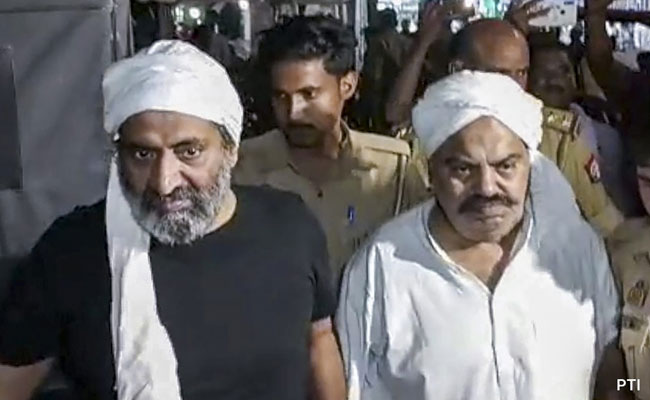
New Delhi (PTI): The Supreme Court on Friday questioned the Uttar Pradesh government why gangster-politician Atiq Ahmad and his brother Ashraf were paraded before media while being taken to hospital for a medical checkup in police custody in Prayagraj.
The top court, which was hearing a plea by advocate Vishal Tiwari seeking an independent probe into the killing of Ahmad and his brother Ashraf, also asked the UP government how the killers got the knowledge that they were being taken to hospital.
"How did they know? We have seen it on TV. Why were they not taken to the ambulance right from the entry gate of the hospital? Why were they paraded?" a bench of Justices S Ravindra Bhat and Dipankar Datta asked senior advocate Mukul Rohatgi, who appeared for the UP government.
Rohatgi informed the bench the state government is probing the incident and has constituted a three-member commission for this. A UP Police special investigation team is also investigating the matter, he said.
"This man and his entire family are embroiled in heinous cases for last 30 years. This incident particularly is a gruesome incident. We have apprehended the killers and they said they did this to gain importance," Rohatgi said.
"Everyone saw the killings on the television. The killers came in the guise of news photographers. They had passes, were carrying cameras, and were even carrying identity cards that were later found to be fake. There were 50 people there and more people outside. This is how they managed to kill," Rohatgi told the bench.
The court directed the UP government to submit a status report on steps taken after the incident.
"A comprehensive affidavit would be filed indicating the steps taken to inquire into the deaths which occurred on April 15 near Moti Lal Nehru Divisional Hospital,Prayagraj. The affidavit shall also disclose the steps taken with respect to the incident that occurred immediately prior to the one in question and also disclose the follow-up steps taken following Justice BS Chauhan commission report. List after three weeks," the bench said in its order.
Former apex court judge Justice Chauhan headed a commission to probe the encounter of gangster Vikas Dubey in 2020.
Atiq Ahmad (60) and Ashraf were shot dead at point-blank range by three men posing as journalists in the middle of a media interaction while police personnel were escorting them to a medical college.
The plea also sought an inquiry into the 183 alleged criminals killed in police encounters in UP since 2017. UP Police recently said they have gunned down 183 alleged criminals in encounters in six years of the Chief Minister Yogi Adityanath-led government and this included Ahmad's son Asad and his accomplice.
The plea sought the setting up of an independent expert committee to probe the killing of Ahmad and Ashraf.
"Issue guidelines/directions to safeguard the rule of law by constituting an independent expert committee under the chairmanship of a former Supreme Court justice to inquire into the 183 encounters which had occurred since 2017 as stated by Uttar Pradesh Special Director General of Police (Law and Order) and also to inquire into the police custody murder of Atiq and Ashraf," it said.
Referring to Ahmad's killing, the plea said "such actions by police are a severe threat to democracy and rule of law and lead to a police state".
"In a democratic society, the police cannot be allowed to become a mode of delivering final justice or to become a punishing authority. The power of punishment is only vested in the judiciary," the plea submitted.
It said extra-judicial killings or fake police encounters have no place in the law.
When the police turn "daredevils then the entire rule of law collapses and generates fear in the mind of people against the police which is very dangerous for democracy and this also results in more crimes," the plea stated.
Let the Truth be known. If you read VB and like VB, please be a VB Supporter and Help us deliver the Truth to one and all.
CCTVs in police stations: SC asks amicus to convene meeting on utilisation of funds
New Delhi (PTI): The Supreme Court on Tuesday said that a meeting be convened on May 6 to deliberate on the aspect of utilisation of funds by the states on installation of CCTVs in police stations across the country.
A bench of Justices Vikram Nath and Sandeep Mehta asked senior advocate Siddhartha Dave, who is assisting it as an amicus curiae in a suo motu matter concerning lack of functional CCTVs in police stations, to hold a meeting on May 6 with the Centre, all states and Union Territories.
"We are of the view that a meeting be convened by the amicus, as done earlier, in which the home secretary of the central government or his nominee not below the rank of joint or additional secretary and the home secretary of states/Union Territories will participate," the bench said.
The issue cropped up after the amicus flagged the aspect of utilisation of funds by the states.
Dave told the bench that in UTs, the Centre gives 100 percent funds while in hilly states, the central government gives 90 percent funding.
He said in remaining states, the Centre gives 60 percent while the rest 40 percent funding is by the respective state.
"Why don't we get responses of the states only on utilisation of funds?" the bench said.
The top court suggested that the amicus can convene a meeting with the Centre, states and UTs on the issue.
It posted the matter for hearing on May 13 and said that a report be submitted before it.
On April 7, the Centre told the top court that all issues concerning installation of CCTVs in police stations would be sorted out within two weeks.
Attorney General R Venkataramani had told the bench that he was taking stock of the issue and a lot of things were happening.
On February 26, the apex court directed the Centre and others to participate in a meeting to deliberate upon the feasibility, modalities and implementation framework of the issues, including creation of a centralised dashboard and standardisation of CCTV infrastructure in police stations.
The top court had earlier directed registration of a suo motu case over the lack of functional CCTVs in police stations after taking cognisance of a media report.
The apex court had in 2018 ordered the installation of CCTV cameras across police stations to check human rights abuses.
In December 2020, the top court directed the Centre to install CCTV cameras and recording equipment at the offices of investigating agencies, including the Central Bureau of Investigation (CBI), the Enforcement Directorate (ED) and the National Investigation Agency (NIA).
It said that states and UTs should ensure that CCTV cameras were installed at every police station, at all entry and exit points, main gate, lock-ups, corridors, lobby and reception, as well as in areas outside the lock-up rooms so that no part was left uncovered.
The top court said that CCTV systems must be equipped with night vision and have audio as well as video footage.
The court made it mandatory for the Centre, states and the UTs to purchase such systems which allow storage of data for at least one year.