Will accept Stalin as leader: Alagiri
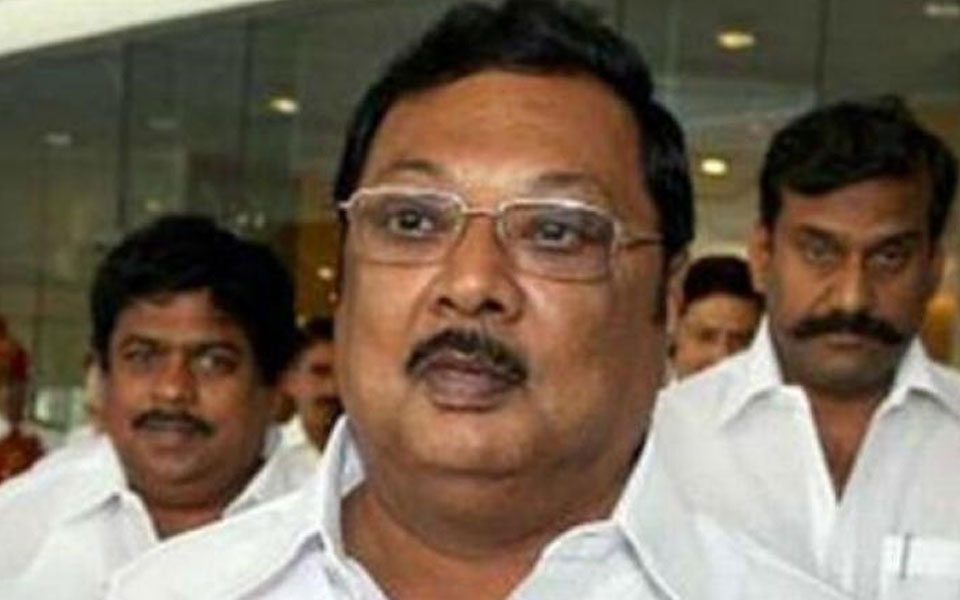
Madurai, Aug 30 : Expelled DMK leader and former Union Minister M.K. Alagiri on Thursday said he will accept his younger brother and party President M.K. Stalin as "leader" -- if he was taken back into the party.
Alagiri had publicly stated earlier that he cannot consider anyone as his leader other than the late M. Karunanidhi, his father and party President who died earlier this month.
Alagiri was expelled from the DMK by Karunanidhi for anti-party activities.
Speaking to reporters here, Alagiri said the current leadership of the DMK -- a reference to Stalin -- was not willing to re-admit him despite his requests.
He said the DMK did not consist just of the General Council, which has elected Stalin as the DMK President, and that "genuine party cadres" were with him.
Asked if he would accept Stalin's leadership, Alagiri said: "If I am in the party, then I will." In a show of strength, Alagiri is preparing to organise a rally in which he says over 100,000 people would take part.
On August 27, Alagiri warned in Madurai that if the DMK leadership did not take him back, then its leadership will have to face "consequences". He did not elaborate.
Alagiri was opposed to Stalin becoming the DMK President. After the death of his father, he spoke in riddles claiming that the DMK would face difficulties if it ignored him.
Let the Truth be known. If you read VB and like VB, please be a VB Supporter and Help us deliver the Truth to one and all.
EAM Jaishankar meets Jamaican PM, gifts over 10 BHISHM Cubes
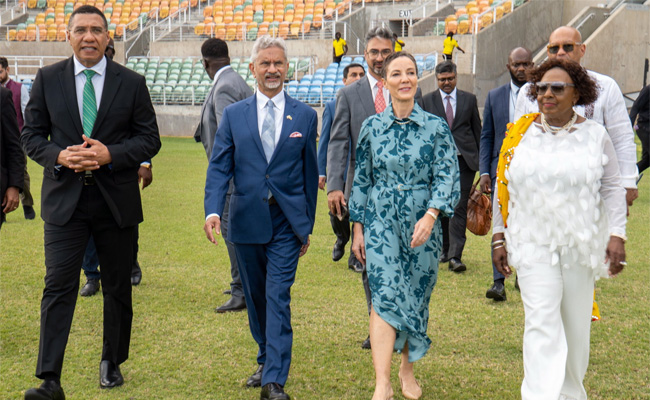
Kingston (PTI): External Affairs Minister S Jaishankar on Monday met Jamaican Prime Minister Andrew Holness and discussed ways to further deepen "political, economic and people-to-people cooperation."
Jaishankar also conveyed greetings from Prime Minister Narendra Modi to Holness.
"Pleased to call on Prime Minister @AndrewHolnessJM in Kingston. Conveyed the greetings of PM @narendramodi," Jaishankar posted on X.
"Discussed deepening our political, economic and people-to-people cooperation. Value his commitment towards further strengthening India-Jamaica relations," the post further read.
Also, the external affairs minister handed over 10 BHISHM (Bharat Health Initiative for Sahyog Hita & Maitri) Cubes as a gift to Jamaica.
"Formally handed over 10 BHISHM Cubes as a gift from India to Jamaica, in the presence of PM @AndrewHolnessJM, Health Minister @christufton and FM @kaminajsmith," Jaishankar posted on X.
"The BHISHM Cube mobile hospital system, designed for rapid deployment, will help Jamaica during disasters and emergencies. The gift of these cubes is a statement of friendship, a commitment to disaster preparedness, and an outcome of innovation," the post said.
Jaishankar arrived in Kingston on Saturday evening, marking the first leg of his nine-day tour of Jamaica, Suriname, and Trinidad and Tobago, aimed at further strengthening India's strategic and cultural ties with the Caribbean nations.
Earlier in the day, he interacted with the Indian diaspora and discussed India's ongoing transformation in infrastructure, human development and technology-driven governance and entrepreneurship with them.
He also highlighted the cricket bond between both countries as India gifted a scoreboard to Jamaica.
A scoreboard was dedicated at Sabina Park in Kingston. It is the home of the Jamaica cricket team and is the only Test cricket ground in the Caribbean island nation.
The minister expressed hope that the new scoreboard would witness many memorable innings, including those symbolising the enduring friendship between the two countries.
Cricket has long been a strong cultural bridge between India and Jamaica, which is part of the West Indies cricket team.
Jamaican players, including Chris Gayle, Courtney Walsh and Michael Holding, have played a major role in shaping the legacy of West Indies cricket in the international arena, contributing to its dominance in earlier decades and its continued global appeal.