Will form committee on MSP after assembly polls: Agriculture Minister Tomar tells RS
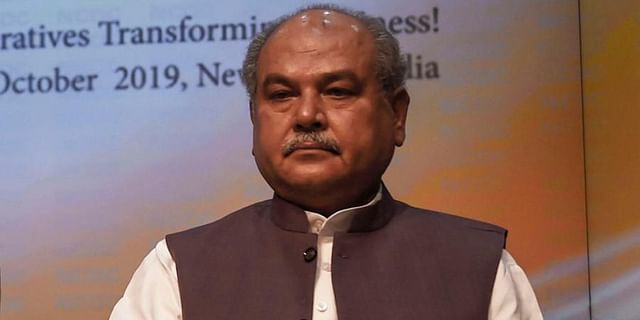
New Delhi(PTI): The government is committed to forming a panel on Minimum Support Price (MSP) and the Election Commission has said it can be done after the polls are over, Agriculture Minister Narendra Singh Tomar said in the Rajya Sabha on Friday.
While announcing the repeal of three farm laws in November last year, Prime Minister Narendra Modi had promised to set up a committee to discuss the farmers' demand for a legal guarantee on MSP.
Replying to a supplementary question during the Question Hour, Tomar said the government had written to the Election Commission in view of assembly elections in five states.
The minister said the matter of forming the Committee on MSP is under consideration of the ministry and will be formed after the elections are over.
"The entire country knows that the prime minister has announced the formation of a committee to make crop diversification, natural farming and MSP effective and transparent. The government is committed to the announcement made by the PM. The matter is under consideration of the ministry," Tomar said.
He said since the elections are on, the government had written to the EC for guidance.
"The EC's reply has come. It has said that the committee should be formed after the elections conclude," the minister said.
Elections are scheduled in five states of Uttar Pradesh, Uttarakhand, Manipur, Goa and Punjab.
Replying to another query by Prasanna Acharya (BJD) who asked if the government is considering bringing a bill in this House to give a legal guarantee to MSP, Tomar said prior to 2018, there was no mechanism to define MSP and make farming profitable.
In fact, fixing MSP at 50 per cent higher than the cost of production was one of the 14 recommendations of the Swaminathan Committee that were rejected by the inter-ministry panel then, he said.
However, Prime Minister Modi accepted that recommendation in 2018-19 and started fixing higher MSP in the interest of farmers, he added.
With regard to bringing a law on giving MSP guarantee, the Minister said a committee on MSP -- as announced by the PM -- will be set up after assembly polls in some states.
"Whatever the recommendations the committee will make, the government will examine them," he said.
The Minister also informed that the MSP is an administrative decision and is being implemented for many years across the country, he said.
Noting that the government's MSP procurement has increased in the last seven years, Tomar said, "MSP has been doubled from the earlier times. In the current budget too, about Rs 2.37 lakh crore provision has been made for procurement."
Replying to another query by Kanakmedal Ravindra Kumar (TDP) that if the Centre will take steps to stop farmers' suicides in Andhra Pradesh due to lower procurement and MSP, Tomar said, "Farmers should get the right price for his produce. The government is making efforts towards that..."
Asserting that the government is committed towards procurement, he said ensuring MSP to farmers is one aspect, while helping them make farming profitable is another aspect for which they need to be supported.
Besides increasing procurement, the government is also implementing schemes such as PM-KISAN, setting up FPOs and infrastructure fund provisions so that farmers can save crops after harvesting, he said.
The minister informed that the government has been buying more wheat and paddy at MSP from farmers. Even pulses and oilseeds are being procured. If any state wants to supply the cereals via PDS, that state would be given permission to do so.
BJD leader Sasmit Patra, in his supplementary, asked how many recommendations of the Swaminathan Committee have been accepted and implemented by the government so far.
To which, Minister of State for Agriculture Kailash Choudhary said the Swaminathan committee, constituted in 2004, had submitted its report in 2006. Thereafter in 2007, an inter-ministerial panel was set up and it accepted 201 recommendations out of 215 made by the committee.
"The current government has accepted 200 recommendations and started working on them," he said.
The Minister further said that the Swaminathan committee had recommended MSP to be fixed 50 per cent higher than the cost of production but this was not accepted by the inter-ministerial panel then.
"However, our government accepted that recommendation. And now procurement is being undertaken at MSP that is 50 per cent higher than the cost of production," he said.
At that time, the Swaminathan committee had also recommended renaming the ministry as Krishi Kalyan Mantri but this was rejected by the inter-ministry panel.
However, the Modi government renamed the ministry as 'Agriculture and Farmers Welfare Ministry', he said.
The Minister further informed that the MSP guarantee, promotion of organic and zero budget farming, unification of PDS and setting up of women farmers groups -- were rejected by the inter-ministerial panel.
He said, however, the current government has accepted them and launched Paramparagat Krishi Yojana and set up farmer producer organisations (FPOs) for training women farmers.
A provision to set up Genome banks in every state as recommended by the committee has been made in the Rashtriya Krishi Vikas Yojana, he added.
Let the Truth be known. If you read VB and like VB, please be a VB Supporter and Help us deliver the Truth to one and all.
Jaishankar holds talks with Russia's Lavrov; trade, geopolitics top agenda
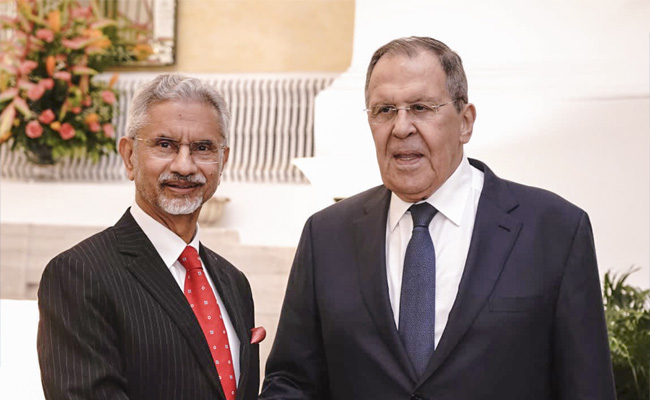
New Delhi (PTI): External Affairs Minister S Jaishankar and Russian Foreign Minister Sergey Lavrov held "productive" talks on Wednesday to advance bilateral cooperation in energy and trade amid shifting geopolitical tensions.
Jaishankar met Lavrov, shortly after the Russian foreign minister landed in New Delhi to attend a two-day conclave of the BRICS member states beginning Thursday.
Iranian Foreign Minister Abbas Araghchi, Brazil's Foreign Minister Mauro Vieira and South Africa's Minister for International Relations Ozzy Lamola are among those who already arrived in the national capital for the BRICS foreign ministerial meeting.
Jaishankar and Lavrov are learnt to have deliberated on the West Asia crisis as well as the Ukraine conflict.
In a social media post, the external affairs minister described his talks with his Russian counterpart as "productive exchange of views".
"Our conversation touched upon several aspects of the India-Russia Special and Privileged Strategic Partnership, including trade and investment, energy and connectivity, science and technology, as well as facilitating mobility of skills and talent," he said.
"Other global and multilateral issues of mutual interest were also discussed," he said.
It is not immediately known if India's procurement of Russian crude oil figured in the talks.
In his televised opening remarks at the meeting, Jaishankar said India and Russia have a shared interest in strengthening multipolarity and could benefit through greater "de-risking" .
"The last few years have seen a steady and sustained growth in our bilateral partnership. Its economic and energy dimensions have become pronounced. Our political cooperation is even more valuable in an uncertain and volatile global environment," Jaishankar said.
"We have expanded our collaboration in science and technology. The mobility of talents and skills has acquired greater salience and our interest in ensuring better connectivity is deeper," he said.
"The complicated international situation also merits an open exchange of views, especially between two trusted partners," he said.
The external affairs minister said India and Russia have a shared interest in strengthening multipolarity.
Jaishankar also held separate bilateral talks with Brazilian Foreign Minister Vieira South Africa's Ozzy Lamola.
The external affairs minister also met Maldivian Foreign Minister Iruthisham Adam.
"Underlined our Neighbourhood First policy and reviewed our bilateral cooperation. Reiterated India's commitment to Maldives' progress and development," he said on X.
India, as the chair of the BRICS, is hosting the conclave of the foreign ministers ahead of the annual summit of the grouping in September.
BRICS, originally comprising Brazil, Russia, India, China, and South Africa, expanded in 2024 to include Egypt, Ethiopia, Iran, and the United Arab Emirates, with Indonesia joining in 2025.
It has emerged as an influential grouping as it brings together 11 major emerging economies of the world, representing around 49.5 per cent of the global population, around 40 per cent of the global GDP and around 26 per cent of the global trade.
The BRICS meeting will be chaired by Jaishankar.