Will form committee to look into Waqf properties issue: CM Siddaramaiah
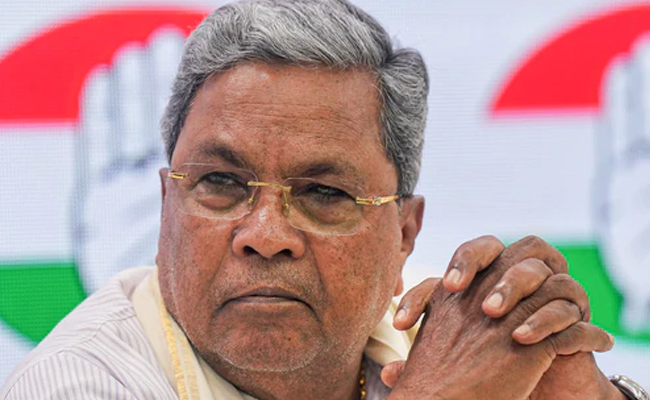
Belagavi (PTI): Karnataka Chief Minister Siddaramaiah on Wednesday said he is ready to form a committee headed by a retired judge to look into the Waqf properties issue.
The chief minister also assured the Karnataka Assembly that the government will not remove those temples which are built on Waqf properties. In case notices have been served to them, then they will be withdrawn, he said.
Replying to the question raised by the opposition BJP on the Waqf land issue in the ongoing Assembly session on Thursday, the chief minister said, "Revenue Minister Krishna Byre Gowda has given a detailed reply to the charges of the opposition party.
"If they are not content with our reply, the government is ready to form a committee headed by a retired judge," the chief minister told the house.
He also made it clear that the matter is not a prestige issue.
Siddaramaiah said the central government had enacted the Wakf Act in 1954, which the state government cannot amend.
"The BJP-led government was in power in the state from 2008 to 2013 and from 2019 to 2023. The BJP has been in power at the Centre since 2014. Then, without thinking about amending the Wakf Act, they are now raising a controversy,” he alleged.
Siddaramaiah said the BJP, in its election manifesto, had said that it would discuss with Muslim religious leaders and clear and protect the encroached Waqf properties.
The government has clearly answered all the questions of the opposition. This should remove the confusion among the people, he added.
Siddaramaiah also assured the House that the government will not touch Waqf lands sanctioned under the Inam Cancellation and Land Reforms Act.
According to him, of the total 1.28 lakh acres of Waqf property, 47,263 acres are under the Inam Cancellation and 23,623 acres under the Land Reforms Act, and 3,000 acres have been used for public purposes. About 17,969 acres of Waqf land has been encroached on by private individuals.
"There is a Supreme Court order to protect these. Once it is registered as a Waqf property, it will always be a Waqf property," he said.
During a discussion on the issue of the Waqf Board issuing eviction notices to farmers, temples and many other individuals, the chief minister said, "If temples have been built on Waqf properties then we will not remove them. I am making it very clear. In case any notice has been issued, they (notices) will be withdrawn."
As the raging Waqf issue echoed in the Assembly with the BJP raising it, Waqf and Minority Affairs Minister B Z Zameer Ahmed Khan clarified that if notices were given to farmers and temples then they would be withdrawn.
The chief minister too reiterated Khan's statement and said no farmer will be evicted from the land they have been tilling.
BJP legislator Araga Jnanendra demanded that the properties mentioned in the government records as those of Waqf should also be removed as the mere cancelling of notices will not serve the purpose.
Leader of the Opposition R Ashoka justified the demand by saying that 110 Kuruba families in the Krishna Raja constituency in Siddaramaiah's home district of Mysuru had been running from pillar to post to get the notices revoked.
They have submitted several memoranda to Siddaramaiah, but to no avail, he said, adding there were hundreds of such instances where people were facing hardships due to such notices.
Khan reminded the BJP that in its manifesto in 2014, there was a promise to remove encroachment on Waqf properties.
The chief minister underlined the need to save the Waqf properties, saying there were 1.10 lakh acres of such properties in the state which has now been reduced to just 20,000 acres due to various provisions of law such as the Inam Abolition Act as well as encroachment.
Jnanendra said, "We (BJP) too support saving the Waqf properties but our point is why notices were given now."
Siddaramaiah said the situation was such that there was a need to save the properties and notices were given as there is a central law for it.
The clarification was necessary now because he explained that a march was taken out from Bidar by the Vijayapura BJP MLA Basanagouda Patil Yatnal from Bidar.
"There is a political split in the BJP but I won't discuss your internal matter," Siddaramaiah quipped.
He referred to the differences between Yatnal and BJP state chief B Y Vijayendra. As a show of strength, Yatnal decided to take out a march from Bidar to Chamarajanagar with the support of 12 senior BJP leaders including MP and MLAs.
He accused the BJP of politicising the issue. He reminded that despite the attempt to communalise the atmosphere in the state, the BJP lost the recent bypolls in all three assembly segments, Channapatna, Sandur and Shiggaon.
Not satisfied by the explanation given by the Congress government, the BJP legislators staged a walkout from the assembly.
Let the Truth be known. If you read VB and like VB, please be a VB Supporter and Help us deliver the Truth to one and all.
Rajnath to top commanders: Outmaneuver adversaries with strategic surprise
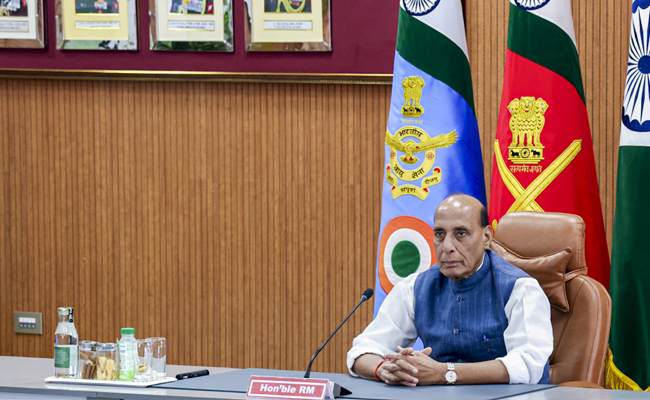
Jaipur/New Delhi (PTI): Defence Minister Rajnath Singh on Friday directed the top military commanders of the three services to integrate an "element of surprise" into modern warfare to outmaneuver India's adversaries and bolster strategic posture.
In his address at the joint commanders conference in Jaipur, Singh also described the Operation Sindoor as a testament to the "swift, precise, and joint response" of the Indian armed forces to safeguard national interests and called upon the military to remain ready to deal with any security challenges.
In their two-day deliberations, the commanders carried out a comprehensive review of the combat preparedness of the military in the wake of the evolving regional security situation.
Operation Sindoor was a demonstration of India's growing capabilities and a symbol of the nation's collective resolve and new military ethos, Singh said, a day after the first anniversary of Operation Sindoor.
He also unveiled a 'Joint Doctrine for Integrated Communication Architecture' that is aimed at strengthening doctrinal clarity, interoperability and integrated communications across the armed forces in future multidomain operations.
The joint commanders' conference, themed 'Military Capability in New Domains', brought together the top leadership of the defence ministry and the three services to deliberate on emerging security challenges and future readiness.
Comprehensive deliberations were held on future warfare, multidomain operations, technological transformation and joint capability development.
The conference witnessed extensive discussions on cognitive warfare, cyber resilience against evolving quantum and AI-enabled threats, military capability development in emerging domains, indigenous innovation and AI-enabled warfighting concepts.
It was attended by Chief of Defence Staff Gen Anil Chauhan, Chief of the Naval Staff Admiral Dinesh Kumar Tripathi, Chief of the Army Staff Gen Upendra Dwivedi, Chief of the Air Staff Air Chief Marshal AP Singh and Defence Secretary Rajesh Kumar Singh among others.
In his remarks, Singh asked the commanders to remain "future-ready" by learning from the operation as well as the current global security landscape.
He underscored the need to strengthen capabilities in artificial intelligence, autonomous systems, data analytics and secure communication networks to stay prepared in the rapidly evolving geopolitical security scenario. He emphasised that future conflicts will increasingly be shaped by hybrid threats, information dominance and operations conducted simultaneously across cyber, space, electromagnetic and cognitive domains, according to an official readout.
Highlighting the transformative impact of emerging technologies, Singh stressed on the importance of ensuring integrated national preparedness across all spectrums of conflict, it said.
Singh's remarks at the conference came a day after the first anniversary of Operation Sindoor.
The defence minister appreciated the progress achieved in enhancing jointness, integration and technological adoption across the three services, the readout noted.
Singh said that jointness constitutes a pivotal dimension within the transformative changes sweeping across the global defence sector.
"Future wars will not be won solely through weaponry, but through innovative thinking and enhanced synergy," he said.
The defence minister exhorted the commanders to cultivate the "element of surprise" to remain unpredictable to the nation's adversaries and secure a strategic edge in any given situation.
He, however, urged them to remain vigilant of the element of surprise of the enemy and always stay two steps ahead.
Singh also reiterated the Narendra Modi government's commitment to enhancing the capabilities of the defence forces through state-of-the-art weapons and platforms. He added that special focus is being laid on research in niche domains.
During the conference, he released a documentary film on Operation Sindoor.
The film reaffirms the nation's and defence forces' commitment to operational preparedness and decisive national response capabilities.
Demonstrations of advanced systems and platforms developed for intelligence fusion, operational planning and information management were also showcased during the conference reflecting growing integration of cutting-edge technologies into joint operational structures, according to the defence ministry.
The discussions will contribute significantly towards shaping India's future military transformation and integrated operational preparedness, it said.