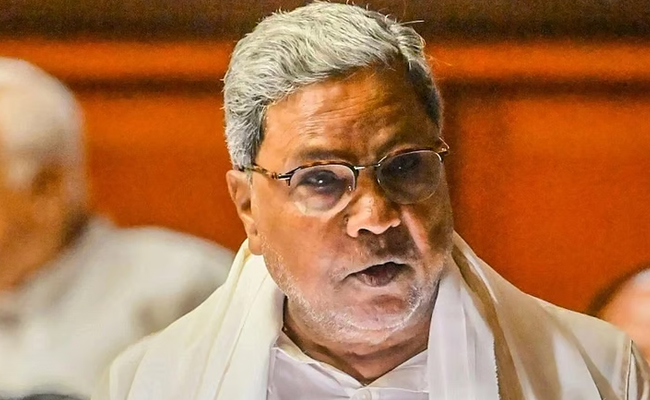
Bengaluru (PTI): Karnataka Chief Minister Siddaramaiah on Wednesday said he would table two more budgets, provided the Congress high command allows him to do so. Siddaramaiah was speaking in the Karnataka Assembly while replying to the discussion on the budget he had presented on March 6.

In an attempt to remind the chief minister about the power tussle between him and his deputy D K Shivakumar, the Leader of Opposition, R Ashoka, said that he has to table at least one more budget.

Siddaramaiah quickly retorted, saying he will table two more budgets.

“See, I have to table two more budgets. Our government will table it,” the chief minister said.

To this, Ashoka wondered whether he was so sure about it.

“If our high command allows me, then I will table the next two budgets as well. Our government will come to power again in 2028,” Siddaramaiah said.

He challenged Ashoka to declare that he would be the next chief minister.

“Can you say that? We cannot predict the future,” he said.

The Leader of Opposition sarcastically remarked that he has made his deputy Shivakumar run around temples, and his latest pilgrimage was to the Kamakhya Temple in Assam.

During the discussion, Siddaramaiah said he always promoted rational thinking, social justice and equality. He was always opposed to the Karma theory, which made people condemn the sufferers.

Ashoka quipped, saying that the chief minister presented the budget at 1.15 am on March 6, keeping in mind the ‘Rahu Kaala’, an inauspicious time.

To this, Siddaramaiah said, "Some people advised me to present it before ‘Rahu Kaala’, but I don’t believe in ‘Rahu Kaala’ or ‘Gulika Kaala’, but being a democratic person, I respected their views and nothing else".

He also said that in the past, he had presented budgets during Rahu Kaala and Gulika Kaala.

The BJP leader taunted that the situation in the past was different from the present time. He has to take note of the auspicious and inauspicious Muhurtha so that he can present the next budget.

Dismissing Ashoka’s comment, Siddaramaiah said, "I never believed in the restrictions associated with Rahu Kaala, Gulika Kaala, Yamaganda Kaala and even solar eclipse. Does anyone eat non-veg food during festivals? I ate mutton on Shivaratri. There is nothing wrong with it. All days are equal".

He said he believed in God, who is omnipresent and not confined to temples only.

Siddaramaiah had presented his 17th budget on March 6 in the Karnataka Assembly, which is a record in the state.

Let the Truth be known. If you read VB and like VB, please be a VB Supporter and Help us deliver the Truth to one and all.


Lahore (PTI): Pakistan is relaying messages between Iran and the US with the aim to help de-escalate the West Asia conflict, a top government official said on Wednesday.

"We are trying to broker US-Iran peace talks and have also offered Islamabad as a venue for the purpose. But it will be possible if Iran agrees to sit at the table with America," a top official in the Shehbaz Sharif administration said on the condition of anonymity.

"At the moment, Pakistan is relaying messages between the US and Iran. Islamabad not only handed over the 15-point proposal of the US to Iran but also Tehran's demands to the Trump administration to ink a peace deal," he said.

The 15-point proposal outlines strict conditions targeting Iran’s nuclear and regional policies in exchange for major sanctions relief, he added.

Under the proposal, Iran would be required to fully dismantle its nuclear programme and commit never to pursuing nuclear weapons. All enriched nuclear material would be transferred to the International Atomic Energy Agency (IAEA) within an agreed timeframe.

Key nuclear facilities, including the Natanz Nuclear Facility, Isfahan Nuclear Technology Centre and Fordow Fuel Enrichment Plant, would be decommissioned and destroyed under the plan. The IAEA would also be granted full access to all aspects of Iran’s nuclear programme, he said, speaking about the proposal.

The proposal further calls on Iran to cease funding, directing and arming allied groups across the region, a longstanding point of contention with both Washington and Israel, he added.

In a move aimed at safeguarding global energy supplies, the plan ensures that the Strait of Hormuz will remain open as a free maritime route, preventing any disruption to international shipping.

As a final decision on Iran’s missile programme has been deferred, the proposal says any future arrangement would impose limits on the range and number of missiles, restricting their use to defensive purposes only.

In return, the United States is prepared to lift all sanctions on Iran and support the development of a civilian nuclear programme, including assistance at the Bushehr facility, the official informed.

The proposal also includes removing the so-called “snapback” mechanism, which allows for the automatic reimposition of United Nations sanctions.

The Iranian regime has hardened its stance and is seeking significant concessions from the United States if mediation efforts lead to serious negotiations, he said.

"In any talks with the US, Iran would not only demand an end to the war but concessions that are likely red lines for President Trump —guarantees against future military action, compensation for wartime losses and formal control of the Strait of Hormuz," the official said and added Iran would also refuse to negotiate any limitations to its ballistic missile programme.

Iran’s president earlier warned that stability in the region is possible only through cooperation and respect for the will of the nations.

“Today we are witnessing the awakening of the people in many countries around the world,” Masoud Pezeshkian wrote on X, claiming that people of Pakistan, Turkiye, Iraq, Lebanon, Egypt, and Arab countries are loudly expressing their rejection of the US, Israel and their crimes.

He said that Iran has also outlined a set of key counter-conditions in response to the 15-point proposal.

Iran has demanded the lifting of US-imposed economic sanctions. It rejected calls for a total halt to uranium enrichment, insisting that its nuclear programme is for peaceful purposes and falls within its sovereign rights, he added.

Another major sticking point is Iran’s defence and missile programme, which Iranian officials describe as essential for national security.

Tehran has refused to accept any proposal that would limit its missile capabilities or weaken its regional deterrence posture.

Iran is also seeking binding guarantees from Washington to ensure that any future agreement will not be abandoned unilaterally, as happened in the past, he added.

Iranian leaders have stressed the need for assurances against military escalation or regime-change efforts.

Iran also wants no presence of US forces in the Gulf and control over strategic waterways, the official added.