Will take legal course if film is stopped: Vivek Agnihotri on release of 'The Bengal Files' in WB
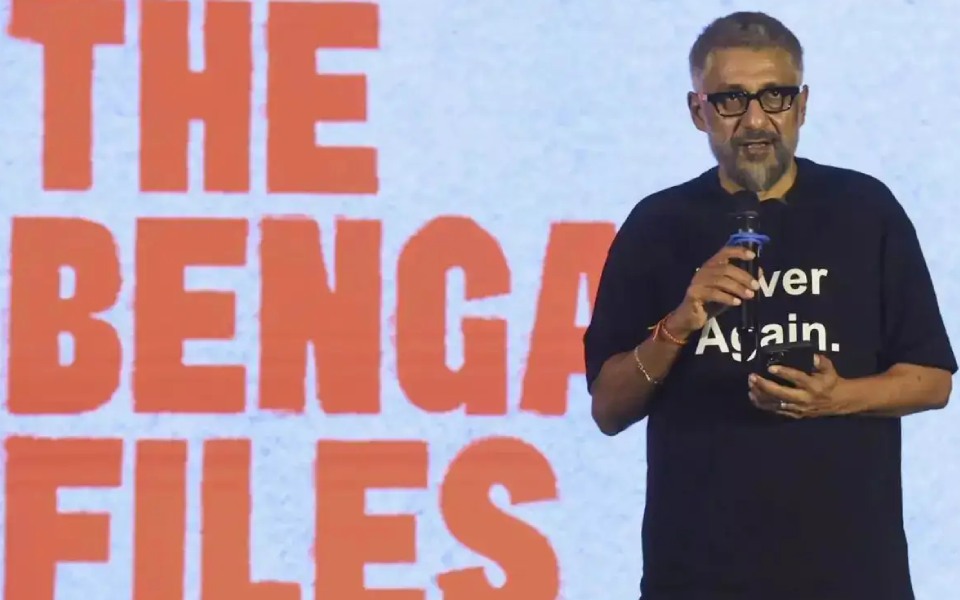
Kolkata, Aug 18 (PTI): Filmmaker Vivek Ranjan Agnihotri on Monday said he would go the legal route if the release of his film "The Bengal Files" is stalled in West Bengal.
The trailer launch of the film in Kolkata was disrupted on Saturday. Agnihotri claimed the event was first cancelled by a multiplex and then moved to a hotel where power supply was disrupted and police turned up asking if permission had been taken.
"We will go by the Constitution. We will go legally. If they stop us, we will take the legal course. What can we do? We are common citizens like you... We will pray that sanity prevails and the state government does not do it (stop the release)," the filmmaker said at a press conference here while hitting out at the Mamata Banerjee-led TMC government in West Bengal.
"The Bengal Files", which is slated for release on September 5, revolves around the Calcutta riots of August 16, 1946, which were triggered after the All-India Muslim League called for 'Direct Action Day' to demand a separate homeland.
"...This is an Indian film. I am telling you the truth," Agnihotri said.
Known for films such as "The Kashmir Files" and "The Tashkent Files", Agnihotri also addressed the many controversies surrounding his latest release, including an FIR by Gopal Chandra Mukherjee's grandson Santanu Mukherjee.
Gopal Mukherjee is said to have played a pivotal role in the resistance against the Muslim mob violence in 1946. Santanu claims Agnihotri's film refers to his grandfather as a butcher.
Agnihotri said Gopal Mukherjee in his film is an inspired character and not central to the plot.
"I will not go into his history. Watch Santanu's interview. I can give you all the links. There is an interview of Gopal Mukherjee on BBC. In that interview, what he has said, we have only shown that much. I have nothing to do with Gopal Mukherjee's life, politics. He was a hero and I have shown him as a hero," he said.
"I respect Gopal Mukherjee a lot. His grandsons work with TMC. There is a compulsion there... They have done it legally. We are giving a legal answer to that," he said.
Agnihotri claimed the film is his attempt to reveal hidden truths. He said he aims at showing "the untold stories of India".
"Our purpose is very clear. I make films on Hindu civilization. That is why I make films on Hindu history. I do not consider myself capable of making films on Islamic history or Christian history," he said, adding that filmmakers like Mani Ratnam and Vishal Bhardwaj have already made movies on the Islamic history of Kashmir through "Roja" and "Haider".
Agnihotri said the censor board passed "The Bengal Files" without any cuts though it went through the examining committee and then the revising committee.
"This film was made with a lot of responsibility and sincerity. No one can object to this. Bengalis will be proud of this film."
"The Bengal Files" stars Mithun Chakraborty, Saswata Chatterjee, Anupam Kher, Pallavi Joshi, Priyanshu Chatterjee and Darshan Kumar.
Let the Truth be known. If you read VB and like VB, please be a VB Supporter and Help us deliver the Truth to one and all.
Rickelton's ton in vain as SRH beat MI by 6 wickets
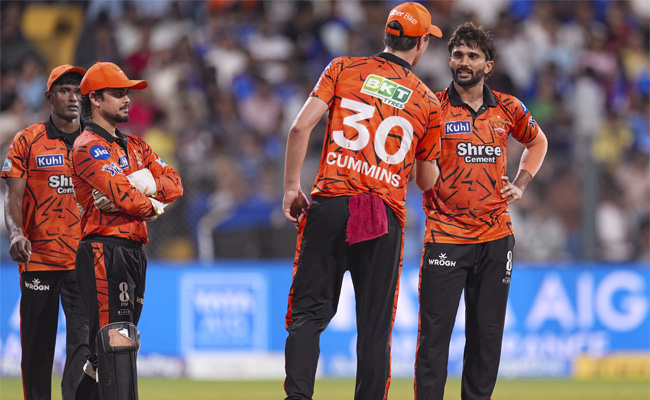
Mumbai (PTI): Ryan Rickelton's whirlwind unbeaten ton was overshadowed by Heinrich Klaasen's unbeaten 65 as Sunrisers Hyderabad defeated Mumbai Indians by six wickets in an IPL match here on Wednesday.
Chasing an imposing 244-run target, Travis Head (76 off 30) and Abhishek Sharma (45 off 24) shared 129 runs for the opening wicket to set the platform for SRH.
Klaasen (65 not out off 30 balls) then displayed his all-round hitting abilities to guide SRH home with the help of Nitish Kumar Reddy (21) and Salil Arora (30 not out off 10) in 18.4 overs.
Earlier, Rickelton's knock powered MI to 243 for five.
MI rode on a 93-run stand between Rickelton (123 not out off 55 balls) and Will Jacks (46 off 22) in 7.1 overs for the opening stand to power the side.
MI skipper Hardik Pandya scored a valuable 31 off 15 balls before being dismissed.
Praful Hinge (2/54), Eshan Malinga (1/29), Sakib Hasan (1/39) and Nitish Kumar Reddy (1/31) were the wicket-takers for SRH.
Brief Scores:
Mumbai Indian: 243 for 5 in 20 overs (Ryan Rickelton 123 not out; Praful Hinge 2/54).
Sunrisers Hyderabad: 249 for 4 in 18.4 overs (Travis Head 76, Heinrich Klaasen 65 not out; AM Ghazanfar 2/51).