With best efforts, Tripura to be 'drug free state': Deb
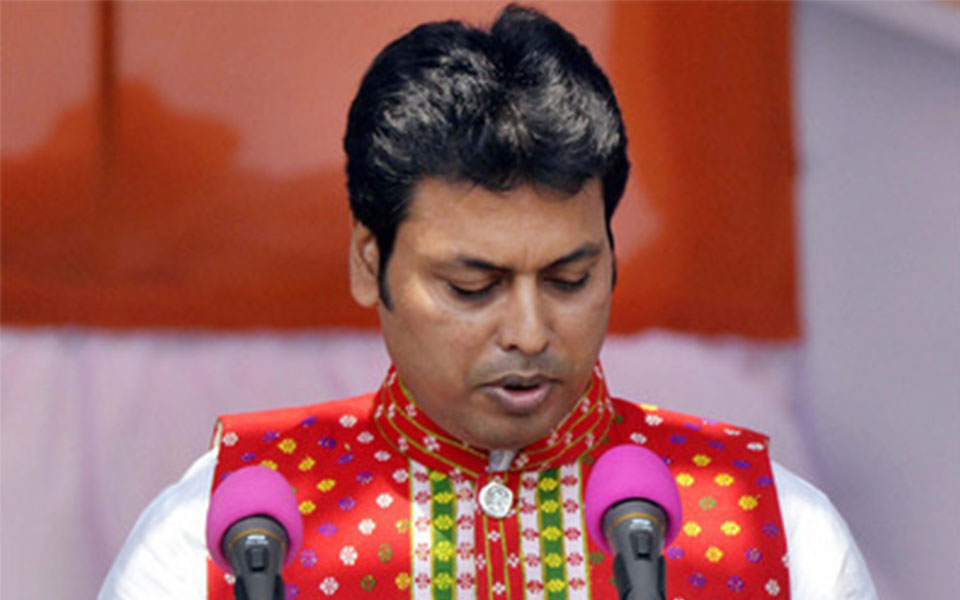
Agartala, June 25: The law enforcing agencies have maximised their insistent efforts to make Tripura a "drug free state" as declared by the BJP government, Chief Minister Biplab Kumar Deb told the Tripura assembly on Monday.
"During the first 100 days of BJP (Bharatiya Janata Party) government, the law enforcing agencies, specially the police, have seized 12,035 kg dry 'ganja', various types of cough syrup, habit-forming tablets, brown sugar and heroin in Tripura," Deb, who also holds the Home portfolio, told the house.
The market value of 12,035 kg dry 'ganja' is around Rs 7.22 crore.
The Chief Minister said that as per the state government's instructions, the law enforcing agencies would intensify and continue their actions against smuggling, abuse, illegal trade and cultivation of drugs.
"The efforts of the law enforcing agencies will continue until the state becomes a 'drug free zone'. The actions and drive against the smuggling, abuse, illegal trade and cultivation of drugs were minimal during the 25-years rule of previous Left Front government causing their huge magnitude," he said detailing the comparative statistics of drug-related activities and actions.
Deb said that during the first 100 days of BJP governance in Tripura, over two lakh "ganja" plantations were destroyed in different parts of Tripura.
"With the curbing of drug-related activities, the state government is keen to diminish the crime against women. Besides the state government has taken a series of steps to check these crimes," the Chief Minister said.
In order to boost community policing, he said, PRAYAAS committee has been formed in each police station area to deal with policing. "These will involve all sections of people, including former policemen, women, veterans and renowned personalities of the locality."
"Bangladesh is our good and friendly neighbour. Various types of drugs specially the different kind of cough syrup should not be smuggled to that country from India. We have a responsibility for the welfare of Bangladesh," Deb added.
Tripura, Meghalaya, Mizoram, and Assam share an 1,880 km border with Bangladesh.
Let the Truth be known. If you read VB and like VB, please be a VB Supporter and Help us deliver the Truth to one and all.
AIITA welcomes Karnataka’s ban on obscene songs in school events

Bhatkal: The Karnataka unit of the All India Ideal Teachers Association (AIITA) has welcomed the Karnataka government’s decision to strictly ban school children from dancing to obscene songs during educational and cultural programmes in government, aided, and private schools across the state.
AIITA Karnataka State President M. R. Manvi congratulated the government for taking what he termed an important step to preserve the sanctity of education.
“Such decisions to safeguard the dignity of school children and uphold the values of education are the need of the hour. This rule should not be limited to government schools alone but must be strictly implemented in all private educational institutions as well,” he said.
He further urged the government to address other concerns within school programmes.
“The government should not only prohibit obscene dances in the name of school anniversaries, but also ensure that plays and dialogues that incite religious hatred are avoided. Schools should be centres of harmony, not platforms for spreading hatred,” he added.
According to a recent circular issued by the Department of School Education and Literacy, obscene dances are adversely affecting the mental health and moral values of students.
In this regard, schools have been advised to use songs that promote nationalism, positive thinking, the greatness of Kannada culture, and value-based traditions instead of inappropriate content during programmes.
The circular also emphasises that students should be dressed in decent attire.
AIITA also backed the department’s warning that disciplinary action would be taken against head teachers if such guidelines are violated. The association has further demanded that district Deputy Directors of Public Instruction strictly monitor the implementation of these rules.