With drained battery and no fuel, India's Mars Orbiter craft quietly bids adieu
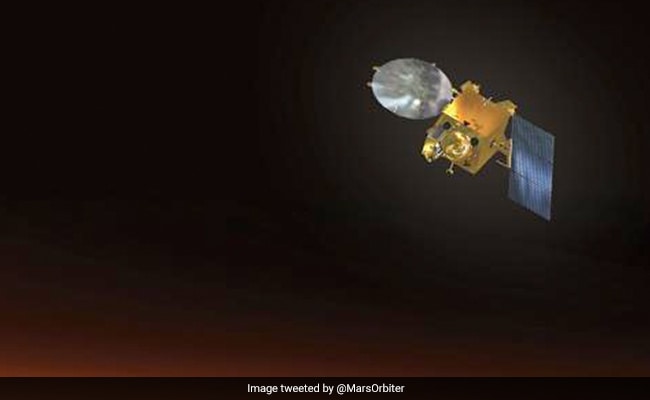
Bengaluru, Oct 2: India's Mars Orbiter craft has run out of propellant and its battery drained beyond the safe limit, fuelling speculation that the country's maiden interplanetary mission 'Mangalyaan' may have finally completed its long innings.
The Rs 450 crore Mars Orbiter Mission was launched onboard PSLV-C25 on November five, 2013, and the MOM spacecraft was successfully inserted into Martian orbit on September 24, 2014 in its first attempt.
"Right now, there is no fuel left. The satellite battery has drained," sources in the Indian Space Research Organisation (ISRO) told PTI. "The link has been lost".
There was, however, no official word from the country's national space agency, headquartered here.
With fuel on board, ISRO had been performing orbital manoeuvres on MOM spacecraft to take it to a new orbit to avoid an impending eclipse in the past.
"But recently there were back-to-back eclipses including one that lasted seven-and-half hours," officials said on condition of anonymity, noting that all the propellant on board the ageing satellite had been consumed.
"As the satellite battery is designed to handle eclipse duration of only about one hour and 40 minutes, a longer eclipse would drain the battery beyond the safe limit," another official said.
ISRO officials noted that the Mars orbiter craft functioned for almost eight years, well beyond its designed mission life of six months.
"It has done its job and yielded significant scientific results," they said.
The objectives of the mission were primarily technological and included design, realisation and launch of a Mars Orbiter spacecraft capable of operating with sufficient autonomy during the journey phase; Mars orbit insertion/ capture and in-orbit phase around Mars.
The MOM -- a technology demonstration venture -- carried five scientific payloads (total 15 kg) collecting data on surface geology, morphology, atmospheric processes, surface temperature and atmospheric escape process.
The five instruments are: Mars Color Camera (MCC), Thermal Infrared Imaging Spectrometer (TIS), Methane Sensor for Mars (MSM), Mars Exospheric Neutral Composition Analyser (MENCA) and Lyman Alpha Photometer (LAP).
"MOM is credited with many laurels like cost-effectiveness, short period of realisation, economical mass-budget, and miniaturisation of five heterogeneous science payloads", ISRO officials pointed out.
Highly elliptical orbit geometry of MOM enabled MCC to take snap shots of 'Full disc' of Mars at its farthest point and finer details from closest point.
The MCC has produced more than 1000 images and published a Mars Atlas.
Meanwhile, plans on a follow-on 'Mangalyaan' mission to the red planet, however, are yet to be firmed up.
ISRO came out with an 'Announcement of Opportunity' (AO) for future Mars Orbiter Mission (MOM-2) in 2016 but officials acknowledged that it's still on the drawing board, with the coming 'Gaganyaan', 'Chandrayaan-3' and 'Aditya - L1' projects being in the space agency's current priority list.
The AO had said: "It is now planned to have the next orbiter mission around Mars for a future launch opportunity. Proposals are solicited from interested scientists within India for experiments onboard an orbiter mission around Mars (MOM-2), to address relevant scientific problems and topics."
"Not in the approved list as of now", a senior ISRO official told PTI on being asked about an update on the MOM-2.
"We need to formulate the project proposals and payloads based on the wider consultation with the research community," the official said. "It's still on the drawing board. But needs some more details and international collaboration for finalising the mission."
Let the Truth be known. If you read VB and like VB, please be a VB Supporter and Help us deliver the Truth to one and all.
NEET student hangs self in Rajasthan's Sikar

Jaipur (PTI): A student preparing for the NEET examination allegedly committed suicide by hanging himself in a rented room in Rajasthan's Sikar on Friday, police said.
According to the police, the student allegedly hanged himself from a ceiling fan using his sister's scarf while one sister was attending coaching classes and the other was in the bathroom.
He had appeared in the NEET UG exam 2026, which was cancelled due to paper leak, they said.
Udyog Nagar SHO Rajesh Kumar said that the deceased, identified as Pradeep Meghwal, was a resident of Kanika ki Dhani village in Jhunjhunu's Gudha Gaudji area.
He had been living in a rented room in Sikar's Jaldhari Nagar area with his two sisters while preparing for NEET over the last three years.
His elder sister later found him hanging and informed the landlord and police after bringing him down, officials said.
The SHO said the body was kept at SK Hospital mortuary, and a postmortem had not been conducted.
The student's father, Rajesh Kumar Meghwal, told police that Pradeep's NEET examination had gone well and the family was expecting him to score around 650 marks.
Former Rajasthan deputy chief minister Sachin Pilot expressed grief over the incident and linked it to anxiety among students after reports of irregularities and paper leaks in NEET 2026.
Pilot said repeated paper leak incidents and cancellation of examinations were affecting students' mental health and demanded a time-bound investigation and strict action against those responsible.