With eye on polls, Modi reviews schemes with BJP CMs
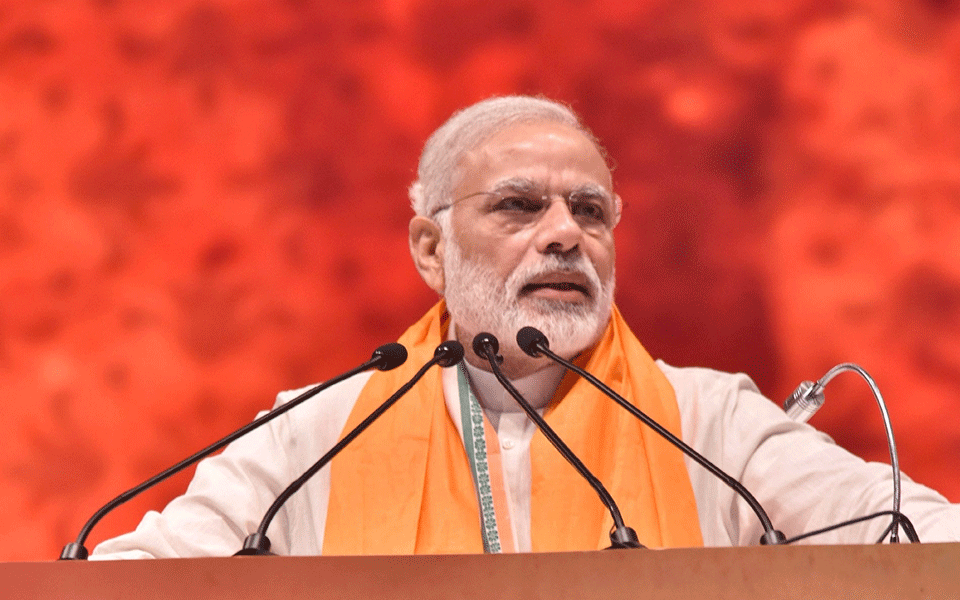
New Delhi, Aug 28 : Preparing for the upcoming Lok Sabha polls and Assembly elections, Prime Minister Narendra Modi on Tuesday took stock of the implementation of the various welfare schemes with Chief Ministers and Deputy Chief Ministers of 15 states, who took a pledge to ensure that he comes back to power with a bigger majority in Parliament.
In a day-long meeting of the BJP Chief Ministers' Council here at the party headquarters, chaired by President Amit Shah, the Chief Ministers said the party will face the people in the next Lok Sabha polls on the issues of the implementation of the development programmes it has initiated and also on the promises it made in the 2014 election manifesto.
"The Prime Minister took stock of the work done by the states and also discussed the situation in the states in the wake of the Center's initiative on higher MSP (minimum support price) for farmers, passage of OBC Commission Bill giving it a constitutional status, restoration of provisions of SC/ST Act, the National Register of Citizens in Assam and the Citizens Amendment Bill," Chhattisgarh Chief Minister Raman Singh told a press conference.
"We resolved that the BJP, under Narendra Modi, will form a majority government again in 2019 by increasing its Lok Sabha tally of 2014," he said, adding they were confident of winning the Assembly polls in Madhya Pradesh, Rajasthan and Chhattisgarh.
taking a dig at the Congress for its plans to form a grand alliance with regional parties to defeat Modi in 2014, Singh said that it was too early to comment as they have not yet decided their leader.
"They have not yet decided the criteria for selection of the Prime Ministerial candidate. One party says the candidate will be of the party that wins maximum seats while other says that the candidate would be of the largest party. I think they won't be able to decide the issue till the elections. It is only Narendra Modi who will be the Prime Minister in 2019," he said.
He said how the pace of implementation of Centre's schemes like Ujjawal, Saubhagya, Aawas, Swachha Bharat and others need to be increased was also discussed at the meet.
Singh said the Prime Minister and the BJP President gave valuable suggestions to the Chief Ministers of the three party-ruled states on winning the coming elections. The Chief Ministers presented a report on the situation in their states.
The meeting also discussed plans to reach out to the beneficiaries of the Centre's welfare schemes.
The BJP has 15 Chief Ministers and seven Deputy Chief Ministers -- two in Uttar Pradesh and one each in Gujarat, Bihar, Nagaland, Arunachal Pradesh and Tripura.
The Council meeting has been an annual affair since 2014.
Let the Truth be known. If you read VB and like VB, please be a VB Supporter and Help us deliver the Truth to one and all.
Maharashtra sets up state vaccination task force to strengthen immunisation programme

Mumbai (PTI): The Maharashtra government has set up a State Vaccination Task Force to strengthen the regular immunisation programme and review the progress of related campaigns, a health department official said on Monday.
The State Vaccination Task Force will comprise at least 29 members and will be headed by the administrative head of the health department, he informed.
The government has also constituted separate district-level and municipal vaccination task forces to improve implementation and address challenges at the grassroots level, he said.
Municipal task forces, chaired by respective civic commissioners, have been constituted in view of the vast urban population in Maharashtra and the role of civic bodies in implementing different health programmes.
The district-level task forces will function under the chairmanship of collectors.
"Complete immunisation of children at the appropriate age is an extremely simple, cost-effective and highly effective measure to reduce child mortality and the prevalence of diseases among kids. Immunisation is a powerful tool for reducing illness in children," maintained the official.
To ensure full vaccination of all children, the state government implements various campaigns from time to time as per the central government guidelines, he pointed out.
"Active participation and cooperation of other relevant government departments are essential (in making these campaigns successful)," according to the official.
The state-level body will review the regular immunisation programme, associated campaigns and vaccine-preventable diseases in detail. It will also conduct focused assessments of high-risk districts and municipal corporations, including vacancies at district, municipal and sub-district levels, availability of cold chain equipment, resource gaps and training requirements, he noted.
The state task force will review allocation and utilisation of funds for immunisation and ensure timely action by officers concerned based on reports from district and municipal task forces and state-level monitoring mechanisms, the official said.
It will also ensure active coordination and participation of other government departments in immunisation drives, while district and municipal task forces will carry out similar functions at their respective levels, the official added.