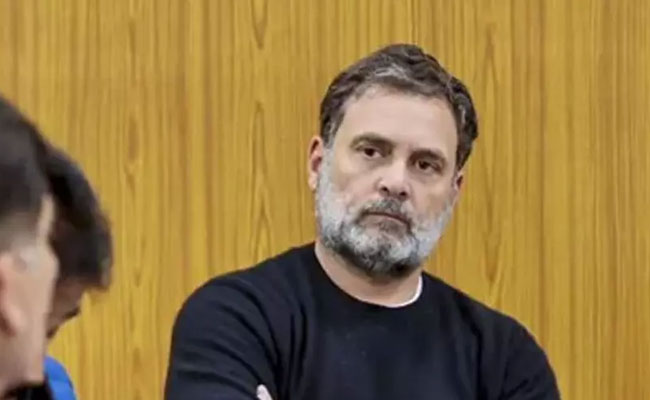
New Delhi (PTI): Upping the ante against the government over the India-US interim trade deal, Congress leader Rahul Gandhi on Sunday posed a string of questions to Prime Minister Narendra Modi and alleged that "we are witnessing a betrayal" of Indian farmers.
Gandhi, who has been attacking the government and accusing it of a sell-out through the deal, said this issue concerns the future and asked whether India is allowing another country to gain a long-term hold over India's agriculture industry.
"In the name of a US trade deal, we are witnessing a betrayal of Indian farmers," the Leader of Opposition in the Lok Sabha said in his post in Hindi on X.
Posing questions to the prime minister, Gandhi asked what it means to import Dried Distillers' Grains (DDG). "Does it mean that Indian cattle will be fed distillers' grains made from GM American corn? Won't this effectively make our milk products dependent on the US agricultural industry?" he questioned.
Gandhi further inquired that if India allows the import of GM soy oil, what would its implications be on soy farmers in Madhya Pradesh, Maharashtra, Rajasthan, and across the country? "How will they withstand another price shock?" he asked.
"When you say 'additional products', what does that include? Does this indicate pressure to open pulses and other crops to US imports over time?" he questioned.
He also asked, "What does it mean to remove 'non-trade barriers'? Will India be pressured in the future to loosen its stance on GM crops, weaken procurement, or reduce MSPs and bonuses?"
Gandhi expressed concern that once the door is opened, it may be difficult to keep it from opening wider each year. "Will it be prevented, or will more crops gradually be put on the table each time?" Gandhi said, adding that farmers must receive this clarity.
"This isn't just about today. It's about the future too -- are we allowing another country to gain a long-term hold on India's agriculture industry?" he stressed.
On Saturday, Gandhi accused the government of cheating cotton farmers and textile exporters in the country over the India-US interim trade deal, noting that the agreement could cause significant harm to both sectors.
He had also claimed that the trade deal, which now favours Bangladesh through zero per cent tariffs, will either finish the textile sector, the cotton farming or both, adding that the nation is aware of this.
In a post on X, Gandhi criticised the government for failing to protect the interests of cotton farmers and textile exporters. He argued that a visionary government would have negotiated a deal that safeguarded both sectors and ensured their prosperity.
"18 per cent Tariff vs 0 per cent - Let me explain how the prime minister and his cabinet are spreading confusion on this issue. And how they are cheating India's cotton farmers and textile exporters through the India-US trade deal," he had said in his post.
Let the Truth be known. If you read VB and like VB, please be a VB Supporter and Help us deliver the Truth to one and all.
United Nations (PTI): India is a "very successful" emerging economy with a bigger influence in global affairs, and is the “right place” to host the AI summit, UN Secretary-General Antonio Guterres has said.
In an exclusive interview with PTI at the UN Headquarters ahead of the India–AI Impact Summit 2026, Guterres underscored that Artificial Intelligence should benefit the entire world and not just be a privilege reserved for developed nations or two superpowers.
“I strongly congratulate India for organising this Summit. It's absolutely essential that AI develops itself to the benefit of everybody, everywhere and that countries in the Global South are part of the benefits of AI,” he said.
The high-powered event being held from February 16 to 20 will be the first-ever AI summit hosted in the Global South and is anchored in the three guiding principles of ‘People, Planet and Progress’.
Guterres, who will be travelling to India to attend the Summit, asserted “it would be totally unacceptable that AI would be just a privilege of the most developed countries or a division only between two superpowers”, an apparent reference to the US and China.
“It is absolutely essential that AI becomes a universal instrument for the benefit of humankind,” Guterres said.
“The role of India, (which) is today a very successful emerging economy that is having a bigger and bigger role in not only the global economy but in its influence in global affairs, India is the right place to have this Summit and to make sure that AI (is) being discussed in depth, in all its enormous potential and also in all its risks, but that AI belongs to the whole world and not only to a few,” he said.
From world leaders, including French President Emmanuel Macron, Brazilian President Luiz Inacio Lula da Silva, to technology honchos, including Google and Alphabet CEO Sundar Pichai, Adobe CEO Shantanu Narayen and Anthropic CEO Dario Amodei, the Summit is bringing together leaders, policymakers and innovators from across the world for deep-dive discussions on the way forward for AI.
Guterres had met Prime Minister Narendra Modi late last year on the sidelines of the G20 Summit in Johannesburg and External Affairs Minister S Jaishankar when he was in New York.
Underlining his strong advocacy for multipolarity, Guterres highlighted India’s contribution in a multipolar world, saying he looks forward to discussing this with the Indian leadership during his visit to New Delhi.
"There are two things we need to avoid in the world. We need to avoid the system in which there is total hegemony by only one power or a system in which the world is divided between two superpowers,” he said.
Guterres added that he is a “very strong advocate” of the need for true multipolarity in the world.
For true multipolarity, it is important for emerging economies to have a “higher and higher” role and to establish a “stronger and stronger” network of trade, technological and international cooperation relations.
In this regard, he said the recent trade agreement between India and the European Union is a “good example”. “India is one of the most relevant emerging economies,” he said.
"We are seeing across the world, more and more, the creation of a network of, I would say, all developed countries but also, and very importantly, emerging economies creating a true multipolarity without any hegemony, and allowing, then, multilateral organisations to be effective,” he said.
Emphasising the importance of multipolarity, Guterres spoke about his “frustration” over the failure of the UN Security Council to address conflicts and maintain international peace and security.
"When one looks at the UN, you can imagine my frustration when I see the Security Council unable to take decisions, and it is clear that we need a fundamental reform of the Security Council, first of all, to represent the world as it is today and not after the Second World War. And second, to be able to take effective decisions for peace and security around the world,” he said.
Guterres added that for a "fair" multilateral system, both in the UN and international financial institutions, emerging economies need to have a stronger voice and be at the centre of this networking.
"I see India in the centre of those emerging economies, and this is something I would be delighted to discuss with Prime Minister Modi because I have a lot of hope for the role that India can play in shaping this multipolar world,” he said.
At the Summit, Guterres will be joined by senior UN leaders, including UN High Commissioner for Human Rights Volker Turk and Under-Secretary-General and UN Secretary-General’s Envoy on Technology Amandeep Singh Gill.
Guterres further underlined that “it is always fantastic” to go to India, “a democracy with an enormous diversity and extraordinary civilisation and culture.”
The UN chief elaborated that he is currently reading about how India, for centuries, has been the main factor of transformation of the world, “starting hundreds of years before Christ and going on for centuries, with an enormous influence of Indian culture, of Indian civilisation that we can see in China, Southeast Asia, the Indian Ocean."
"Even in the time of the Roman Empire, there were very strong connections with India and a very important influence of Indian culture in what is today the Mediterranean area.
“So it is always an enormous pleasure to visit India,” Guterres said.