Woman declared foreigner gets Indian citizenship under CAA
Guwahati (PTI): A woman, who spent two years in detention after being declared a foreigner, has been granted Indian citizenship under the Citizenship Amendment Act (CAA) in Assam's Cachar district, her lawyer said.
The woman, identified as 59-year-old Depali Das, a resident of the Hawaithang area under the Dholai assembly constituency, was declared an illegal migrant by a Foreigners' Tribunal (FT) in February 2019.
Depali is the first declared foreigner in Assam who had once been lodged in a detention centre and later released on bail to receive Indian citizenship under the CAA.
The police detained her after the tribunal's order and sent her to the Silchar detention centre on May 10, the same year, where she remained for nearly two years before being released on bail on May 17, 2021, following a Supreme Court order, her lawyer Dharmananda Deb said.
ALSO READ: Maharashtra to send 50 leopards to Reliance Foundation's Vantara facility in Gujarat: Sources
Depali was originally a resident of Dippur village under Dhirai police station in Bangladesh's Sylhet district and had married Abhimanyu Das of Parai village under Baniachong police station in Habiganj district in 1987, he said.
A year later, in 1988, the couple entered India and moved to Cachar district, where they have been living since then.
Her citizenship came under scrutiny in 2013 when police initiated an inquiry against her, and a chargesheet was submitted by the police on July 2, 2013, stating that Depali was a resident of Baniachong in Bangladesh and had entered India illegally after March 1971, Deb said.
"The chargesheet later proved crucial in her application for Indian citizenship under the CAA because the applicant must provide documentary evidence showing migration from Bangladesh, Pakistan or Afghanistan," he said.
"In most cases, applicants fail to produce such documents, but in Depali's case, the chargesheet submitted by the police officer in 2013 clearly mentioned that she was from Bangladesh. The authorities accepted this document as valid proof," he added.
After her release on bail in 2021, she wanted to apply for citizenship under the CAA and had approached Deb for legal assistance once the rules of the Act were notified in 2024.
Her first hearing took place on February 24 last year at the office of the Superintendent of Post Offices in Silchar, which is designated to process such applications.
Two more hearings were held subsequently, after which all her documents were submitted online to the Ministry of Home Affairs (MHA).
"She was called to the office of the Superintendent of Post Offices in Silchar for a final appearance on May 25 last year after the field verification by Home Ministry officials, and on March 6, she received her Indian citizenship certificate," social activist Kamal Chakraborty said.
Her three children, a son and three daughters, can now rely on their mother's citizenship certificate if their own citizenship is ever questioned in the future, since all the children were born in India, he added.
The Citizenship Amendment Act, passed by Parliament on December 11, 2019, triggered widespread protests across the country, particularly in Assam.
The Act allows Hindu, Christian, Buddhist, Sikh, Jain and Parsi migrants from Bangladesh, Pakistan and Afghanistan who entered India between March 25, 1971 and December 31, 2014 to apply for Indian citizenship.
Before Das, four Bangladeshi nationals living in Assam were granted Indian citizenship under the CAA.
Let the Truth be known. If you read VB and like VB, please be a VB Supporter and Help us deliver the Truth to one and all.
Court can reject anticipatory bail but cannot direct accused to surrender: SC
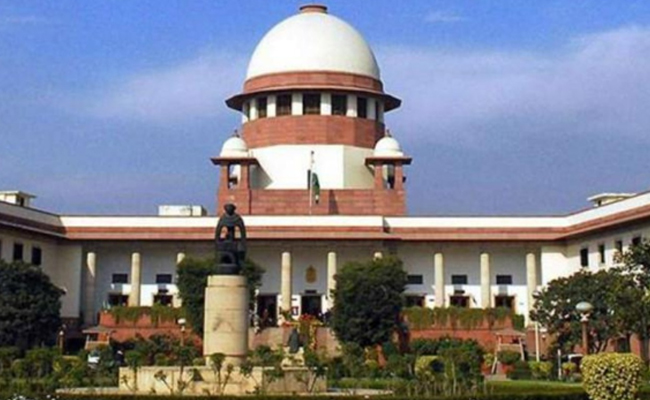
New Delhi (PTI): A court can reject anticipatory bail of an accused but it has no jurisdiction to direct him to surrender before the trial court, the Supreme Court has said.
A bench of Justices J B Pardiwala and Ujjal Bhuyan made the observation while hearing a plea filed by a man accused of cheating and forgery.
"If the court wants to reject the anticipatory bail, it may do so, but the court has no jurisdiction to say that the petitioner should now surrender," the bench said.
The Jharkhand High Court had rejected anticipatory bail plea of the accused and asked him to surrender and seek regular bail.
In this case, a complaint had been filed before a magistrate alleging offences under Sections 323 (voluntarily causing hurt), 420 (cheating), 467 (forgery of valuable security), 468 (forgery for purpose of cheating), 471 (using forged document) and 120B read with 34 of the IPC, in connection with a land dispute.
The high court had dismissed the second anticipatory bail application of the accused on the ground that no new circumstances were shown.
It had relied on its earlier order rejecting his first anticipatory bail plea, in which the court directed the petitioner to surrender before the trial court and seek regular bail in terms of the decision in Satender Kumar Antil v. CBI.
The top court said such a direction was wholly without jurisdiction and said that if a court chooses to reject anticipatory bail, it may do so, but it cannot compel the accused to surrender.