Women's reservation bill: SC grants Centre 2 weeks to respond to Congress leader's plea
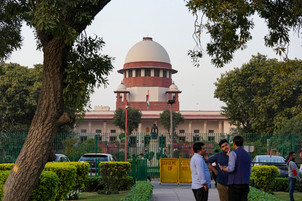
New Delhi, Jan 22: The Supreme Court on Monday asked the Centre to respond within two weeks to a plea by a Congress leader seeking immediate implementation of the Nari Shakti Vandan Act-2023 so that one-third of the seats in the Lok Sabha and state assemblies can be reserved for women before the general elections due this year.
A bench of Justices Sanjiv Khanna and Dipankar Datta allowed the Centre time after its advocate Kanu Agrawal said the government needs some time to file a comprehensive reply.
Senior advocate Vikas Singh, appearing for petitioner Jaya Thakur, said the court should issue a direction to ensure that the law can be implemented before the general elections.
Justice Khanna said the court cannot pass a direction and this stage and asked Singh to wait for the Centre's reply.
When advocate Prashant Bhushan said he wanted to file a petition on the issue, the bench told him his plea, being a fresh matter, can only be assigned to a bench by Chief Justice DY Chandrachud.
It posted the matter for further hearing after three weeks.
On January 16, the top court had deferred the hearing of the plea till January 22 after counsel who were to appear on the Centre's behalf were not available.
The SC had said on November 3, 2023 it would be "very difficult" for the court to strike down a part of the women's reservation law that says it will come into effect after the Census.
On September 21, 2023, the watershed bill to reserve one-third of the seats in the Lok Sabha and state assemblies for women received the parliamentary nod.
The Lok Sabha passed the Constitution amendment bill with near unanimity, while the Rajya Sabha cleared it unanimously.
The law will take some time before it is implemented as the next census and the subsequent delimitation exercise for redrawing the boundaries of Lok Sabha and assembly constituencies will help identify the seats to be reserved for women.
The quota for women in the Lok Sabha and state assemblies will continue for 15 years. Parliament can later extend the duration of the quota for women.
While there is quota within quota for Scheduled Caste (SC) and Scheduled Tribe (ST) women, the opposition had demanded that the benefit be extended to Other Backward Classes, too.
Data shows that women MPs account only for nearly 15 per cent of the Lok Sabha's strength, while their representation is below 10 per cent in many state assemblies.
Let the Truth be known. If you read VB and like VB, please be a VB Supporter and Help us deliver the Truth to one and all.
India achieves major milestone in wind energy; capacity now 56 gigawatts: PM Modi
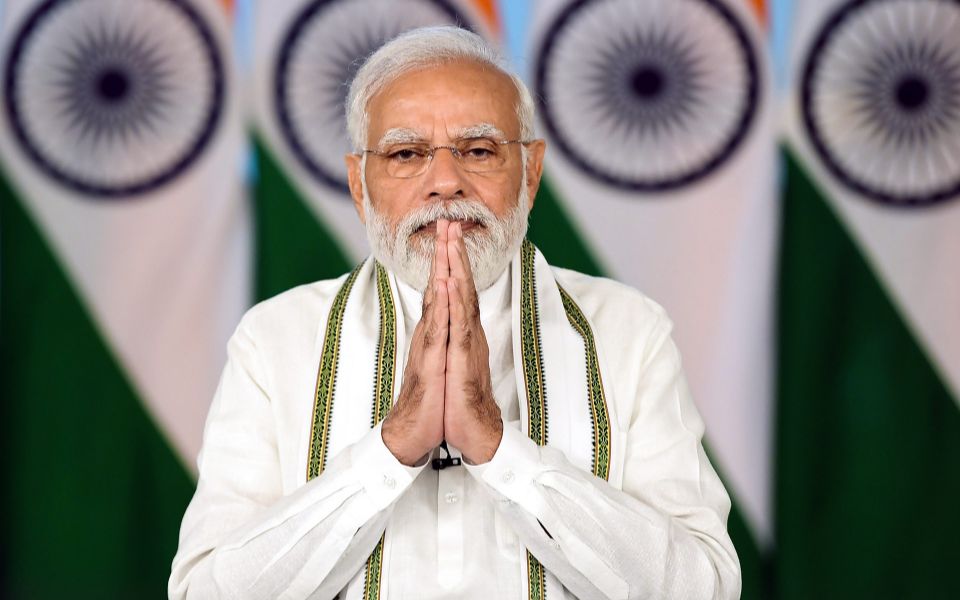
New Delhi (PTI): India has achieved a major milestone in wind energy, with the country's wind energy generation capacity exceeding 56 gigawatts, Prime Minister Narendra Modi said on Sunday.
In his monthly radio address 'Mann Ki Baat', Modi also said the country must save electricity and adopt clean energy.
“India recently achieved a major milestone in wind energy. India's wind energy generation capacity has now exceeded 56 gigawatts. In just the past year, nearly 6 gigawatts of new capacity have been added,” he said.
Underlining that solar and wind energy are essential for India's development, Modi said, “It is not just about the environment; it is about securing our future, and we all have a role to play in it.”
On April 22, Union Minister for New and Renewable Energy, Pralhad Joshi, said that India has recorded its best-ever year in wind energy capacity addition, with a historic 6.1 GW added during 2025-26.
India currently ranks fourth globally in wind energy, with more than 56.1 GW installed capacity and an additional 28 GW under implementation.
Emphasising the vast untapped potential of the sector, Joshi highlighted that India's wind energy potential at 150 metres hub height is estimated at nearly 1,164 GW.
He expressed confidence that with sustained efforts, the country will achieve 100 GW wind capacity by 2030 and 156 GW by 2036, contributing significantly to the net-zero target by 2070.
Joshi also underlined that wind energy plays a critical role in stabilising India's energy system, particularly due to its peak generation during evening and night hours, which aligns with high demand periods.
He noted that nearly 45 per cent of wind power generation occurs during peak demand hours, making it a vital complement to solar energy.