World Bank commits $25-30 bn for India's transition to high middle-income country
New Delhi, Sep 21 : The World Bank Group (WBG) on Friday approved its largest country program for India with a likely assistance of $25-30 billion by fiscal 2021-22 to help India's transition to a higher middle-income country.
"With a fast growing economy, global stature, and its unique experience of lifting the highest number of poor out of poverty in the past decades, India is well-positioned to become a high middle-income country by 2030," World Bank South Asia Vice President Hartwig Schafer said.
The WBG Board endorsed a new Country Partnership Framework (CPF) for India aimed at supporting India's transition by addressing its key development priorities -- resource efficient and inclusive growth, job creation and building its human capital.
"The Group expects to deliver $25-30 billion during this CPF period, ending in FY 2022," the multilateral lending agency said in a statement.
India, which has strong collaboration with Group's institutions, is the largest client of International Bank for Reconstruction and Development (IBRD). As of mid-September 2018, total World Bank assistance stood at $27.2 billion representing 104 projects.
At the end of July 2018, International Finance Corporation's (IFC) India portfolio contained 281 projects, amounting to a committed exposure of $6.4 billion.
"This CPF charts a path for how the World Bank, IFC and MIGA (Multilateral Investment Guarantee Agency), will leverage their relative strengths to deliver stronger development outcomes for this dynamic country, half of whose population is under the age of 25," Schafer said.
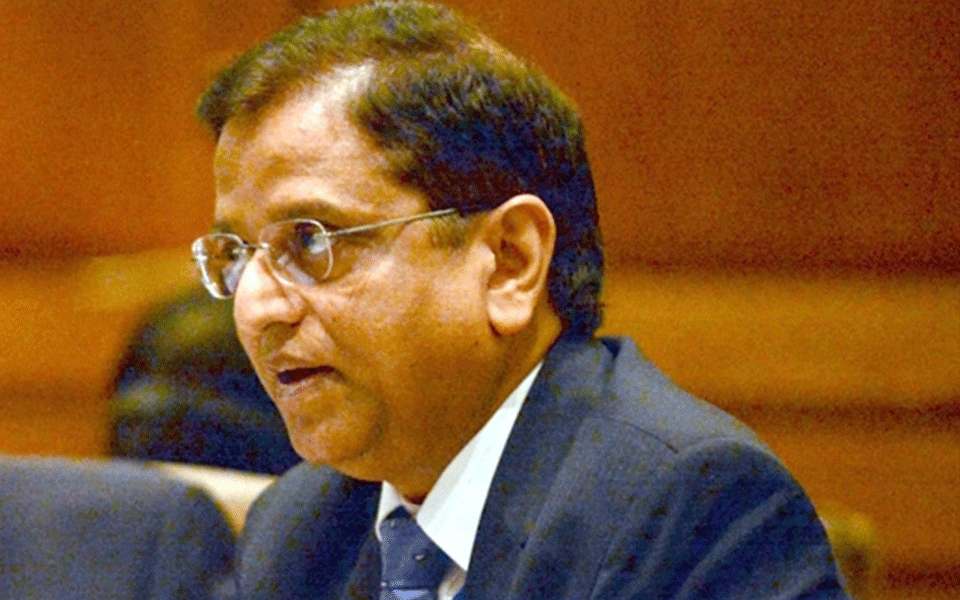
India's Economic Affairs Secretary S.C. Garg complemented the bank for aligning the CPF with India's development and investment objectives, the statement said.
The WBG will focus on promoting a resource efficient growth path, mainly in the use of land and water, to remain sustainable; enhancing competitiveness and job creation; and investing in health, education and skills to improve human capital.
It will also address the challenge of air pollution, jobs for women, raising the resilience of financial sector and investing in early years of children's development. It will harness new technology in all spheres.
The CPF highlights the shift from a "lending" to a "leveraging bank", emphasizing the growing potential and need to draw in capital markets in the financing of development priorities, the World Bank statement said.
Complementing transformational national programs, the bank will also develop strategic state partnerships to address state-specific development priorities.
"The future of India lies in the states of India. The country's transition to high middle-income status will be determined in large part by the effectiveness of India's federal compact," said Junaid Ahmad, Country Director, World Bank India.
The CPF also emphasises on India's global leadership role in promoting renewable energy and disaster resilient infrastructure development through its "Lighthouse India" initiative. India's experience will help countries in Africa and Central Asia, it said.
Let the Truth be known. If you read VB and like VB, please be a VB Supporter and Help us deliver the Truth to one and all.
Akeal Hosein bosses powerplay overs with 'skill and mental fortitude'
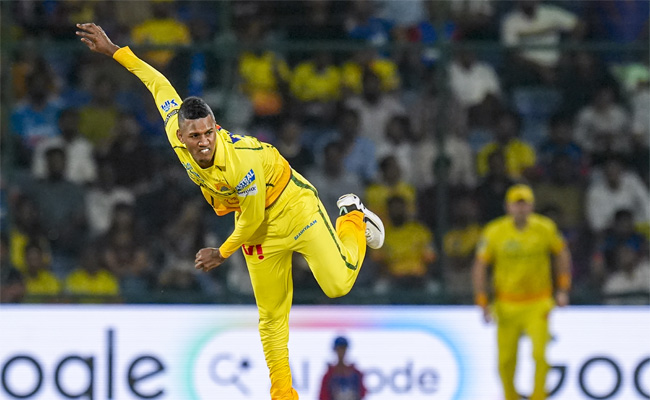
New Delhi (PTI): For a spinner who bowls majority of his overs in the powerplay, Chennai Super Kings' West Indian import Akeal Hosein relies as much on mental fortitude as his skills to excel in the most unforgiving phase of the game.
With just two fielders in the deep in the first six overs, the margin for error is miniscule and the pressure is sky high.
However, Hosein thrives in that tense environment. The left-arm spinner returned with frugal figures of 3-0-15-1 in the powerplay to play a crucial role in his team's eight-wicket win over Delhi Capitals in an IPL match here on Tuesday.
"You need both of them (skill and mental toughness). Especially when you come upon pitches that aren't conducive to spin and it's just about being disciplined as well," he said.
"Having two fielders out in the power play. It's not a job that you can go searching for wickets or you can be too greedy. It's just about sticking to the plan," he explained.
Hosein got the all-important wicket of an in-form K L Rahul, who was foxed by the West Indian as he stepped out to smash him for an inside out six.
Hosein's inclusion in the playing eleven after not being picked in the initial phase of the tournament has allowed CSK to win more games. On Tuesday, the pitch offered him a bit of help and he ended up dominating the batters.
After the win over DC, Hosein was asked about his recipe for success in the powerplay.
"...it's a bit scripted because you only have two guys out so it's just about being disciplined and trying to do the job for the team. At the end of the day if you don't get wickets and you bowl economically in the power play, that's a damn good job you've done for the team," said Hosein.
He has taken seven wickets in five games at an impressive economy rate of 7.25.
Fully aware that the batter is a mere couple of hits away from putting the pressure back on him, Hosein says practising for high-pressure situations helps him stay in the present.
"I think homework is very important. You want to have that head-start when you come up against whichever batter you're going to face. And like I say it's just about making assessments as quickly as possible.
"You might come up on a pitch that is spinning. You might come up against one that isn't spinning. Thankfully I can spin the ball. So it's just about picking which deliveries will give you the most success on a particular day and against a particular batter," said Hosein.
He got rid of Rahul first ball from the other end, something that was decided by captain Ruturaj Gaikwad. Post powerplay, Noor Ahmad took over the mantle from Hosein and maintained the pressure on DC batters.
"Getting the opportunity to bowl first for me is just about again making that assessment as quickly as possible and then passing on that information to Noor or even to the seamers as well if it was a bit of spin or if it's gripping or whatever the case is.
"So conversations with myself and Noor have been fantastic. Really happy for him that he's getting some success," he added.