Yeddyurappa suffers setback in home turf in urban local body poll
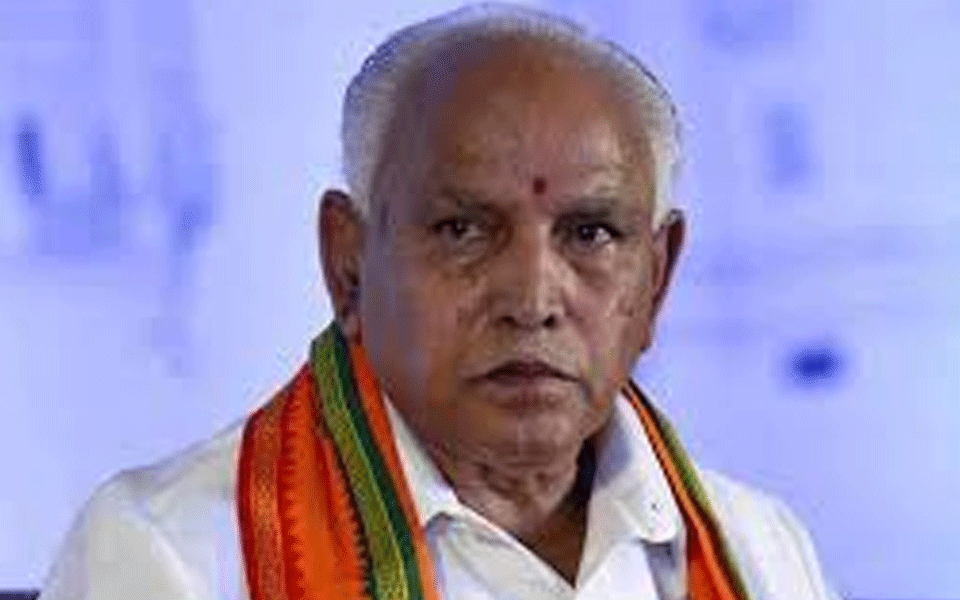
Bengaluru: In a setback to state BJP chief B S Yeddyurappa, the Congress has won majority of wards in his constituency of Shikaripura in Shivamogga district, in the town municipal council poll there for which results were declared Monday.
Of 23 wards in Shikaripura that went to polls Saturday, the Congress has won in 12, the BJP 8 and independents in 3.
The BJP's performance has not been that good in other Uurban Local Bodies (ULB)s of Shivamogga district, considered as its bastion.
In Shiralakoppa town panchayat, the Congress has won in 7 out of 17 wards that went to polls, while the BJP managed 2, the JD(S) 3 and Independents 5.
In Hosanagara town panchayat, of 11 wards, the Congress and BJP managed to win 4 each, the JD(S) 3. In the district's Soraba town panchayat and Sagara municipal council, BJP's performance is somewhat better.
While the BJP won 6 of 12 wards in Soraba, the Congress has won 4, JD(S) and independents have won in one each. In Sagara of 31 wards, the BJP bagged 16, Congress 9, JD(S) 1 andindependents 5.
The Congress and JD(S), which are in alliance in the state, had decided to go to polls separately and had asked its localleadership to decide on any understanding between the partieslocally depending on the prevailing situation there.
Results were declared on Monday for a total 140 wards in Shivamogga and Bengaluru Rural that went to polls Saturday.
Of 140 wards, the Congress is leading by winning 53 wards, the BJP 40, JD(S) 28, BSP 1 and independents 18.
After a rout in the recent Lok Sabha polls, the Congressin Karnataka heaved a sigh of relief last week as the party had won the highest number of seats in the May 29 ULB polls, for which the results were declared Friday.
While the Congress won 509 out of total 1,221 wards in 56urban local bodies for which results were declared on Friday, the BJP was victorious in 366 wards; JD(S) that went alone won 174 wards, BSP in 3, CPI(M) 2, others 7 and independents in 160, the state election commission said.
Meanwhile, Pradesh Congress president Dineh Gundu Rao has asked the party's local leadership to go in for a post poll alliance with JD(S) and independents to gain power in local bodies.
Pointing out that the Congress and JD(S) have majority in many local bodies, in a message he has asked his party men to gain power in those local bodies with support of the regionalparty and independents.
"Wherever we have majority, take cooperation of JD(S), wherever JD(S) has majority cooperate with them and where both of us lack majority seek support of independents. At no cost, the BJP should be allowed to join hands with them.
If there are issues that cannot be resolved at local level bring it to to the notice of the KPCC," the message to local leaders read.
Let the Truth be known. If you read VB and like VB, please be a VB Supporter and Help us deliver the Truth to one and all.
Family of injured driver in murder of Suvendu's aide seeks exemplary punishment
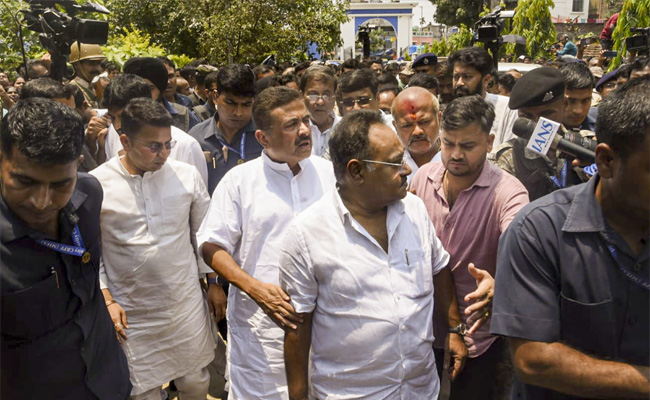
Kolkata (PTI): The family of Buddhabeb Bera, the driver injured in the shooting that killed BJP leader Suvendu Adhikari's close aide Chandranath Rath, demanded exemplary punishment for those responsible and urged the new government to ensure such incidents do not happen in West Bengal.
Rath was shot dead in Madhyamgram near Kolkata on Wednesday night, triggering a political storm in the state. Bera, who was driving the vehicle at the time of the attack, sustained gunshot wounds and is currently undergoing treatment at a private hospital.
Family members said they learned about the incident through television and immediately left for Kolkata.
ALSO READ: Trump says EU has until July 4 to approve last year's trade deal or it will face higher tariffs
"We came to know from TV reports that my nephew had been shot. We still do not know who carried out the attack or why it happened," Buddhabeb's uncle Biswajit Bera said.
"Our only wish now is that he recovers and returns home safely," he added.
Buddhabeb, 25, hails from Majnaberia village in the Chandipur police station area in Purba Medinipur district.
According to family members, he mostly stays in Kolkata for work and visits home occasionally during weekends.
Besides his parents, his younger brother, sister-in-law and several relatives have also travelled to Kolkata following the incident.
Demanding strict action against the perpetrators, the uncle said, "We want the government to conduct a proper investigation and identify those directly involved in the crime. They should be given exemplary punishment so that such incidents do not happen again in West Bengal and no other family has to go through this grief."
A neighbour, Ranjana Ghorai, also sought stringent punishment for those behind the attack.
"In our neighbourhood, we call him Sona. We want exemplary punishment for the people responsible for this incident," she said.
Rath's family members have demanded life imprisonment for the accused, while Adhikari has called for capital punishment for those involved in the killing.