Yogendra Yadav described the budget of Nirmala Sitharaman as "Zero Budget" for the farmer
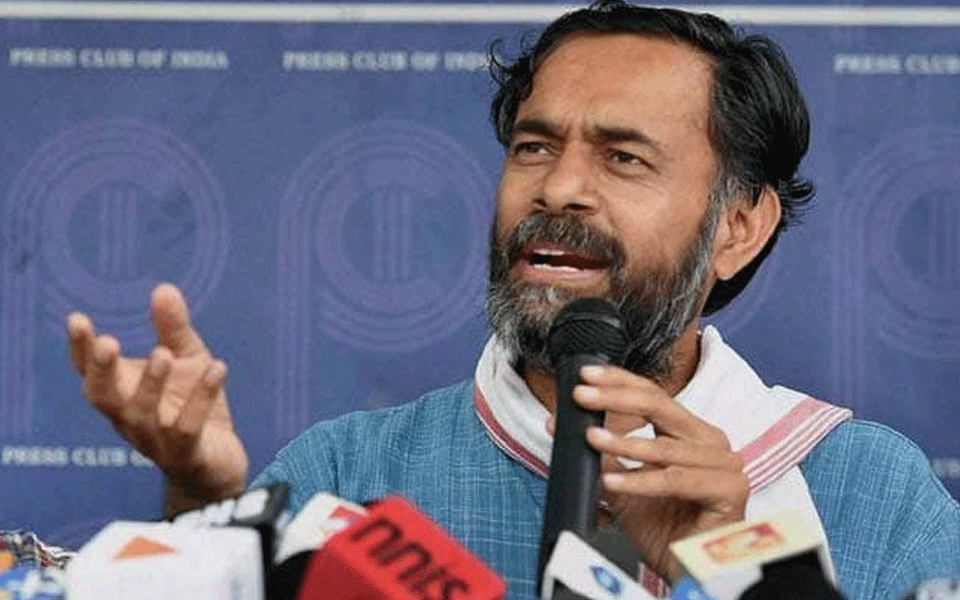
New Delhi: Describing Finance Minister Smt. Nirmala Sitharaman's first budget as “Zero Budget”, Swaraj India President Yogendra Yadav expressed regret that for the farmer this budget neither has any new allocation, nor any data, nor any new direction and nor any new plans. This was the first budget in the country's history in which the Finance Minister did not mention any of the budget items. The reason for not mentioning budget items in the speech was exposed when the amount allocated for each item was seen in the schedule of the budget - it was found to be exactly the same as the interim budget presented in February 2019. Avik Saha, National Convenor of Jai Kisan Movement said that if the Finance Minister had to do this, then what was the need for a new budget?
Re-presenting the February budget again in July is a cruel joke on farmers. Swaraj India expresses great disappointment that changed circumstances and facts that have emerged in the meantime were not kept in mind by the Finance Minister. Rather than improve the condition of farmers, by increasing tax on diesel, she imposed a new burden on them.
- The Prime Minister had announced that the income of farmers would be doubled in 6 years. So far 3 years have passed. The government could have at least informed how much farmer's income has increased till now and what is the plan to double the income in the next 3 years. Instead of sharing this information, the Finance Minister repeated the empty-talk of doubling farmers' income.
- Farmers had hoped that the amount of Rs.6,000 under PM AASHA Scheme would be increased. At least the benefit of the Scheme would be extended to landless farmers who cultivate on contract and lease. The demand of farmers' movements was always that this money should be deposited in account of a woman in the beneficiary farming household. But the Finance Minister did not even mention this Scheme in her speech and retained the sum Rs.75,000 crore already allocated in February 2019. This is very surprising because in the meantime the Government has increased the number of beneficiaries of this Scheme and the Prime Minister himself said after the budget speech that Rs.87,000 crore has been allocated to this Scheme.
- In the Economic Survey released yesterday, it has been acknowledged that farmers are forced to sell 71% of their crops at rates below MSP. The day before, the Government has increased the MSP of Kharif crop. Every farmer had hoped that they would at least get MSP for their crops. For this, it was necessary for the Government to allocate at least Rs. 50,000 crore rupees in the budget under PM AASHA. The Finance Minister did not do this.
- This year, there is possibility of widespread drought in the country. There is 25% deficit in monsoon and sowing has fallen by 15%. In this situation, it was expected that the Government would increase the allocation to National Disaster Relief Fund to deal with drought. It was expected that crop loss compensation would be enhanced from Rs.4,700 per acre to at least Rs.10,000 per acre. It was also expected that PM Fasal Bima Yojna would be modified so that farmers could easily get claims in the event of loss. Regrettably, the Finance Minister remained silent on such a big question.
- In the last few months, news of stray cattle causing heavy loss to farmers has been steaming in from all corners of the country. Farmers had hoped for special financial grants to deal with this and had expected the Government to make appropriate arrangements. The Finance Minister remained silent on this issue.
Instead, the Finance Minister repeated old schemes like E-NAM, Paramparagat Krishi Vikas Yojna (renamed Zero Budget Farming) fisheries etc. but failed to mention why, even in these schemes, the Government has reduced budget allocations rather than increase it.
Anupam, who leads the National Youth Movement named Yuva Halla Bol said that this was a disappointing budget for unemployed youth who are suffering a record breaking 45-year-high unemployment rate. At a time when jobs are being lost across the board in all sectors rather than being created, there was a need to take concrete steps to deal with this crisis.
Till Lok Sabha elections, the Government was unwilling to accept that there is unemployment crisis in the country or that the economy is distressed. The Modi government tried hard to suppress its own NSSO report; in protest the chairman of the Statistical Commission had to resign. When this report came out through the media, some BJP leaders dubbed it as "Fake News". But after the election was over, the government accepted the same survey of NSSO and released it officially. The RBI Chief has now accepted that there is a decline in the economy, which has been confirmed by the Economic Survey released yesterday, which downgraded the growth rate to 7%. Therefore, there was expectation that the government would address the issue of slowing down of the economy and rampant unemployment, through this budget.
But Finance Minister Nirmala Sitharaman did not mention any plans for the creation of employment in the budget speech. Although she mentioned the National Education Policy, she did not touch upon the main dimensions of the policy like doubling of the budget for education learning in five years or extending right to education from 3 years to 18 years.
Rather than making any concrete proposal, the Finance Minster said that foreign students would be welcomed under "Study in India" and Indian students would be trained in subjects like Artificial Intelligence, Big Data, Robotics so that they could find employment abroad. She proposed a new TV program that would be run for and with startups in the country. Unfortunately, the Finance Minister did not say anything on minimum wages in the un-organised sector, or employment in the medium and small scale sector, or in the automobile sector, tractor industry or FMCG sector. She remained silent on urban employment guarantee scheme and about filling up the 24 lakh vacancies in government posts.
Let the Truth be known. If you read VB and like VB, please be a VB Supporter and Help us deliver the Truth to one and all.
Everything in my life began from here: Mamata after filing nomination for Bhabanipur seat
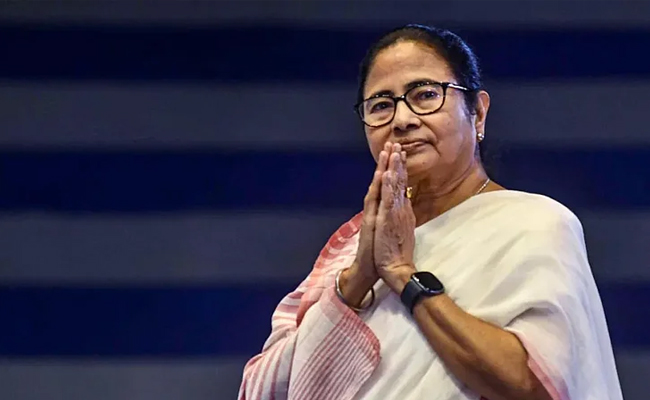
Kolkata (PTI): West Bengal Chief Minister Mamata Banerjee on Wednesday filed her nomination papers as the TMC candidate for the Bhabanipur assembly seat, and said everything in her life began from here.
Amid a sea of supporters raising slogans of 'Mamata Banerjee zindabad' and 'TMC zindabad', Banerjee led a roadshow from her Kalighat residence to the Alipore Survey Building, where she filed the nomination papers.
She walked nearly 800 metres with folded hands and her trademark smile, greeting party workers lined up on both sides of the road.
"I was born and brought up here in Bhabanipur only. Everything in my life began from here," Banerjee told reporters after filing her nomination papers.
Seeking support for the TMC beyond the Bhabanipur contest, she said, "I would appeal to the people, not just in Bhabanipur but across all 294 seats, to ensure the victory of our candidates. We will win with a bigger mandate."
The TMC had won 213 seats in the 2021 assembly polls.
Banerjee, however, expressed concern over the deletion of names from the electoral rolls and said her party would again move a court against the freezing of the voter list.
"I am really pained that so many names have been deleted from the electoral rolls. I fail to understand why the voter lists have been frozen. We will again move a court against it," Banerjee added.
The three-time MLA from Bhabanipur is set to take on BJP candidate Suvendu Adhikari in the high-profile contest.
Those who accompanied her during the nomination filing included Rubi Hakim, wife of Kolkata Mayor Firhad Hakim, TMC block president of Ward 71 Bablu Singh and Miraj Shah of the Bhabanipur Education Society.
Her family members also accompanied her.
The TMC projected Banerjee's roadshow and nomination filing as a message of Bengal's pluralist ethos in Bhabanipur, a constituency where Gujarati businessmen, Bengali families, Punjabi households and Muslim residents have lived side by side for decades.
The ruling party sought to portray Bhabanipur as a "mini-India" and a symbol of West Bengal's inclusive identity.
The elections to the 294-member West Bengal assembly will be held in two phases - on April 23 and 29. Votes will be counted on May 4.