Yogi meets six eminent persons to seek support for BJP in 2019
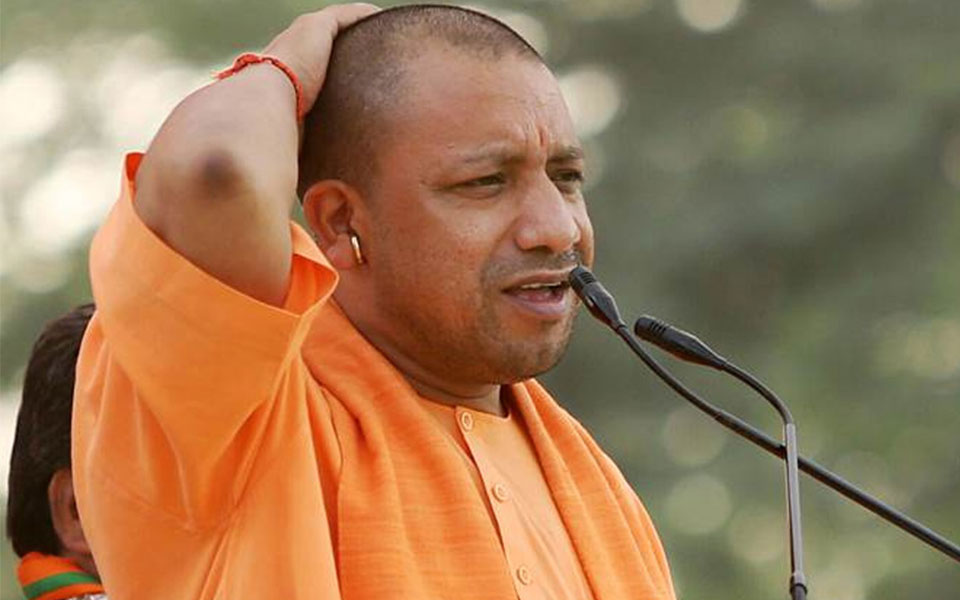
Lucknow, June 15: Under the 'Sampark for Samarthan' campaign of the BJP to garner support for the 2019 general elections, UP Chief Minister Yogi Adityanath met six prominent persons here on Friday and apprised them of various initiatives taken by the Narendra Modi government.
On his first stop, Adityanath met eminent doctor Mansoor Hasan and urged him to support the Bharatiya Janata Party as the party was for 'insaniyat aur vikas' (humanity and development), and both its governments, at the Centre and the state, were committed to improve the lot of the poor and the farmers.
Hasan later told reporters that there was no political discussion but added that this was a good initiative by the ruling party.
Later, the Chief Minister visited met Gopinath Pandey, the father of Kargil hero and posthumous Paramvir Chakra awardee Captain Manoj Pandey, and informed him of various schemes launched by the Modi government for the defence forces and the common people.
Adityanath then went to the residence of eminent theatre artist Raj Bisaria and informed him that this campaign had been unveiled by party President Amit Shah, "so that we could reach out to our own and seek support for BJP in 2019 so that our development agenda gets further impetus".
After this, Adityanath, along with cabinet colleagues - Medical Education Minister Ashutosh Tandon and Law Minister Brajesh Pathak - met Justice (retd.) H.N. Tilhari, Lt. Gen. R.P. Shahi (retd) and eminent educationist Bhumitra Dev and presented them a booklet listing achievements of the Modi government in four years.
Let the Truth be known. If you read VB and like VB, please be a VB Supporter and Help us deliver the Truth to one and all.
Women BJP MLAs protest against opposition in UP assembly premises
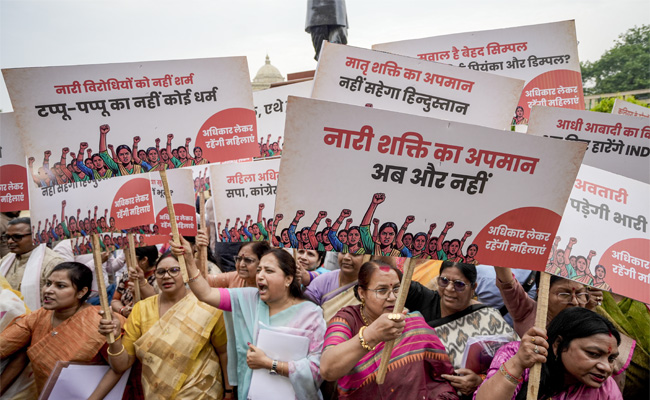
Lucknow (PTI): Women BJP MLAs held a protest in the Vidhan Bhawan complex before the one-day special session of Uttar Pradesh assembly, slamming the opposition for defeating the passage of a bill, which would have led to implementation of the Women's Reservation Law, in the Lok Sabha.
This followed another demonstration by Samajwadi Party MLAs, who alleged that the BJP was misleading public in the name of women's reservation.
The women BJP legislators assembled in front of Chaudhary Charan Singh's statue in the assembly premises, holding banners inscribed with the slogan "Insult to Matrushakti (women's power), India will not tolerate it". The protesting members entered the main hall of Vidhan Bhawan carrying the banners.
Participating in the protest, the state Minister for Women Welfare and Child Development, Baby Rani Maurya, told reporters that all opposition parties, including the Samajwadi Party and the Congress, had opposed the women's reservation, a stance for which they would have to pay a heavy political price.
"On this issue, all of us women stand united. We will ensure that we secure our reservation," she said.
BJP MLA Ketki Singh remarked that their protest represents the collective outrage of millions of women across the state.
Singh asserted that the opposition has betrayed women by creating hurdles in the path of women's reservation. The current demonstration is merely the beginning, and very soon, women from every street, intersection and household will join the protest movement, she said.
Minister Vijaylakshmi Gautam said, "We strongly condemn the despicable act committed by the Samajwadi Party and the Congress in an attempt to hold back 'half the population' (women). Their action was directed against the very bill that Prime Minister Narendra Modi had introduced to empower and strengthen Nari Shakti (women's power), and which he strived to pass expeditiously."
Uttar Pradesh assembly is holding a one-day special session on Thursday. During the session, the government is set to move a censure motion against the opposition parties over their failure to pass the Constitution Amendment Bill, which would have led to implementation of the Women's Reservation Act, in the Lok Sabha.