You may face fate of Supertech twin towers, Bombay HC warns developer
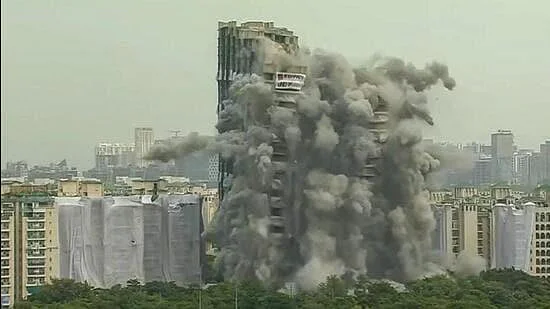
Mumbai, Aug 30: The Bombay High Court on Tuesday remarked that a developer insisting to continue construction of a building adjacent to a plot reserved for a playground despite a stay from the Supreme Court and the HC would face a fate similar to Supertech's illegal twin towers in Noida that were demolished.
The remark was made by a division bench of Chief Justice Dipankar Datta and Justice M S Karnik while hearing a public interest litigation (PIL) that claimed the real estate developer was encroaching on the land reserved for a playground in Mumbai's suburb of Khar.
The court had last week deputed an architect to visit the site where the developer has proceeded with construction flouting a 1995 Supreme Court order and to submit a report stating up to what extent construction has been carried out.
On Tuesday, the bench was informed the report has been submitted by the architect following which the court adjourned the matter for further hearing on September 20.
However, the advocate appearing for the developer urged the court to vacate the stay on construction till demarcation of the land was completed.
Refusing to do so, Chief Justice Datta said, "Let's wait. You may face fate like Supertech."
Supertech's twin towers located in Noida near New Delhi were demolished using explosives on August 28 following directives from the Supreme Court. It was held that the twin towers - Apex (32 storeys) and Ceyane (29 storeys) were illegally built.
The real estate company paid for the demolition which cost about Rs 20 crore.
Last week, the HC had come down heavily on the Mumbai developer for proceeding with the construction despite an order from the Supreme Court in 1995 directing for no construction to be carried out on the 6,000 square metres plot that was reserved for a playground under the 1992 development plan.
The Slum Rehabilitation Authority (SRA), a Maharashtra government agency that had permitted Integrated Realty Project to develop the adjoining plot, said boundaries of the plot have changed and the size of the proposed playground has got reduced to 5,255 square metres from the original 6,000 square metres.
The court had last week held that in view of the rival claims, it was necessary for them to ascertain as to what is the exact extent of vacant land available for the playground.
Let the Truth be known. If you read VB and like VB, please be a VB Supporter and Help us deliver the Truth to one and all.
Trump says EU has until July 4 to approve last year's trade deal or it will face higher tariffs
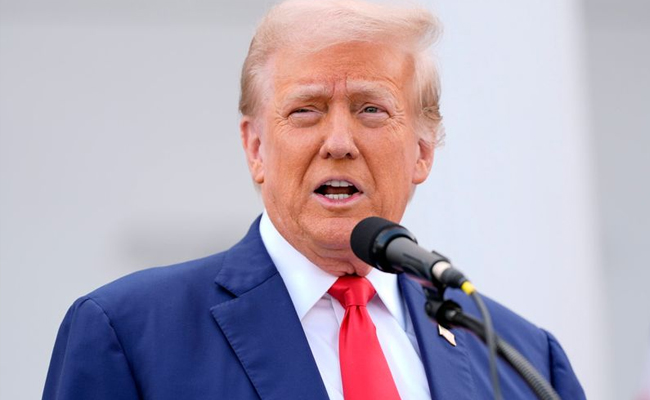
Washington (AP): President Donald Trump has said in a social media post that goods from the European Union would face higher tariff rates if the 27-member bloc fails to approve last year's trade framework by July 4.
The announcement on Thursday appeared to be a deadline extension after the president said last Friday that EU autos would face a higher 25 per cent tariff starting this week. Trump made the updated announcement after what he described as a "great call" with European Commission President Ursula von der Leyen.
Still, the US president was displeased that the European Parliament had yet to finalize the trade arrangement reached last year, which was further complicated in February by the US Supreme Court ruling that Trump lacked the legal authority to declare an economic emergency to impose the initial tariffs used to pressure the EU into talks.
"A promise was made that the EU would deliver their side of the Deal and, as per Agreement, cut their Tariffs to ZERO!" Trump posted. "I agreed to give her until our Country's 250th Birthday or, unfortunately, their Tariffs would immediately jump to much higher levels."
It was unclear from the post whether Trump was implying that the tariff rates would jump on all EU goods or the increase would only apply to autos.
His latest statement indicates he might be backing away from his earlier threat on EU autos by giving the European Parliament several more weeks to approve the agreement.
Under the original terms of the framework, the US would charge a 15 per cent tax on most goods imported from the EU.
But since the Supreme Court ruling, the administration has levied a 10 per cent tariff while investigating trade imbalances and national security issues, aiming to put in new tariffs to make up for lost revenues.