Zakir Hussain dies in US hospital, tributes pour in for tabla maestro
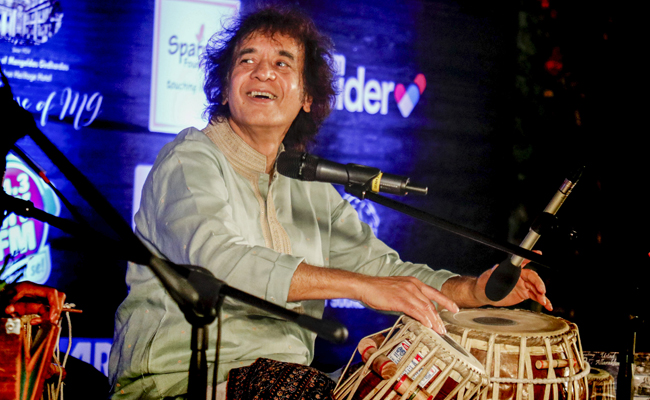
New Delhi (PTI): Tabla maestro Zakir Hussain died in a hospital in San Francisco, US, his family said on Monday. He was 73.
Hussain died from complications arising out of idiopathic pulmonary fibrosis, the family said in a statement.
He had been in hospital for the past two weeks and was shifted to the intensive care unit (ICU) after his condition deteriorated.
Hussain's sister Khurshid Aulia said he passed away "very peacefully".
"He passed away very peacefully after the ventilation machine was switched off. This was 4 pm San Francisco time," she told PTI.
Regarded as the greatest tabla player of his generation, Hussain is survived by his wife Antonia Minnecola and their daughters -- Anisa Qureshi and Isabella Qureshi.
Born on March 9, 1951, he was the son of legendary tabla master Ustad Alla Rakha.
The family said in its statement, "He leaves behind an extraordinary legacy cherished by countless music lovers around the globe, with an influence that will resonate for generations to come."
In a career spanning six decades, Hussain worked with several renowned international and Indian artistes but it was his 1973 project with English guitarist John McLaughlin, violinist L Shankar and percussionist TH 'Vikku' Vinayakram that brought together Indian classical music and elements of jazz in a hitherto-unknown fusion.
Starting at the age of seven, he went on to collaborate with virtually all of India's iconic performers, including Ravi Shankar, Ali Akbar Khan and Shivkumar Sharma, in his career.
His groundbreaking work with Western musicians such as Yo-Yo Ma, Charles Lloyd, Bela Fleck, Edgar Meyer, Mickey Hart and George Harrison brought Indian classical music to an international audience, cementing his status as a global cultural ambassador.
Hussain received four Grammy Awards in his career, including three at the 66th awards ceremony earlier this year.
The percussionist, one of India's most celebrated classical musicians, received the Padma Shri in 1988, Padma Bhushan in 2002, and the Padma Vibhushan in 2023.
As news of Hussain's passing spread, messages of condolence poured in on social media.
Grammy-winning musician Ricky Kej remembered Hussain for his "immense humility, approachable nature".
"One of the greatest musicians and personalities India has ever produced. Along with being the best himself, Zakir ji was known for… being responsible for the careers of numerous musicians, who are now forces to reckon with themselves," Kej said in a post on X.
"He was a treasure trove of skill and knowledge and always shared and encouraged the entire music community through collaborations and his actions. His legacy will live on forever, and his influence will be felt for generations. He left us too soon," he added.
American drummer Nate Smith thanked Hussain for "all of the music you gave us".
Rajya Sabha MP Priyanka Chaturvedi also paid tribute, describing Hussain as an "irreplaceable legend".
"The world of music will be lesser without tabla maestro Ustad Zakir Hussain. Heartfelt condolences to his family, friends and his fans all around the world. My prayers, Om Shanti," she said on X.
Filmmaker Hansal Mehta credited Hussain for bringing "an accompanying instrument to the forefront".
"The maestro, Ustad Zakir Hussain passed away a few hours ago. Goodbye Ustad ji. The man who made the tabla sexy, who brought an accompanying instrument to the forefront is gone. Deepest condolences to his family, fans and students around the globe," Mehta said.
Kerala Chief Minister Pinarayi Vijayan called the percussionist "a beacon of India's rich musical heritage and a true custodian of classical traditions".
"Ustad Zakir Hussain was instrumental in popularising Indian music across the globe, serving as a beacon of India's rich musical heritage. A true custodian of classical traditions, his contributions to the arts remain unparalleled. His passing is a monumental loss to culture and humanity. Heartfelt condolences to his loved ones," Vijayan said.
Expressing his condolences to Hussain's family, Congress president Mallikarjun Kharge called him a "cultural ambassador who bridged borders and generations with his mesmerising rhythms".
"The Padma Vibhushan tabla maestro and percussionist, gloriously took forward the legacy of his father with exceptional performances and collaborations. His numerous national and international honours are a testament to this," Kharge said.
Let the Truth be known. If you read VB and like VB, please be a VB Supporter and Help us deliver the Truth to one and all.
Karnataka: SP’s gunman among two arrested for extorting money from rice smuggler

Ballari (Karnataka) (PTI): An armed police constable serving as the district superintendent of police’s personal gunman, along with his accomplice, was arrested for allegedly extorting money from a rice smuggler, police said on Friday.
Devaraj, who had been serving as the SP’s gunman for the past four and a half years, was identified as the mastermind behind the incident.
Following an investigation, Devaraj and his accomplice Sairam were arrested on May 6, while efforts are underway to nab a third accused, Gadilinga, a practising advocate in Ballari, who is absconding, police said.
The matter came to light after a complaint was filed by Sharabappa, a habitual offender allegedly involved in illegal rice transport, they added.
According to police, the incident occurred on the intervening night of April 27 and 28, when a group of masked men intercepted Sharabappa’s rice-laden vehicles near the Moka forest area.
The accused allegedly introduced themselves as members of an “SP squad”, threatened to seize the vehicles and file criminal cases, and demanded money to avoid legal action.
Police said the accused initially demanded Rs 5 lakh and later extorted around Rs 3 lakh from the complainant.
Investigation revealed that Devaraj was the main person involved in demanding and collecting the money, while Sairam and Gadilinga were also involved in the offence. Sairam was allegedly involved in similar activities earlier as well.
Devaraj and Sairam were arrested under Sections 308(2) (extortion) and 3(5) (common intention) of the Bharatiya Nyaya Sanhita.
Police also seized the extorted cash, the four-wheeler, and mobile phones allegedly used in the crime. Efforts are underway to trace Gadilinga.
Addressing a press conference, Ballari Superintendent of Police Suman D Pennekar described the incident as a serious offence that has tarnished the image of the police department.
"There is no official ‘SP squad’ or ‘DSP squad’ operating in the district. Such labels are often misused by impostors or corrupt individuals to commit extortion," the SP clarified.
She said no involvement of other police officers has been found so far.
Departmental proceedings have been initiated against Devaraj, and suspension proceedings are underway. The SP added that strict action will be taken against anyone involved in such offences.
Police said Sharabappa, the complainant, is a known habitual offender involved in illegal rice smuggling, and several cases have already been registered against him in the Moka and Peddihalli areas. A separate case has also been registered against him in connection with rice smuggling on the night of the incident.
Authorities are also exploring the possibility of initiating externment proceedings against him under applicable legal provisions.
The SP urged the public to report any extortion attempts by persons claiming to be part of an “SP squad”, assuring that the identity of informants will be kept confidential.