Zee News anchor Zeenat Siddiqui alleges harrasment, unlawful termination from management

Noida: In a shocking revelation on X platform, a Zee Media employee Zeenat Siddiqui, who was working as an anchor has come forward with allegations of unlawful termination and harassment. She has also written in detail about the disturbing events leading up to her dismissal.
Siddiqui, narrated the sequence of events that happened on the day of her termination. According to her X post, she arrived at the office on a usual Saturday, a day when a significant portion of the staff, including HR personnel, was absent. Upon her arrival, she described experiencing a sense of confinement, with her belongings inspected and her attempts to contact her mother restricted.
She further alleged that she was subjected to verbal abuse and intimidation, culminating in an attempt to coerce her into signing a resignation letter. Refusing to comply, she attempted to leave, only to be forcibly restrained and ultimately terminated from her position. Throughout the ordeal, she claims to have endured emotional distress and physical discomfort, exacerbated by the beginning of her menstrual cycle.
Despite her efforts to seek assistance from HR, she asserts that her pleas were ignored, and she was left to tackle the problems alone. Subsequently, she lodged a formal complaint with the police, detailing the events of the incident. However, as of the time of her post on X, no formal FIR has been filed, prompting concerns over the handling of the case.
Siddiqui's account has sparked outrage and calls for accountability, with demands for a thorough investigation into the alleged misconduct. The incident has reignited discussions surrounding workplace harassment and the efficacy of existing legal frameworks in addressing such grievances.
Siddiqui remains apprehensive about the outcome of her legal battle, citing concerns over potential external influences. In her post she has also requested for sustained support from the public.
ये मेरा UNLAWFUL TERMINATION ORDER जिसे मैं बिना किसी शर्म के आप लोगों के सामने रख रही हूं, अब ये जानिए ये मुझे दिया कैसे गया
— ZEENAT SIDDIQUI (@ZSiddiki) February 8, 2024
मैं रोज़ की तरह ऑफिस गई, दिन शनिवार , जिस दिन 70 प्रतिशत STAFF/HR DEPARTMENT OFFICE नहीं आता ।
((-1-वक्त सुबह 10.20 मिनट, मेरी घेरेबंदी कर ज़बरदस्ती एक… pic.twitter.com/6sEHM5GbOy
Let the Truth be known. If you read VB and like VB, please be a VB Supporter and Help us deliver the Truth to one and all.
Nabin holds Odisha BJP core committee meeting, discusses strategies for next year's rural polls
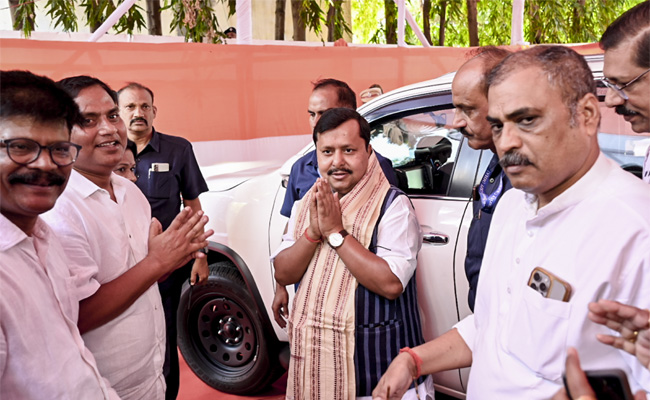
Bhubaneswar (PTI): BJP national president Nitin Nabin Monday chaired a meeting of the party’s core committee in Odisha and discussed its strategies for the next year's rural polls and possible expansion of the council of ministers in the state, party sources said.
Chief Minister Mohan Charan Majhi, Deputy CMs KV Singh Deo and Pravati Parida, Union minister Dharmendra Pradhan, Odisha BJP president Manmohan Samal and its national vice-president Baijayant Panda attended the closed-door meeting that began at 8.30 am at the party's state headquarters here.
BJP MPs Sambit Patra and Pratap Sarangi, and the party's Odisha in-charge Vijay Pal Singh Tomar, co-in-charge Lata Usendi and other senior leaders also participated in the meeting.
"The national president discussed the party's strategies for panchayat polls next year, possible expansion of the council of ministers, and appointments of party leaders in different boards and corporations, and other issues," a BJP source said.
After the meeting, Sarangi said, "The core committee also discussed the BJP's ideology and how to maintain it when the party is in power in the state."
Nabin, who arrived here on Sunday night on his first visit to Odisha after he became the party president, is also scheduled to hold a series of organisational meetings, training programmes, and strategic dialogues with senior party leaders and office-bearers in Bhubaneswar and Puri.
Samal said Nabin’s visit is considered politically significant as it will infuse energy among the grassroots-level workers and leaders.
During the day, Nabin is also scheduled to visit the Lord Jagannath temple in Puri. He will partake of the sacred 'Mahaprasad' at the residence of Puri Lok Sabha MP and BJP's national spokesperson, Sambit Patra.
Upon returning to Bhubaneswar, Nabin will meet state office bearers and frontal unit presidents at 4 pm. He will also chair a meeting with members of the council of ministers of Odisha, another BJP source said.
He is scheduled to return to Delhi on Monday evening, he added.