10 years of Naushad Kashimji murder case: A crime that made the victim immortal, inspired several
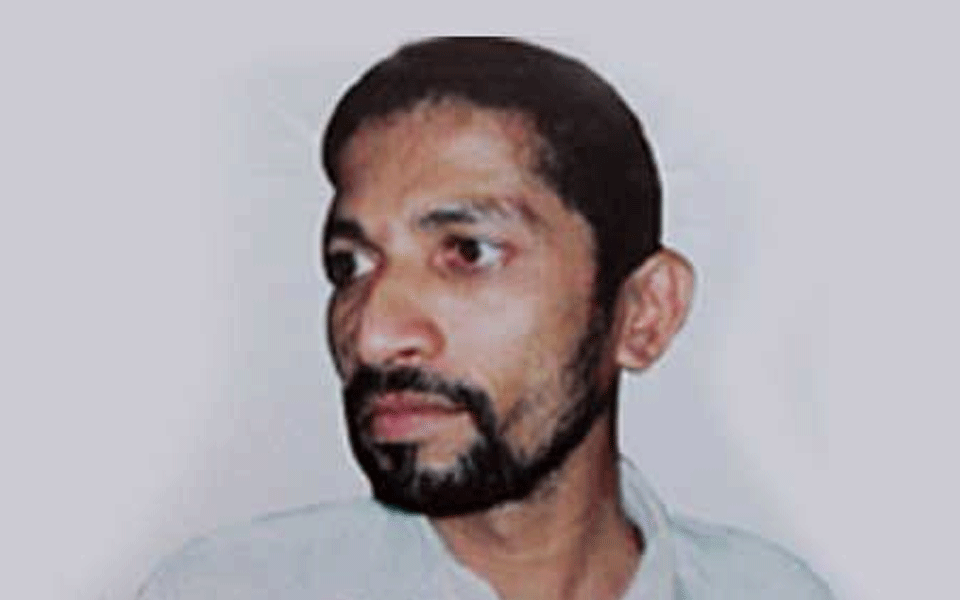
While gunning down Mangaluru-based lawyer Naushad Kashimji on April 9, 2009, his killers must have thought that this act would strike terror within the activists fighting for social justice and human rights and one particular community, especially amongst its youth. That it would deter those who’d dare to follow in the footsteps of their dearly loved lawyer – instilling in them the fear of an untimely and abrupt end. But, Naushad’s death seems to have worked to achieve the opposite, as 10 years into his killing, many youngsters are on their way to fight for justice, or to become a Naushad in their own right.
Mangaluru: On the eve of April 9, 2009, one of the most prominent criminal lawyers of the town Naushad Kashimji was gunned down at his apartment’s basement in Falnir of Mangaluru.
Naushad, hailing from coastal town of Bhatkal and practicing law in Mangaluru, was a human rights lawyer who regularly contested against social injustice and police atrocities and hence raised to prominence in the profession at a very young age much like his senior advocate Purushottam Poojary who trained him.
At the time of his murder Naushad was handling the case of Abdul Rasheed Hassan (Malbari) wherein he had opposed the police custody as sought by Ullal police. According to Purushottam Poojary this was the flashpoint of Naushad’s murder as he named four police officers as accused of the murder in a complaint. Purushottam claimed that Naushad had informed about threats he received by the police officers on the day of his murder. The court however did not consider the allegations and quashed it.
Several NGOs, Lawyers’ fraternity, his community men in Bhatkal all joined in to protest against the brutal murder, which had in many ways changed things in the coastal Karnataka.
Years after the legal struggle of Purushottam Poojary, Advocate Sameer Kashimji (Naushad’s brother) and Advocate Nusrath Jahan (wife of Naushad Kashimji) Mangaluru Sessions Court in November 2015 convicted five people in the case and handed life imprisonment to three of them and seven years rigorous imprisonment to the other two, while the look-out for mastermind of the murder Ravi Poojary continued.
The Karnataka High court in August 2018, acquitted all the five citing lack of concrete evidence in the case.
Ten years after the murder Naushad brother Sameer and Naushad’s wife Nusrath Jahan continue to practice law in Mangaluru, while Purushottam Poojary passed away in May 2014.
A decade later Sameer feels his brother’s sacrifice did not go waste and it is paying off. Speaking to Vartha Bharati on Tuesday, April 9 Sameer did not speak about the emotional aspect of the murder of his brother but stressed upon the change it has brought in the society.
“Naushad fought against social injustice and police atrocities. And his murder was shocking for everybody who cares about human rights. His murder brought in a lot of change in the society and mindset of youngsters as several students started adventuring into legal profession to work like Naushad did. They all want to become Naushad, they all dream and aspire of serving the society. That is something I look at and feel that the sacrifices he made is reaping fruits for the betterment of society. We need more such lawyers in this profession who can fight for the suppressed people. And if not after Naushad’s murder I don’t really think the numbers (especially in the Bhatkal community) of young lawyers would increase over the years” Sameer said.
“It’s been ten years now and yes it is still disturbing at the personal front for all of us” Sameer added.
Sameer says there are several others in his home town who want to practice law like Naushad. In short, for those who conspired to see Naushad dead, he might be long dead and gone. But for dozens of Muslim youth across the country, Naushad abhi bhi zinda hai (Naushad is still alive). His community has proudly given him the status of Shaheed (Martryr) and Naushad lives to inspire them.
Let the Truth be known. If you read VB and like VB, please be a VB Supporter and Help us deliver the Truth to one and all.
Govt comes out with set of FAQs on women's reservation bill
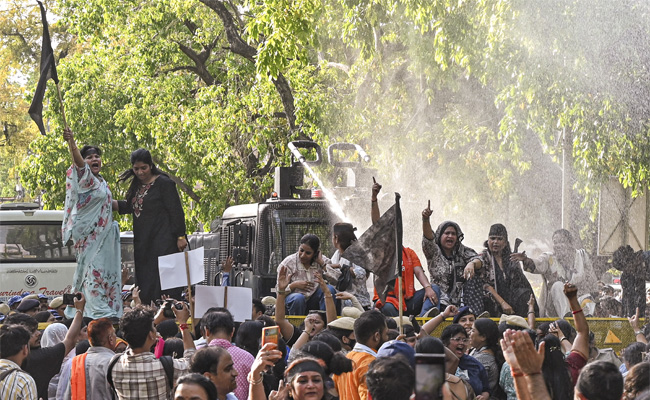
New Delhi (PTI): The government on Sunday came out with a set of Frequently Asked Questions (FAQs) related to the reservation for women in legislatures following the defeat of a Constitution Amendment Bill in the Lok Sabha that seeks to provide 33 per cent quota for women in the Lower House and state assemblies.
The FAQs came amid the Opposition's claim that in the name of women quota, the government was trying to carry out delimitation on its own will based on 2011 census.
Here are the FAQs:-
1. Which Bills were introduced by the central government in the Lok Sabha on April 16, 2026?
A:- On April 16, the central government introduced three key Bills in the Lok Sabha: The Constitution (One Hundred and Thirty-First Amendment) Bill, 2026, The Delimitation Bill, 2026 and The Union Territories Laws (Amendment) Bill, 2026.
2. Why were these three Bills brought at this point in time?
A:- The 'Nari Shakti Vandan Adhiniyam', commonly known as the Women Reservation Act, provides that reservation for women will be implemented based on delimitation after the Census conducted post-2026.
If the government had waited for the Census and subsequent delimitation, women would not have been able to benefit from 33 per cent reservation even in the 2029 general elections as the Census and subsequent delimitation period takes time.
Therefore, to ensure timely benefits to half the population, it was considered necessary to delink implementation of the Act from this condition.
3. What would have been the benefits if these Bills had been passed?
A:- If passed and approved, these Bills would have enabled women to receive 33 per cent reservation in the Lok Sabha as early as the 2029 general elections.
4. Why was delimitation linked with the Nari Shakti Vandan Adhiniyam, and why was there a proposal to increase seats?
A:- Delimitation means finalising the boundary of a constituency. It is essential for implementing women's reservation. The limit on seats in the Lok Sabha was set at 550 in 1976. In 1971, the population of India was 54 crore. Today it is 140 crore. Therefore, it is important to increase seats to 850 in the Lok Sabha. This would enable fair representation of people in Parliament.
5. Was there any attempt to modify the Delimitation Commission Act for political advantage? Would ongoing state elections be affected?
A:- No changes were proposed to the Delimitation Commission Act. The existing legal framework remains intact, and any recommendations of the commission would require parliamentary approval and Presidential assent.
Ongoing elections, including those in states like Tamil Nadu or West Bengal, would not be affected, as elections up to 2029 will be conducted under the current system.
6. What was the rationale behind increasing Lok Sabha seats to 850?
A:- The proposal was based on a proportional expansion approach. A uniform 50 per cent increase in seats would maintain the proportion for all states and UTs. Applying this principle to the current 543 seats would lead to approximately 815 seats. Therefore, the upper limit on seats was increased from current cap of 550 seats in Lok Sabha to 850 seats.
7. Would southern or smaller states have been adversely affected by the new delimitation proposal?
A:- No. All states would see uniform 50 per cent increase in seats. Southern states would not face any reduction in representation; rather, their overall share would remain stable. For example, Tamil Nadu's seats would increase proportionally, ensuring no disadvantage. The southern states currently have 23.76 per cent seats in Lok Sabha. This would have become 23.87 per cent after the passage of the Bills.
Lok Sabha seats in Karnataka would have increased to 42 from present 28; in Andhra Pradesh, the seats would have been 38 from the present 25; in Telangana, the total seats would have been 26 from the present 17; in Tamil Nadu, it would have been 59 seats from the present 39 and in Keralam, it would have been 30 from the present 20 seats.
Total seats in the five southern states would have been increased to 195 from the present 129.
This is 543 seats to 816 seats - 50 per cent increase model.
8. Would states that have controlled population growth face any disadvantage?
A:- No, as the increase in seats was proposed uniformly across states, their proportional representation would remain unchanged or slightly improve.
9. Would the representation of Scheduled Castes and Scheduled Tribes be affected?
A:- No, the process of delimitation ensures proportional reservation for Scheduled Castes and Scheduled Tribes. With an expanded House, the number of reserved seats would increase significantly, thereby strengthening their representation.
10. Was this Constitutional Amendment Bill introduced to delay caste census?
A:- No, the government has already started a time-bound programme for caste census. The process includes detailed enumeration, and caste-related data will be recorded during the population count phase.
11. Why was there no separate quota for Muslim women within the reservation framework?
A:- The Constitution of India does not provide for reservation based on religion. Reservation policies are based on social and economic backwardness, as laid out in the Constitution.
12. Why was women's reservation not implemented in the 2024 general elections itself?
A:- Implementing reservation requires delimitation of seats. Delimitation is an extensive consultative process. It takes about two years to complete delimitation. Therefore, these Bills (including Delimitation Bill) were brought in Parliament for implementing women's reservation.
13. Why was the Women's Reservation Bill introduced in 2023 if it was not to be implemented immediately?
A:- The Bill was introduced and passed in 2023 to establish the legal and constitutional framework for women's reservation. Its unanimous passage reflected broad political support at the time, enabling the enactment of the Nari Shakti Vandan Adhiniyam.
14. Why was a separate Union Territories Bill required?
A:- Legislative Assemblies in Union Territories such as Jammu and Kashmir, Delhi and Puducherry are governed by separate legal provisions. Therefore, specific amendments were required to implement women's reservation in these regions, necessitating a separate Bill.