All religions are equal in Constitution: Siddaramaiah
Connect-2018 Community Convention
Grand Hubburasool Conference

Mangaluru, December 3: “Constitution was written on humanitarian ground. People of all religions in the country should live like one family members because, all religions are equal in the Constitution”, opined former chief minister Siddaramaiah.
Inaugurating the ‘Grand Hubburasool Conference’ of the ‘Connect-2018 Community Get-together’ organized to mark the fifth anniversary of the Karnataka Cultural Foundation (KCF) at Nehru Stadium here on Monday, Siddaramaiah said that the “country has the communities like Hindus, Muslims, Christians, Jains and Buddhists. No religion is above or below. Some people say that Siddaramaiah has been appeasing a single religion. But I have done my administration under the Constitutional provisions. The Constitution does not promote hatred. Instead, it has advocated tolerance, harmony and coexistence”, he said.
“India is a rich country and every individual has share in it. Unfortunately, the wealth is accumulated with a few people. The wealth of the nation should be distributed equally. I have ruled the state in this principle. I have not tried to appease any one religion”, he said.
Various schemes like Anna Bhagya, Ksheera Bhagya, Krishi Bhagya, Matru Poorna and other programmes have benefitted many people. But some people would not tolerate it. He would not hesitate to anything, but he would be committed to the Constitution as it was a guide to him, he added.
BJP-led NDA government has completely failed at the centre. They have failed to fulfill their promises. They remember Sri Rama only when they confront problems or elections. After election, definitely they would forget Rama. Every leader has got the benefit of the Constitution and it was their duty to protect it. More facilities should be ensured to the oppressed class to fulfill the intention of the Constitution, he said.
In his government, Rs 3100 crore was released for minority welfare. But he was not satisfied about it. If he had come to power, he would have kept Rs 10,000 crore to ensure social justice to everybody. He would urge the coalition government to release more funds, he said.
Urban Development and Housing Minister UT Khader said that Dakshina Kannada was a peace loving district. Though some people have been trying to instigate the people, they want peace and harmony, he said.
Yenepoya University Chancellor Abdul Kunhi Yenepoya said that Darul Aman Housing Scheme in Connect-2018 Community Get-together was an important programme. Sulthanul Ulama Shaikhuna Kanthapuram AP Abubakar Musliyar has made name not only in India, but in the world, he said.
Sulthanul Ulama Shaikhuna Kanthapuram AP Abubakar Musliyar delivered speech.
Sunni Jamiatul Ulama Karnataka president Tajul Fuqaha Sheikhuna PM Ibrahim Musliyar Bakel was felicitated by Siddaramaiah on the occasion.
Siddaramaiah also felicitated Minister UT Khader on behalf of Hawwa UT who represented India in International Quran reciting. Sunni Jamiatul Ulama Karnataka president Tajul Fuqaha Sheikhuna PM Ibrahim Musliyar Bakel presided over the programme.
Former minister Ramanath Rai, Haji SM Abdul Rasheed, Kanachur Monu Haji, BH Khader, NS Kareem, Muslim Central Committee president Muhammad Masood, former MLA Moideen Bava, Former MUDA president Ibrahim Kodijal, Congress leader Harish Kumar, Information officer Khader Shah, mayor Bhaskar Moily, Adur Tangal, Kodagu district composite Jamaat Edappal Naib Khazi Shaikhuna KA Muhammad Musliyar, SMA Karnataka president Syed Jalaluddin Hadi Tangal Madani Ujire, Syed Jaafar Assakhaf Tangal Koteshwara, State SSF vice president Syed Hamim Shibuddin Tangal Misbahi Balehonnur, Syed Shafi Naemi Jamalullaili Tangal Marenahalli Sakleshpur, Dr. Muhammad Fazil Razvi Kavalakatte, Jamia Saadiya, Kasaragod Prof. KP Hussain SaAdi KC Road, Abu Sufyan H.I. Ibrahim Madani Katipalla, SJM Karnataka president Atur Sahad Musliyar, SMA Karnataka general secretary NA Abdur Rahman Madani Jeppu, SJU DK district president Muhammad Ali Faizi Balepuni, SJU general secretary TK Muhiuddin Kamil Saqafi Thoke, DKSC Muloor general manager Mustafa Saadi Shirva, Mahboob Saqafi Kinya, Dikra Campus Moodabidri chairman Naufal Saqafi Kalasa, Udupi district composite Jamaat president S Abdul Haji Toufeeq Navunda, Ibrahim Bava Haji Mangaluru, Siddiq Haji of Supreme Traders, Haji A.H. Abubakar Sakaleshpura, Haji Syed Meeran Saheb Kadaba, SSF Karnataka general secretary KM Ilyas, SMA Karnataka secretary MBM Sadiq Malabettu, SSF Karnataka treasurer Sharief Bengaluru and others were present.
Dakshina Kannada District Composite Jamaat Khazi Syed Fazal Koyamma Tangal Madani Al Bukhari offered prayer, while SYS state general secretary Dr MSM Abdur Rasheed Saqafi Zaini Kamil welcomed. SYS state committee secretary MA Siddiq Saqafi Moolur proposed vote of thanks and Shafi Saadi Bengaluru compared the programme.


Let the Truth be known. If you read VB and like VB, please be a VB Supporter and Help us deliver the Truth to one and all.
Have no personal involvement in Cong’s action against some minority leaders: Shivakumar
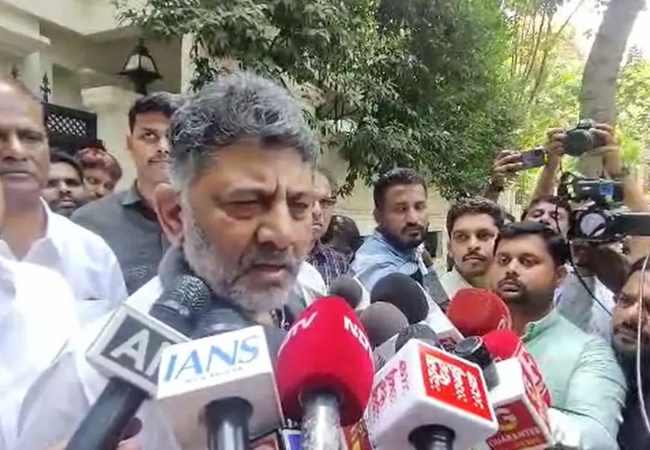
Bengaluru (PTI): Karnataka Deputy Chief Minister D K Shivakumar on Friday said he has no personal involvement in action taken against certain Congress leaders from the minority community following allegations of an internal conspiracy during the recently held Davanagere South bypolls.
He clarified that the decisions were taken by the party high command based on available reports.
Asserting that party discipline is of utmost importance, Shivakumar, who is also the Karnataka Pradesh Congress Committee (KPCC) president, sought to downplay concerns that action against minority leaders may send the message that “Muslims are being targeted.”
“I don’t have any personal involvement in this. Whatever decisions are taken are made by the party leadership. The party has its own reports. Decisions regarding MLAs or MLCs cannot be taken at the state level without instructions from Delhi,” he said.
Speaking to reporters, he added, “People may blame me; I am not concerned. Everyone must function in accordance with party discipline.”
Responding to concerns within sections of the party that recent actions may convey the impression that minority leaders are being targeted, he said the Congress exists for the welfare of Scheduled Castes, Scheduled Tribes, minorities, backward classes, farmers, and all sections of society.
The Congress has suspended MLC K Abdul Jabbar from primary membership and relieved another MLC, Naseer Ahmed, from the post of Chief Minister’s political secretary.
The action followed allegations by a group of Muslim leaders that certain party members conspired to defeat the official candidate in Davanagere South.
Following the action, speculation has emerged that Housing Minister B Z Zameer Ahmed Khan may also face disciplinary measures during the next cabinet reshuffle.
The three leaders had reportedly sought a Muslim candidate for the Davanagere South bypoll ticket, which the party instead allotted to the late MLA Shamanur Shivashankarappa’s grandson, Samarth Mallikarjun.
They were also said to have not actively participated in the campaign.
Shivakumar also rejected claims of factionalism within the ruling party amid speculation that leaders close to Chief Minister Siddaramaiah were being targeted.
Naseer Ahmed and Zameer Ahmed Khan are considered close to the CM.
Rejecting allegations of factionalism within the party, Shivakumar said, “We speak to each other every day. It is the media that creates divisions. Where is my faction? Has anyone put up a board saying they belong to the Siddaramaiah faction? Have I put up any such board?”
“All 139 legislators are my people, and they are all Siddaramaiah’s people as well. Everyone belongs to the Congress,” he added, saying there are no factions within the party and that such claims are media-driven.
Public Works Department (PWD) Minister Satish Jarkiholi met Shivakumar on Friday, a day after expressing concerns that disciplinary action against minority leaders may send the wrong message.
Shivakumar said he discussed with Jarkiholi the need to decongest Bengaluru traffic by diverting vehicles entering the city from state and national highways, along with party-related issues.
“We also discussed political matters in the interest of the party and the need to work together,” he said.
Later, speaking to reporters, Jarkiholi said he discussed with Shivakumar the issue of withdrawing Jabbar’s suspension. He said he will also visit New Delhi next week to meet the high command and discuss state developments.
“Jabbar’s suspension was discussed (with Shivakumar). It should be withdrawn. Let’s issue him a notice and allow him to reply. Then let’s send the report to the high command and seek their approval. High command approval is necessary because the instructions came from there. It may take some time,” he said.
Stating that he met the KPCC chief for “damage control,” the minister said, “We have tried to convince him. Sometimes certain decisions happen that need rectification.”
_vb_33.jpeg)