BC Road Commuters, Auto-Drivers in tizzy as police department suspends buses on service road
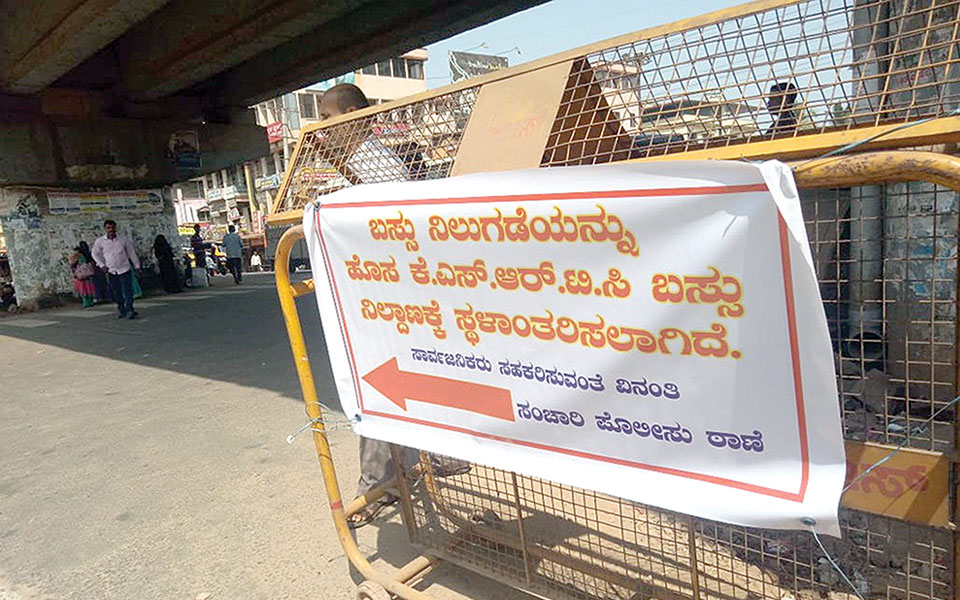
Bantwal: Local police has imposed ban on Government and Private buses from commuting on the service road in Bantwal, calling for protests and criticism from Passengers and Auto-Drivers.
The local police on March 12 had instructed the bus drivers without any prior notice to not commute through service road. The move had caused confusion and anguish among the locals for the sudden role out of the order.
The order had asked the bus drivers to commute through the fly-over and not through service road. The earlier route of the buses was through the service road towards private bus stand. However, the order issued by police instructed the drivers to commute through fly-over and halt near KSRTC bus stop.
Meanwhile, the auto-rickshaw drivers had also protested over the order claiming that it will impact their passenger count. PSI Sudhakar who was handling the matter had promised to provide three auto-rickshaw stands near the KSRTC bus stop.
Inconvenience to commuters:
The move had led to causing inconvenience to the commuters who earlier used to get down at service road/ private bus junction and would take auto to visit different vicinities and landmarks including court, police station, MESCOM, Agriculture, Horticulture department and other. The move will require them to get down on either of the two ends of the fly-over and walk towards their respective destinations.
Additional SP, Saidul Adavath, speaking on the matter added that the protests from the auto-drivers will be sorted through negotiations and separate auto-rickshaw stands will be provided near the KSRTC bus stand. He said the department will soon find solutions to the problems being faced by auto-drivers.
Shamsuddin, Auto-Driver’s union Vice President, added that the promises made by the police department should be fulfilled at the earliest failing which the union will protest against it.
“The public is not happy with the order, senior police officials don’t know our ordeal while they take decisions sitting in their offices. There was no problem in buses running on service road. It was helpful for us. The department should immediately revoke the order” Vasanth Kumar, a daily commuter of the bus on BC Road said.
Let the Truth be known. If you read VB and like VB, please be a VB Supporter and Help us deliver the Truth to one and all.
Belagavi youth’s murder case projected as road accident, cracked in Uttara Kannada; Three arrested

Karwar: Uttara Kannada police have cracked a murder case in which a Belagavi youth was killed and his body burnt inside a car to make it appear like a road accident.
Addressing a press meet in the city, Superintendent of Police Deepan M.N. said three accused from Old Hubballi have been arrested in connection with the case. The crime was a pre-planned act driven by personal enmity, he said.
The case came to light on April 8 morning when a car (KA-04/MJ-8996) was found completely burnt in a roadside ditch near Talekumbri bus stand in Yellapur. Only charred human remains were found inside the vehicle. Initially, it was suspected to be an accident caused by overspeeding, and a case was registered at Yellapur police station based on a complaint filed by the deceased’s father, Jagannath Dhapale.
However, the father later expressed suspicion that his son’s death was not accidental, prompting a detailed investigation.
Taking the matter seriously, two special teams were formed under the leadership of Yellapur Inspector Ramesh Hanapur. On analysing technical evidence and CCTV footage, police found that it was a planned murder.
The accused have been identified as Abdul Raheem Basheer Ahmed Mujawar (32), Maulasab Bavahan Wada (36) and Dadapeer alias Aftab Mehboob Saab Balasangi (22), all chicken traders from Old Hubballi.
Police have seized the car used in the crime along with two scooters. The accused have been remanded to judicial custody.
Investigations revealed that the accused killed Nitesh Dhapale due to personal enmity and later set the car on fire along with the body to project it as an accident.
SP Deepan M.N. appreciated the efforts of Inspector Ramesh Hanapur, PSIs Rajashekhar Vandali and Siddappa Gudi, and the entire team for solving the complex case.