Belthangady MLA Harish Poonja released on station bail after inquiry in two cases
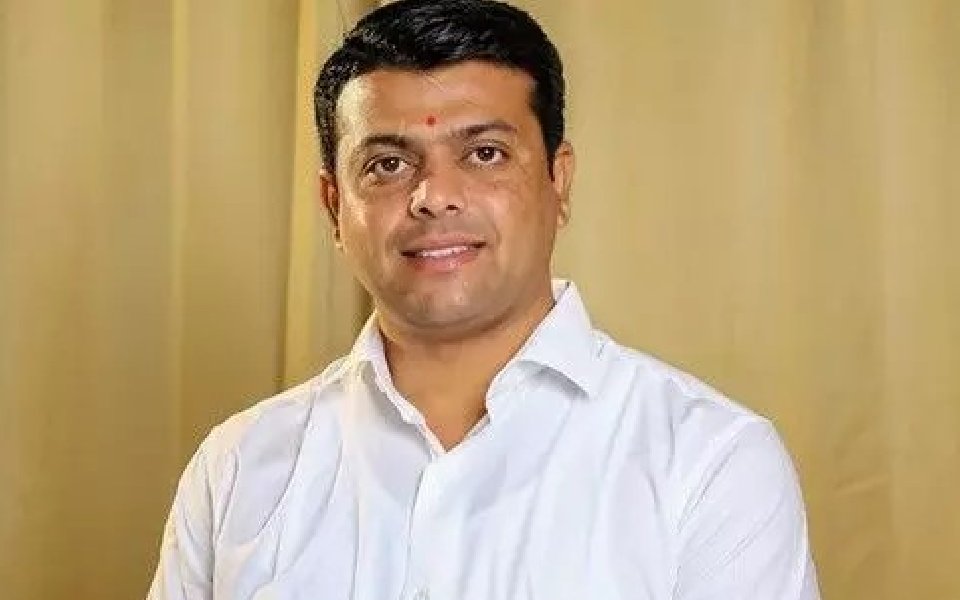
Belthangady: Legislator Harish Poonja, who had surrendered to the Belthangady Police on Wednesday night, was released on station bail a couple of hours later, after he submitted to police inquiry in connection to two cases against him.
Belthangady Police had registered a case against Poonja on May 19 for creating ruckus at the police station the previous night over the arrest of BJP Yuva Morcha president Shashiraj Shetty in an illegal quarrying case. A second case had been booked against the MLA on May 21 for having staged a protest without permission outside the Vikasa Soudha in Belthangady on May 20, opposing Shetty’s arrest.
The Belthangady Police officers visited Poonja’s residence in town on Wednesday for a questioning in the cases. As a safety measure, policemen were placed outside the house throughout the day.
A large number of BJP activists, including Dakshina Kannada MP Nalin Kumar Kateel and BJP MLAs, who suspected the arrest of the MLA, also gathered outside Poonja’s house and raised slogans against the Karnataka government. Poonja’s advocate Shambhu Sharma asked the police to issue a notice for the legislator to attend the inquiry.
Belthangady Police sent two notices to Poonja on Wednesday evening, summoning him for inquiry in the cases, after which, the legislator visited the police station with BJP District President Satish Kumpala and other leaders of the party. Post-inquiry, Poonja was released on station bail, the police officers have said.
Let the Truth be known. If you read VB and like VB, please be a VB Supporter and Help us deliver the Truth to one and all.
Paper leak mafia thriving under BJP's double-engine governments: Bhagwant Mann
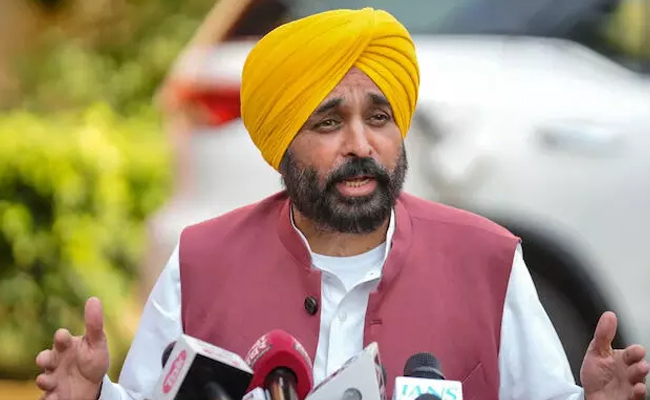
Shimla (PTI): Punjab Chief Minister Bhagwant Mann on Thursday slammed the Centre over the alleged NEET paper leak and said that such incidents are surfacing in regions governed by the BJP's 'double-engine' and 'triple-engine' governments.
He said the leak and cancellation of the National Eligibility cum Entrance test (NEET) 2026 examination is a major failure on the part of the Union government.
"This is not the first time that a paper leak has happened. Such incidents have surfaced in 2017, 2021, 2024, and now even in 2026 and every time, a CBI inquiry is initiated, arrests are made, yet after a short while, the accused are released on bail," he said.
Mann, who arrived at the Dharamshala Cricket Stadium to boost the morale of the Punjab Kings team ahead of their upcoming IPL match, told the media that lakhs of students toil day and night, harbouring dreams of transforming their families' fortunes, but when exams are cancelled due to paper leaks, these students are left heartbroken.
The NEET 2026 paper held on May 3 was cancelled on May 12 after reports of a paper leak in Rajasthan.
He said that the paper leak mafia is predominantly surfacing in regions governed by the BJP's 'double-engine' and 'triple-engine' governments. "Paper leaked, dreams shattered, the country's administrative system is unable to conduct even a single examination properly", he added.
Taking a dig at Prime Minister Narendra Modi, Mann said that while Modi imposes various restrictions on the public, he himself continues to embark on foreign tours.
He asserted that the public deserves to know the country's true economic situation.
"The prime minister must disclose the current status of the country's oil reserves, the extent of our gold reserves, and fundamentally why restrictions are being imposed on every single commodity", he said.
No other nation has imposed such restrictions and the ongoing war is being used as a pretext, even though the country's economy is already in a precarious state, Mann added.
Regarding the ongoing campaign against drugs in Punjab, Mann said that the state government is continuously taking action against drug traffickers and asserted that a large number of traffickers are being sent to jail and that Punjab will soon move towards becoming drug-free.
Speaking about the upcoming IPL match between Punjab Kings and Mumbai Indians to be held in Dharamshala, Mann said that he also holds the portfolio of Punjab's sports minister and has arrived in Dharamshala to cheer the team.