Bhatkal: Are BJP leaders ‘Unidentified’? FIR skips notable protestors, names only foot soldiers
Two FIRs registered in Sangh Parivar’s protests against SP M Narayan
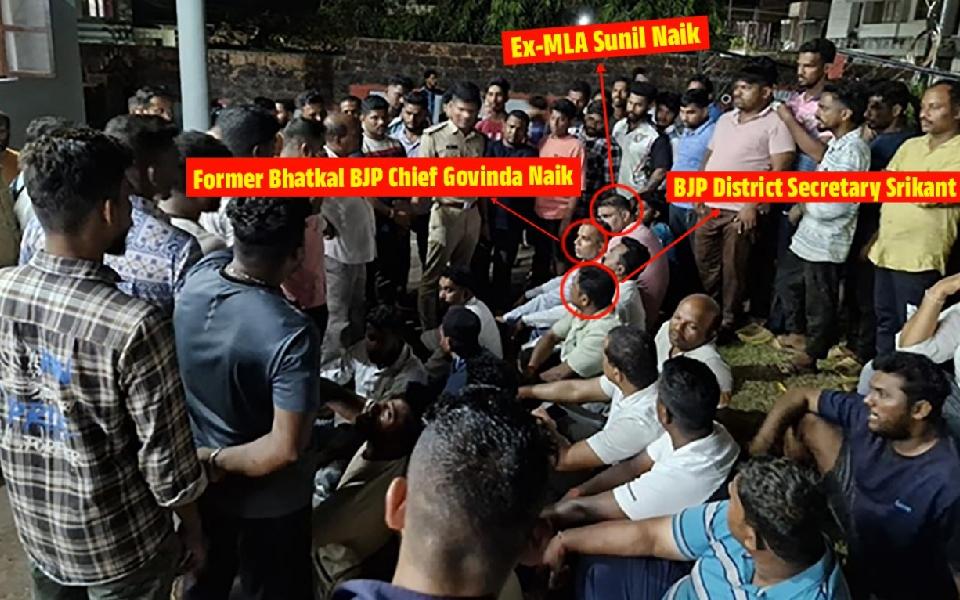
Bhatkal, April 12: In a development that has sparked serious questions about fairness and transparency in law enforcement, two FIRs registered at the Bhatkal Town Police Station in connection with the recent Sangh Parivar-led protests have conspicuously excluded the names of prominent BJP and Hindutva leaders who were very much present and leading the demonstrations.
On April 8 and 9, members of various right-wing groups staged aggressive protests in Bhatkal—first by blocking the National Highway 66 and later by gathering in front of the police station—after reports surfaced alleging that Uttara Kannada Superintendent of Police (SP) M. Narayan had manhandled Sangh activist Srinivas Naik during a rowdy-sheeter parade in Sirsi.
However, what stands out in the FIRs is not who is named—but who isn’t.
Despite photographic and video evidence clearly showing the presence of several senior leaders—including former Bhatkal MLA and BJP face Sunil Naik, former Bhatkal BJP President Govinda Naik, and known Hindutva leader and BJP's District Secretary Srikanth—the police have failed to mention their names. Instead, the FIRs include a list of lesser-known workers and dozens of conveniently labeled “unidentified individuals.”
This raises a very serious question: When top BJP and Sangh Parivar leaders are visibly leading the protest, how can they be passed off as ‘unidentified’?
Are the police, under pressure or willingly, shielding political figures with influence and clout? Are the law enforcement officers deliberately omitting the names of powerful individuals to avoid backlash or political consequences?
According to the FIR registered by PSI Naveen S. Naik, 11 names have been mentioned—none of whom are leading figures. The second FIR, filed by PSI Timmappa Bedumane, carries a similar pattern. Known leaders who are seen raising slogans and standing at the front lines of the protest are nowhere in the official records. Yet, the police have written off at least 60 protesters across both FIRs as “unidentified.”
When the police claim that they are scrutinizing CCTV footage and videos to identify protestors, one must ask—how do they manage to skip over the most visible faces leading the protest? These individuals are no strangers. They are seasoned politicians and activists who frequently appear in public forums and media.
Is this selective amnesia or selective protection?
At a time when the police are expected to act impartially and uphold the rule of law, such omissions dent public trust and raise doubts about the neutrality of those entrusted with enforcing the law.
Justice cannot and should not be divided between the powerful and the powerless. If FIRs can be drawn up against common workers, then the leaders guiding them must also be held accountable. The law must not just act—it must be seen to be acting without fear or favour.
If prominent faces are still being labeled as “unidentified,” then it is not just a failure of policing—it is a failure of honesty.
Let the Truth be known. If you read VB and like VB, please be a VB Supporter and Help us deliver the Truth to one and all.
Belagavi youth’s murder case projected as road accident, cracked in Uttara Kannada; Three arrested
Karwar: Uttara Kannada police have cracked a murder case in which a Belagavi youth was killed and his body burnt inside a car to make it appear like a road accident.
Addressing a press meet in the city, Superintendent of Police Deepan M.N. said three accused from Old Hubballi have been arrested in connection with the case. The crime was a pre-planned act driven by personal enmity, he said.
The case came to light on April 8 morning when a car (KA-04/MJ-8996) was found completely burnt in a roadside ditch near Talekumbri bus stand in Yellapur. Only charred human remains were found inside the vehicle. Initially, it was suspected to be an accident caused by overspeeding, and a case was registered at Yellapur police station based on a complaint filed by the deceased’s father, Jagannath Dhapale.
However, the father later expressed suspicion that his son’s death was not accidental, prompting a detailed investigation.
Taking the matter seriously, two special teams were formed under the leadership of Yellapur Inspector Ramesh Hanapur. On analysing technical evidence and CCTV footage, police found that it was a planned murder.
The accused have been identified as Abdul Raheem Basheer Ahmed Mujawar (32), Maulasab Bavahan Wada (36) and Dadapeer alias Aftab Mehboob Saab Balasangi (22), all chicken traders from Old Hubballi.
Police have seized the car used in the crime along with two scooters. The accused have been remanded to judicial custody.
Investigations revealed that the accused killed Nitesh Dhapale due to personal enmity and later set the car on fire along with the body to project it as an accident.
SP Deepan M.N. appreciated the efforts of Inspector Ramesh Hanapur, PSIs Rajashekhar Vandali and Siddappa Gudi, and the entire team for solving the complex case.