BJP MLA V Sunil Kumar accuses Congress of 'hindering' Udupi tourism development
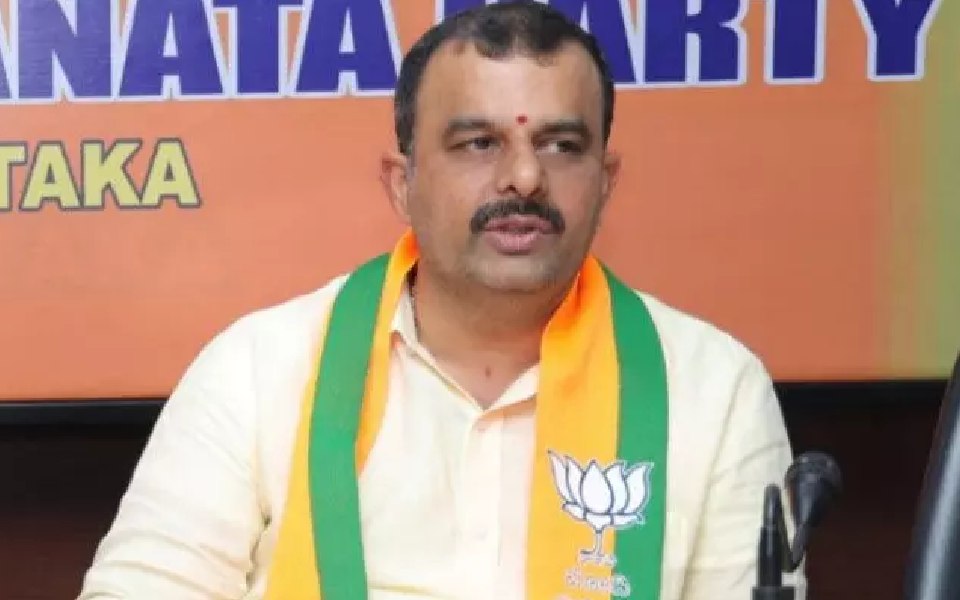
Karkala (Karnataka), Nov 13: Karkala BJP MLA V Sunil Kumar on Wednesday criticised the local Congress leadership and the state government for "obstructing" the progress of Karkala’s tourism project over the past year.
His remarks come in the wake of opposition from the Congress camp in Karkala, which raised questions about the authenticity of the 33-foot bronze statue of Lord Parashurama.
Speaking to reporters, Kumar, former Minister for Kannada and Culture, emphasised the importance of the Parashurama Theme Park, a project with administrative approval and funding of Rs 11.05 crore aimed at "boosting local tourism" in Karkala.
The park, located atop Umikkal Hill in Bailoor, Karkala, is seen as a unique stop for travellers journeying between Dharmasthala and Udupi.
Kumar accused Karkala Congress leaders and the state government of "blocking the initiative due to political motives", pointing out that Rs 4.33 crore of the allocated funds remains unreleased.
Addressing the controversy, Kumar explained that sculptor Krishna Naik, who was recently detained following a private complaint by Nallur Krishna Shetty, had sought permission from the district administration to realign the statue based on expert recommendations.
An evaluation by the National Institute of Technology Karnataka (NITK), Surathkal, had suggested minor adjustments in the statue’s alignment. With official approval, the statue was temporarily disassembled, but Congress leaders claimed that it was not constructed with bronze, Kumar alleged.
Kumar also noted that while the tourism department was supposed to release Rs 6.5 crore for the project, only Rs 2.67 crore has been disbursed. He expressed concerns over the release of the remaining funds, given the state’s current financial situation, which he argued is "stalling Karkala’s tourism development".
Rejecting allegations of corruption, Kumar reiterated that the statue was temporarily removed solely for minor alignment adjustments as recommended by NITK experts and will be reinstalled in due course.
Let the Truth be known. If you read VB and like VB, please be a VB Supporter and Help us deliver the Truth to one and all.
No contract was signed with Muzarabani for PSL stint, but verbal agreement was reached: PCB

Karachi (PTI): The Pakistan Cricket Board admitted that no contract was ever sent to Blessing Muzarabani to play in the PSL but insisted that a firm verbal agreement was reached with the Zimbabwe pacer and he had breached the trust while joining the Indian Premier League.
The PCB recently imposed a two-year ban on Muzarabani from playing in the PSL claiming he breached a contract with Islamabad United and joined IPL side Kolkata Knight Riders.
The fast bowler’s agent, Rob Humphries tore into the PCB on Sunday in a social media post for the ban and claimed his client neither took part in the PSL players auction nor signed any contract with Islamabad United.
Humphries said the ban was excessive and unjustified.
But sources in the PCB while conceding no contract was signed with Rabbani claimed that a clear verbal agreement between both the parties was reached.
The source said this was also clear in the PCB announcement about the ban that despite a clear offer and an unequivocal acceptance of essential terms, the player chose to disregard these obligations in favour of a conflicting arrangement.
The PCB source said once essential terms — including remuneration and structure — are agreed upon through written correspondence, a binding obligation is formed.
But Humphries said after talks began with Islamabad United they had made it clear that unless they had a contract they couldn’t apply for an NOC from the Zimbabwe Cricket.
“We've remained quiet publicly over the last six weeks because we did not wish to create or cause anymore animosity for the Pakistan Super League/Pakistan Cricket Board than they had already created for themselves,” Humphries’ statement said.
"[On] 13 February, Blessing [was] approached by Islamabad United about a playing opportunity for the 2026 PSL. The deal [was] agreed subject to obtaining a No Objection Certificate (NOC) from Zimbabwe Cricket.
“An NOC cannot be obtained without a contract from the PSL. Islamabad United/PSL announced the signing to the world via social media,” it said.
Humphries further urged the PCB to gracefully withdraw the ban and accept this situation risen out of an administrative error at their end.
Muzarabani was taken by Islamabad as a replacement for West Indian pacer Shamar Joseph for USD 40,000.