Central govt responsible for delay in fishing harbor development: JR Lobo
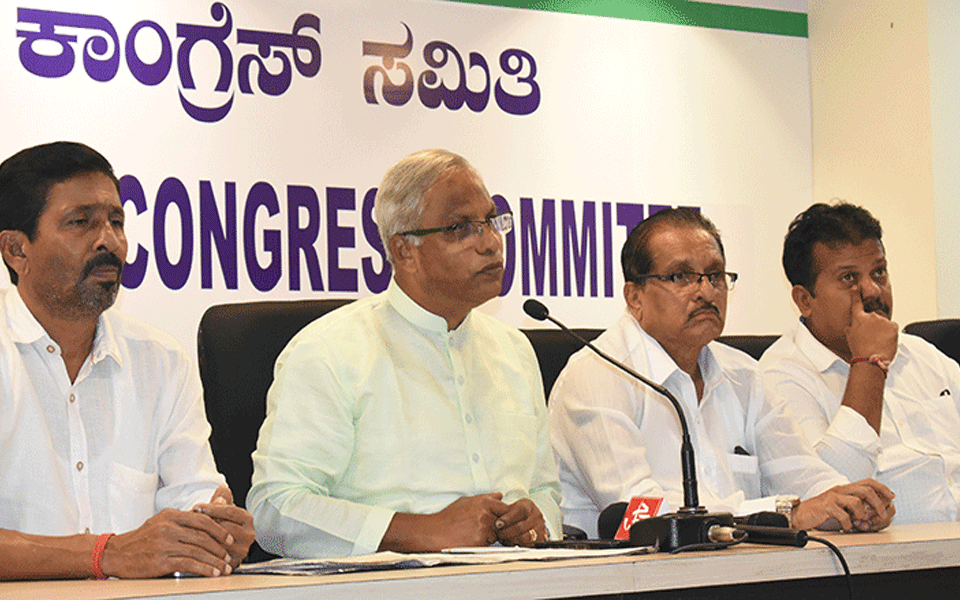
Mangaluru: Coming down heavily on central government, former MLA J R Lobo on Saturday said that the central government is responsible for the delay in the development of stage III of Mangaluru fishing harbour.
Addressing a press conference here, JR Lobo said, "Recently a daily newspaper carried an article saying that due to the rift between the central and the state government the development of stage III of Mangaluru fishing harbor is being delayed. There is no rift, but it is because of the central government that is delaying the release of funds.
"The foundation stone for the project was laid in the year 2010 and it was supposed to finish by 2015. But due to lack of support from the central government, it was not possible to complete it on time. The estimated cost of this project was Rs 57.60 crore and the central government's share was Rs 43.20 crore, and that of the state government Rs 14.40 crore,” he added.
"Out of the central government's share of Rs 43.20 crore, only Rs 13 crore has been released so far. There has been no response so far from the central government to the revised estimated cost of Rs 98.26 crore, which has made it difficult for the state government to move forward with this project," said J R Lobo.
Kallige Tharnath Shetty, Mahabala Maarla, TK Sudheer, Santosh Shetty, Neeraj Paul, Sabitha Misquith, Arif Bava and others were present.
Let the Truth be known. If you read VB and like VB, please be a VB Supporter and Help us deliver the Truth to one and all.
Delhi: Father, son held for killing 19-year-old woman in suspected honour killing

New Delhi (PTI): The Delhi Police has arrested a man and his son for allegedly murdering his 19-year-old daughter in west Delhi's Hari Nagar area, an official said on Friday.
The case first came to light on April 1 after a PCR call was received around 2 pm, alleging that a woman had been killed by her family members and her body was being taken for last rites, he said.
The accused, identified as Mohammad Maneer (55), a vegetable vendor, and his son Meraj Ali (19), were arrested in connection with the case, the officer said.
The victim had been in a relationship with a man from her native place for the past two years, which was opposed by her father, Maneer and brother Meraj, he said.
"When the girl did not end the relationship despite objections, the family killed her," the officer said.
On April 1, the police said that when their team reached the spot, they found that the woman's body was being taken for burial.
Acting on the input, the burial process was stopped over suspicion of honour killing.
"Police intercepted the family members and took possession of the body," he said.
Police said that the man who had made the PCR told them that the woman was in love with his cousin.
During the inquiry, police also interacted with the PCR caller, who said his cousin, a friend of the deceased, had informed him about the situation and suspected foul play, prompting him to alert the police control room.
The body of the woman was subsequently shifted to the mortuary of Deen Dayal Upadhyay Hospital for preservation and postmortem.
Police said that both the crime team and the forensic science laboratory (FSL) team were called to inspect the scene and collect evidence.
Police said that, as per the postmortem report, the cause of death was identified as smothering, indicating that the woman was suffocated.
A preliminary inquiry also revealed that the family had initiated preparations for the last rites soon after the woman's death, raising suspicion about the circumstances.
Initial investigation pointed to the family's opposition to the woman's relationship.
"The family members of the woman saw her with the man, and she was taken back home. We got to know that she was beaten up and even locked inside the house for some days," a source said.
Further investigation into the matter is underway, police added.