Decades-old crocodile of Sri Ananthapadmanabha Swamy temple in Kasaragod dead

Kasaragod (Kerala) (PTI): A decades-old lone crocodile, claimed to be a vegetarian, that inhabited the lake at the Sri Ananthapadmanabha Swamy temple here and often found roaming inside its premises was found dead late on Sunday night.
Temple officials told PTI that the crocodile, fondly called Babia, was missing since Saturday. Thereafter, the carcass was found floating on the lake around 11.30 pm on Sunday night and the same was conveyed to the police and the animal husbandry department, temple officials said.
The carcass was removed from the lake and put on public display as hundreds of people, including politicians, turned up on Monday for a last glimpse of the crocodile.
Temple officials claimed the crocodile was a vegetarian which subsisted on the 'prasadam' made there.
Union Minister of State for Agriculture and Farmers' Welfare Shobha Karandlaje said she hoped that the "God's own crocodile", which lived at the temple for over 70 years, attains 'sadgati' or salvation.
"Babiya, the god's own crocodile of Sri Anantapura Lake temple has reached Vishnu Padam. The divine crocodile lived in the temple's lake for over 70 years by eating the rice & jaggery prasadam of Sri Ananthapadmanabha Swamy & guarded the temple. May she attain Sadgati, Om Shanti!," she tweeted.
BJP state president K Surendran also paid tribute to the crocodile in a Facebook post. "Babiya has left. For decades, was a constant presence at the Kumbla Ananthapuram Mahavishnu temple. Millions of devotees sought its darshan, considering it as the image of God. Pranamam," he said.
Temple officials said that the carcass of the crocodile would be buried before Monday noon in a pit nearby.
The Mahavishnu temple is located at Ananthapura near Kumbla in the northern Kerala district of Kasaragod. The temple is known as the 'moolasthanam', the original source, of the Sri Anantha Padmanabha Swamy temple of Thiruvananthapuram, according to its website.
The temple's website also claims that a "very unusual phenomenon" there was the presence of a single crocodile in the temple lake, named 'Babia'.
"By tradition, the lake is inhabited by a single crocodile and in the memory of the very aged men the present crocodile happens to be the third one they have seen. When one crocodile dies another one inevitably appears in the lake and this continues to be an unexplained phenomenon," the website stated.
"There is no river or pond nearby where crocodiles exist. The crocodile is friendly and harmless to human beings. Its presence in the lake around the Mahavishnu temple reminds one of the well-known Gajendra Moksha stories in the Bhagavatha Puranam," it further said.
Let the Truth be known. If you read VB and like VB, please be a VB Supporter and Help us deliver the Truth to one and all.
Accused gunman at correspondents' dinner was believed to be targeting top officials, Blanche says
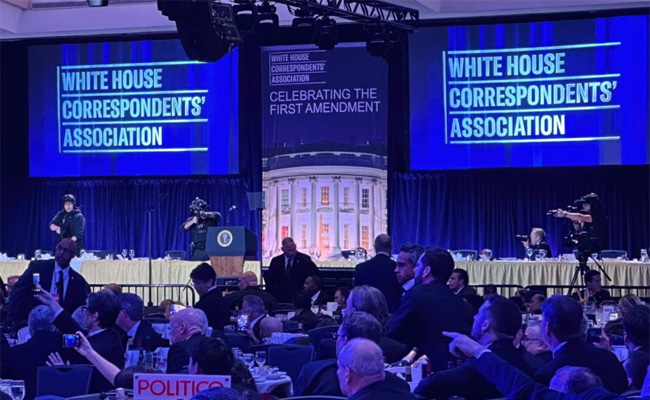
Washington (AP): The accused gunman who tried to storm the ballroom at the White House Correspondents' Association dinner with guns and knives travelled across the country before the event and is believed to have been targeting members of the Trump administration, acting Attorney General Todd Blanche said Sunday.
Blanche also said officials believe the suspect traveled by train from California to Chicago and then on to Washington, where in recent days he checked in as a guest to the hotel where one of Washington's glitziest events was being held Saturday night.
Investigators have not publicly named the suspect, but two law enforcement officials familiar with the matter have identified him to The Associated Press as 31-year-old Cole Tomas Allen of Torrance, California.
Law enforcement officials who have examined the gunman's electronic devices and his writings preliminarily believe he intended to target administration members in attendance at the dinner. He attempted to charge into the cavernous ballroom at the Washington Hilton but was tackled to the ground in a chaotic scene that resulted in shots being fired, President Donald Trump being hurried off the stage and guests ducking for cover beneath their tables.
“It does appear that he did in fact set out to target folks who work in the administration, likely including the president,” Blanche told NBC's “Meet the Press.”
The suspect is believed to have purchased the firearms he carried within the last couple of years, Blanche said. He is not being cooperative and is expected to face multiple charges on Monday.
Video posted by Trump showed the suspect running past security barricades as Secret Service agents ran toward him. One officer was shot in a bullet-resistant vest but was recovering, officials said. The gunman was taken into custody and was not injured, but was being evaluated at a hospital, police said.
“He failed,” Blanche said on CBS's “Face the Nation.” “Law enforcement did their jobs.”
Social media posts that appear to match the suspect show he is a highly educated tutor and amateur video game developer.
A May 2025 profile photo of Allen appears to match the appearance of the man in a photo of the alleged attacker being taken into custody that was posted Saturday night by Trump. The photo, posted to the social networking site LinkedIn, shows him in a cap and gown after graduating with a master's degree in computer science from California State University, Dominguez Hills.
Allen earned a bachelor's degree in 2017 in mechanical engineering from the California Institute of Technology in Pasadena. He listed his involvement there in a Christian student fellowship and a campus group that battled with Nerf guns.
The shooting at the security barricades happened minutes after the event got underway.
The Secret Service and other authorities swarmed the room as guests ducked under tables by the hundreds. Gasps echoed through the ballroom as guests realized something was happening. Hundreds of journalists immediately got on phones to call in information.
“Out of the way, sir!” someone yelled. Others yelled to duck. From one corner, a “God Bless America” chant began as the president was escorted offstage. Outside the hotel, members of the National Guard and other authorities flooded the area as helicopters circled overhead.
After an initial attempt to resume the event, it was scrapped for the night and will be rescheduled.
_vb_69.jpeg)