Does Indian law allow Euthanasia? Mangaluru's Dr. Haroon shares his thoughts after SC's recent order
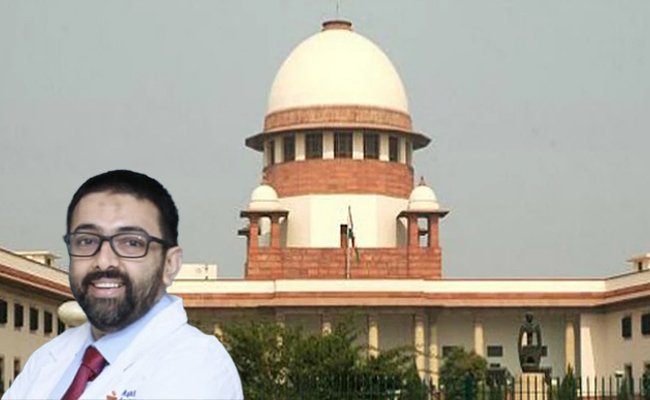
Mangaluru: The recent Supreme Court order allowing passive euthanasia for a 32-year-old man who has been in a coma for more than 12 years has brought renewed discussion on the legal and medical framework surrounding end-of-life decisions in India.
Speaking about the issue, Dr. Haroon, a leading physician in Mangaluru who practices in the Department of Internal Medicine at KMC Mangaluru, explained the ethical principles, legal safeguards and procedures involved when such decisions are considered.
Ethical principles behind end-of-life decisions
Dr. Haroon said that medical decisions in such situations are guided by three important ethical principles: autonomy, beneficence and non-maleficence.
Autonomy refers to the patient’s right to make decisions about their own medical care. Beneficence requires doctors to act in the best interest of the patient, while non-maleficence means avoiding harm.
He pointed out that these principles are closely linked to the Right to Life guaranteed under Article 21 of the Constitution of India.
Legal status of euthanasia in India
According to Dr. Haroon, euthanasia itself is not permitted in India. However, passive euthanasia is allowed under strict legal guidelines laid down by the Supreme Court.
In many cases, patients may remain alive but exist in what doctors describe as a vegetative state, where basic bodily functions continue but there is no meaningful brain activity or possibility of recovery.
Dr. Haroon said that in such situations doctors may assess the “futility of care”, meaning that continued medical treatment may not improve the patient’s condition and there may be no chance of revival.
Role of a living will
Dr. Haroon emphasised that the best way for individuals to express their wishes in advance is through a living will.
A living will is a written document in which a person states what medical treatment they would or would not want if they lose the ability to make decisions in the future.
“If I were to lose my decision making ability,” a living will allows the patient’s wishes to be respected, he said.
He described the living will as the best way to ensure that a person’s preferences regarding life support and medical treatment are followed.
Next of kin and medical boards
In cases where a living will is not available, Dr. Haroon said that decisions may be taken with the involvement of the patient’s next of kin.
He explained that a primary medical board will examine the patient’s condition and give its opinion within 48 hours.
After this, a secondary medical board will independently review the situation.
The secondary board must include one member nominated by the Chief Medical Officer of the district.
Judicial oversight
Dr. Haroon also noted that the process involves legal oversight. Once the medical boards complete their assessment, the matter must be notified to a Judicial Magistrate.
According to him, the entire process generally takes around four to five days.
He added that if any conflict or disagreement arises during the process, the matter can be reviewed by the High Court.
Let the Truth be known. If you read VB and like VB, please be a VB Supporter and Help us deliver the Truth to one and all.
SC notice to Centre on PIL against Muslim personal law sections being 'discriminatory' against women
New Delhi (PTI): The Supreme Court on Thursday sought the Centre's response on a PIL challenging the constitutional validity of certain provisions of the Muslim Personal Law (Shariat) Application Act, 1937, on the ground that those are allegedly discriminatory against women.
A bench of Chief Justice Surya Kant and Justices Joymalya Bagchi and Vipul M Panchol took note of the submissions made by lawyer Prashant Bhushan, who appeared in the matter for petitioners Poulomi Pavini Shukla and the Nyaya Naari Foundation, and issued a notice to the Union Ministry of Minority Affairs.
The plea says the current Shariat inheritance rules are "manifestly discriminatory" against women, often granting them only half or less of the share allocated to their male counterparts.
Bhushan said the 1937 Act violates Article 14 (right to equality) of the Constitution.
He said matters of succession are civil in nature and do not constitute an "essential religious practice" protected under Article 25.
"Saying women will get half or even less than half compared to male counterparts is discriminatory," the lawyer said.