Don’t uproot plants brought from Hyderabad: MLA Ashok Rai appeals to public
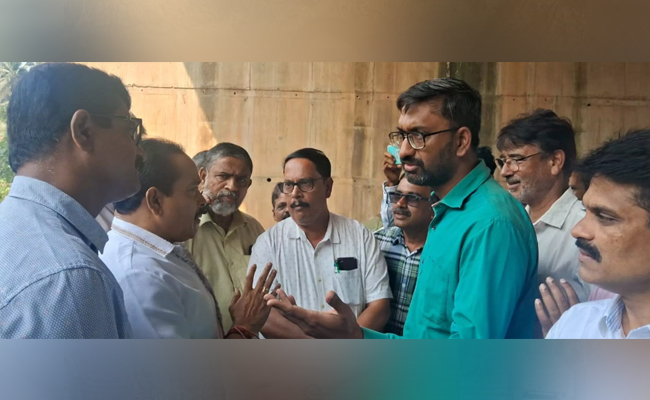
Puttur: MLA Ashok Kumar Rai appealed to the public not to uproot flower plants brought from Hyderabad, which have been planted along the divider on the Puttur-Uppinangady road. In a public appeal on Saturday, he requested people to refrain from damaging these plants, mats, and water pipes and instead support the development efforts in the area.
The appeal was made during an inspection of the Puttur-Uppinangady road project along with officials from the Forest and Social Forestry departments and the Public Works Department (PWD). Speaking to the media, Ashok Kumar Rai stated that a budget of Rs 20 crore has been sanctioned for developing this road, aiming to make it a model project.
Requesting people to avoid tampering with the plants, he urged the public to report anyone damaging them by capturing photos and submitting them to the police.
He also informed that road repairs between Berike and Nekkiladi had been impacted by recent rains, but contractors would soon complete the necessary repair and maintenance work. Additionally, the Bolwar-Harady, Sediapu-Kodimbady, and Nekkiladi sections will begin work on the four-lane expansion later this year.
He further added that an additional request for Rs 5 crore has been submitted to the government for installing street lights along the divider, with the aim of completing a fully developed four-lane road between Puttur and Uppinangady.
Accompanying him during the inspection were PWD Assistant Executive Engineer Rajaram, Assistant Engineer Tausif, Social Forestry Officer Vidya Rani, Deputy Forest Officer Yashodhara K., and several local leaders.
Let the Truth be known. If you read VB and like VB, please be a VB Supporter and Help us deliver the Truth to one and all.
8 children between ages of 1 and 14 dead after mass shooting in Louisiana, police say

Shreveport(US) (AP): A gunman in Louisiana killed eight children in shootings at two different homes early Sunday in the nation's deadliest mass shooting in more than two years, police in Shreveport said.
The victims ranged in age from one to about 14 years old, said Shreveport police spokesperson Chris Bordelon. A total of 10 were shot and some of the children were related to the suspect, Bordelon said.
The gunman later died after a chase with officers who fired at the suspect, Bordelon said. The suspect stole a car while leaving the scene of the shootings and was followed by police, according to Bordelon.
Police did not release the name of the suspect but did say he was an adult male. The shootings were the result of a “domestic disturbance,” Bordelon said.
Officials said they were still gathering details at the crime scenes south of downtown Shreveport — the two homes and a third location.
“This is an extensive scene unlike anything most of us have ever seen,” he said.
It was the deadliest mass shooting in the US since eight people were killed in a Chicago suburb in January 2024, according to a database maintained by The Associated Press and USA Today in partnership with Northeastern University.
At a news conference outside the residence where one of the shootings occurred, officials appeared stunned, requesting patience and prayers from the community as they sorted through multiple crime scenes.
“I just don't know what to say, my heart is just taken aback,” Shreveport Police Chief Wayne Smith said. “I cannot begin to imagine how such an event could occur.”
“This is a tragic situation — maybe the worst tragic situation we've ever had,” said Tom Arceneaux, mayor of the city in northwestern Louisiana with about 180,000 residents. “It's a terrible morning.”
Louisiana State Police say their detectives have been asked by Shreveport police to investigate. In a statement, state police say no officers were harmed in the shooting that involved an officer after a police pursuit into Bossier City on Sunday morning.
State police are asking anyone with pictures, video or information to share it with state police detectives.
Louisiana Gov Jeff Landry said in a statement that he and his wife were heartbroken. “We're deeply grateful to the law enforcement officers and first responders working tirelessly on the scene,” he added.