List of 132 martyrs from Karnataka who laid down their lives during 1857 War of Independence
Compiled by: Dr. Shamsul Islam
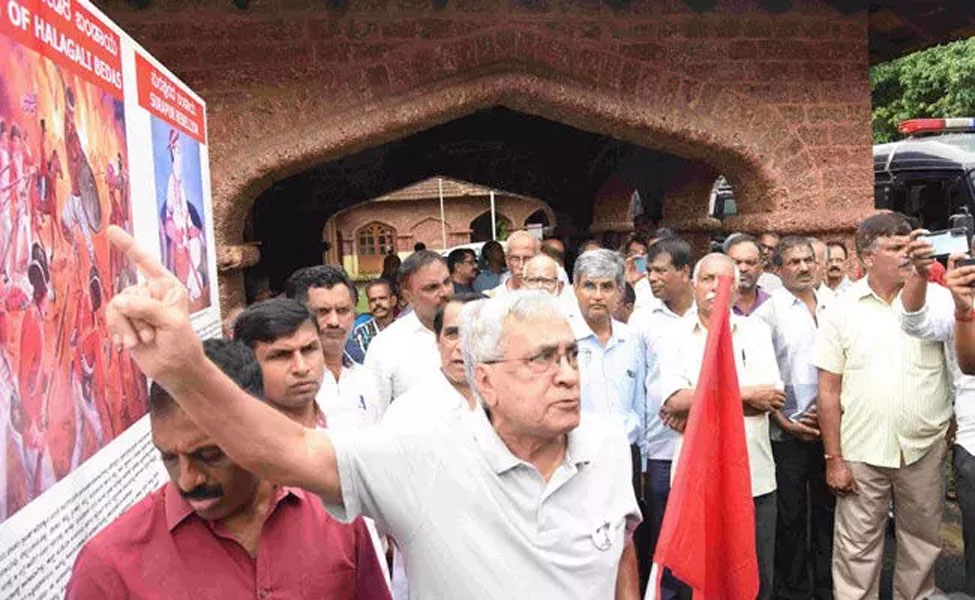
Mangaluru: Many parts of India, including parts of Kananda-speaking states, witnessed revolts against the British Raj following the mutiny of 1857. The following 132 names of the martyrs of the 1857 War of Independence are from Karnataka (hundreds of martyrs remain unaccounted for). These included Hindus-Muslims-Sikhs as well as people of all Castes and sections, women included. These names have been gathered from Dictionary of Martyrs: India’s Freedom Struggle 1857-1947, v. 5, Ministry of Culture, Government of India & ICHR, 2018. It is based on contemporary British official documents including ‘Mutiny Records’. This list has been compiled by Dr. Shamsul Islam, former Associate Professor of Delhi University, and published as a Poster during the BV Kakkilaya Oration 2023, held at University College, Mangalore on September 9, 2023.
Koppala Durga (Fort) Battle 1858
The bloodiest anti-British rebellion was at Koppala Fort under the leadership of Bhima Rao Nadagouda, also known as Mundaragi Bhima Raya. Bhima Raya was born as the son of Ranga Rao, Tehsildar of Bellary. Bhimaraya himself served as a Mamledar (a land revenue official) in Bellary, Hoovina Hadagali, and Harapana Halli. He could not stand the exploitation of peasantry under British rule and he was finally dismissed from his position as a result of his protests against the British exploitation of the peasantry. He led the anti-tax propaganda in Dharwad and urged people to join the anti-British movement. In 1857, he gathered 300-400 people and planned a revolt at Hammigi.
However, he had to hold the plan as the information leaked and the District Collector got to know about their plan. He was a friend of Nana Saheb and the latter urged him to revolt in his letters.
He contacted various groups of Beda fighters and started accumulating arms and creating ammunition dumps at various places. He organized an anti-British alliance of patriotic chiefs like Kenchan Gowda Sirnagowda of Govenkop, Srinivas Desai of Dumbal, and Bhaskar Rao Bhave of Nargund, and raised an army of over 3,000 soldiers. On 23 May 1858, the founder of Dambal raided one such arms cache of Kenchan Gowda at Hammigi and sealed it. Rao and his comrade Soratur Desai gathered supporters and marched on Hemmigi took back all the arms and ammunition and shifted to a safer place in Shirahatti. Then he started raiding British armories in various places. Many local landowners and kings supported Bhimaraya and joined him in the revolt. When the British took Bhimaraya’s wife and kids as hostages, Bhimaraya came with his army freed his family went to the fort in Koppal, and prepared to fight with a large stock of food, arms, and ammunition. By May 30, they and Kenchan Gowda had fled to Koppal Fort after killing the security guards, looting the weapons, and attacking the treasuries at Dambal and Gadag. British gathered a large force from their stations at Dharwad, Raichur, Hyderabad, and Bellary and marched on Koppal fort. After a fierce fight, Bhimaraya fell to the bullets on 1 June 1858. British carried out brutal reprisals against Bhimaraya’s associates and supporters.
Martyrs of the Koppaladurg Battle 1858
- Bhim Rao Nadgowda: Mundargi, Gadag. Leader. Fell at the battleground after gallant resistance and died on 1 June 1858.
- Kenchan Gowda Sirnagowda: Hammigi, Mundaragi, Gadag. Leader. Killed during the battle near the gateway of the fort on 1 June 1858.
Captured by the British during the battle, sentenced to death, and shot dead by firing squad or blown away with a cannon in June 1858
- Bala Saheb: Kurlahalli, Mundargi, Gadag
- Baramappa: Kurlahalli, Mundargi, Gadag.
- Barma: Kurlahalli, Mundargi, Gadag.
- Bani Saheb: Hammigi, Mundargi, Gadag.
- Barmappa: Nowli, Hadagali, Ballary.
- Basava: Mundwad, Mundargi, Gadag.
- Basavanna: Navalagund, Dharwad.
- Basayya: Kurlahalli, Mundargi, Gadag.
- Basayya: Wadarhatti, Mundargi, Gadag.
- Basayya Talari: Tahrargi, Mundargi, Gadag
- Bawa/Baba Saheb: Kurlahalli, Gadag.
- Beemah: Kurlahalli, Mundargi, Gadag.
- Beemnah: Hammigi, Mundargi, Gadag.
- Bassya: Kundgul, Dharwad.
- Bhim: Kurlahalli, Mundargi, Gadag.
- Bhima: Kukanur, Yelburga, Koppal.
- Bhima: Kurlahalli, Mundargi, Gadag.
- Bhimanna: Kurlahalli, Mundargi, Gadag.
- Bhimappa: Hirenandihal, Koppal.
- Burmah: Kurlahalli, Mundargi, Gadag.
- Channappa: Betageri, Gadag.
- Chenna: Singtalur, Mundargi, Gadag.
- Chunia Virappa: Hammigi, Mundargi, Gadag.
- Daud Saheb: Venkatapur, Mundargi, Gadag.
- Durga: Kurlahalli, Mundargi, Gadag.
- Ella: Hammigi, Gadag.
- Eman Saheb: Kurlahali, Mundargi, Gadag.
- Fakeer Saheb: Kurlahali, Mundargi, Gadag.
- Girianna: Kurlahali, Mundargi, Gadag.
- Gograppa: Hemmigi, Mundargi, Gadag.
- Gograppa: Kurlahalli, Gadag.
- Gurda: Hesarur, Mundargi, Gadag.
- Hamid Sahib: Kurlahalli, Mundargi, Gadag.
- Hammanna: Hesarur, Mundargi, Gadag.
- Hanagowda: Gangapur, Mundargi, Gadag.
- Hanumanna: Kurlahalli, Mundargi, Gadag.
- Hareah Saheb: Kurlahalli, Mundargi, Gadag.
- Hayat Saheb: Kurlahalli, Mundargi, Gadag.
- Hayat Saib: Bannur, Koppal
- Hiriyappa: Hesarur, Mundargi, Gadag.
- Hulgia: Kurlahalli, Mundargi, Gadag.
- Hunma: Waddarhatti, Mundargi, Gadag.
- Hunnamah: Kurlahalli, Mundargi, Gadag.
- Hussun Saib: Kurlahalli, Mundargi, Gadag
- Jivan Sahib: Hammigi, Mundargi, Gadag.
- Junah: Hammigi, Raichur.
- Kajah: Kurlahalli, Mundargi, Gadag.
- Karka: Kurlahalli, Mundargi, Gadag.
- Karka: Hammigi, Mundargi, Gadag.
- Karyanna: Hammigi, Mundargi, Gadag.
- Lakshmana: Kurlahalli, Mundargi, Gadag.
- Latchma: Bagewardi, Gadag.
- Laxmana: Bagewadi, Mundargi, Gadag.
- Linga: Hammigi, Mundargi, Gadag.
- Linga: Harpanahalli, Bellary.
- Linga: Kurlahalli, Mundargi, Gadag.
- Madarangah: Hesarur, Mundargi, Gadag.
- Malliah: Waddarhatti, Mundargi, Gadag.
- Mudallaner: Kuran, Koppal.
- Mulla (II): Kurlahalli, Mundargi, Gadag.
- Mulla (I): Kurlahalli, Mundargi, Gadag.
- Peeru: Hesarur, Mundargi, Gadag.
- Pongari: Kurlahalli, Mundargi, Gadag.
- Punee Saheb: Hammigi, Gadag.
- Ramannah: Singatalur, Mundargi, Gadag.
- Ranga (II): Kurlahalli, Mundargi, Gadag
- Ranga (I): Kurlahalli, Mundargi, Gadag.
- Sahib Husain: Kurlahali, Mundargi, Gadag.
- Shidda: Bagwadi, Mundargi, Gadag.
- Syed Budin: Bankapur, Haveri.
- Tammanna: Kukanur, Yelburga, Koppal.
- Tammayya: Hesarur, Mundargi, Gadag.
- Timma: Kurlahalli, Mundargi, Gadag.
- Tummanah Talari: Hesarur, Mundargi, Gadag.
- Ukunda: Kurlahalli, Mundargi, Gadag.
- Urvee: Hammigi, Mundargi, Gadag.
- Vallabhadas: Bagewadi, Mundargi, Gadag.
- Veerappa: Raichur.
- Vobul Doss: Begewadi, Gadag.
- Yalya: Hammigi, Mundargi, Gadag.
- Yllya: Hammigi, Mundargi, Gadag.
- Balakristayya: Bhalki, distt. Bidar is a descendant of the royal family of Satara. Captured by the British and sentenced to transportation for life, died in penal servitude.
Nargund Revolt
The principality of Nargund was under British overlordship and Bhaskar Rao Bhave also known as Baba Saheb rose to the throne of Nargund in 1842. As he did not have a son, he wanted to adopt one to create an heir for Nargund. The British refused permission and this enraged Baba Saheb and he got in touch with several rulers in Karnataka like Mundaragi Bhimaraya, Surpur Venkatappa Nayaka, the Desais of Hammigi, Dambal, Soratur, and many others. He was aware of the North Indian uprising and wanted to time his revolt in June of 1857. However, he postponed the date at the last moment.
In May 1858 when the British sent a force to prevent his networking with other rulers, he attacked them and brought the decapitated head of Officer Manson, the head of the British force sent to suppress him, to his fort and displayed it to the people. The British army marched to Nargund Fort on 1st June.
Baba Saheb, upon realizing the treachery of his close associates sought help from Bhimrao and Kenchan Gowda. But they were busy fighting the British at Koppal. The British force killed around 70 men and burned the possessions of Saheb. Though he escaped from the fort, he was later captured at Toragal forest. He was tried and hanged at Haystack Hill at Belgaum on 12 June 1858.
Martyrs of Naragund Revolt
- Bhaskar Rao Bhave: Ruler of Nargund Princely State, Gadag. Revolted against the British for the question of adoption, murdered S. J. Manson. He was caught and hanged at Haystack Hill at Belgaum on 12 June 1858.
- Vishnu Hirekoppa alias Vishnu Kulkarni: Hirekoppa, Nargund, Gadag. Reported to have beheaded the British Officer, Manson, at Sureban on the night of 29 May 1858. Hirekoppa was captured and hanged publicly at Nargund in 1860.
- Srinivas Veenkatadri Desai: Dumbal, Gadag. Joined the Chief of Nargund, Bhimrao Mundargi, and others on 24 May 1858. Caught and blown away with a gun on 12 June 1858.
- Bapu: Nargund, Gadag. He was Naik (leader) of the Shetsanadis of Nargund. On the charge of assisting the Chief of Nargund in his rebellion against the British, he was caught on 10 June 1858 and hanged in front of the Petah of Nargund.
- Arjun: Nargund, Gadag. Arrested and hanged on 24 June 1858 in front of the Petah of Nargund.
- Basappa: Nargund, Gadag. Arrested and shot dead by firing squad at Nargund on 10 June 1858 at 5 p.m.
- Basappa: Amargol, Nargund, Gadag. Caught on 18 June 1858 and hanged in front of the Petah of Nargund
- Basappa Sindagi: Nargund, Gadag. Arrested and shot dead by musketry at Nargund on 12 June 1858.
- Basappa Tambe: Nargund, Gadag. Caught and hanged at a public place at Dharwad in June 1858.
- Bhawani Singh: Koppal, Kiledar of Koppal. Captured and shot dead
- Fakir Mohammad: Nargund, Gadag. Arrested, shot dead by firing squad at Nargund on 10 June 1858 at 5 p.m.
- Faras Khan: Nargund, Gadag. Arrested, shot dead by firing squad at Nargund on 10 June 1858 at 5 p.m.
- Gangadhar Chintamun alias Anna Sahasrabudhe: Nargund, Gadag. He was a Clerk in the Nargund Princely State; aged 24. Arrested, hanged to death at a public place at Dharwad in June 1858.
- Govind Dhanagar: Nargund, Gadag. Arrested and shot dead by firing squad at Nargund on 12 June 1858.
- Govind Narayan Parachure alias Anna Parachure: Nargund, Gadag. Arrested and hanged at Dharwad in June 1858.
- Guddu: Nargund, Gadag. Arrested, shot dead by firing squad at Nargund on 10 June 1858 at 5 p.m.
- Hanumant Ghatage: Nargund, Gadag. Arrested and shot dead by firing squad on 28 June 1858.
- Hanumanta: Nargund, Gadag. Captured and hanged at Dharwad in the last week of June 1858.
- Imam Ismail: Nargund, Gadag. Shot dead by musketry at Nargund on 10 June 1858 at 5 p.m.
- Kallappa: Shirole, Nargund, Gadag. Captured and shot dead by firing squad on 28 June 1858
- Laxman Janardan: Nargund, Gadag arrested and shot dead by musketry at Nargund on 10 June 1858 at 5 p.m.
- Linga: Nargund, Gadag. Arrested on 18 June 1858 and hanged in front of the Petah of Nargund.
- Piraji: Nargund, Gadag. Captured, shot dead by firing squad at Nargund on 10 June 1858 at 5 p.m.
- Raghoba Limaya: Nargund, Gadag. Arrested and hanged in front of the Petah of Nargund on 16 June 1858 at 6 p.m.
- Rehaman Khan: Nargund, Gadag. Arrested and charged with waging war against the British between 24 May and 2 June 1858, was shot dead by firing squad at Nargund on 12 June 1858.
- Raju: Nargund, Gadag. Arrested and hanged on 24 June 1858 in front of the Petah of Nargund.
- Ramappa: Nargund, Gadag. Captured, shot dead by firing squad at Nargund on 10 June 1858 at 5 p.m.
- Shankrappa Desai: Kalas and Madathi, Nargund, Gadag. Arrested and hanged on 24 June 1858 in front of the Petah of Nargund.
- Tammanna: Nargund, Gadag. Captured and shot dead by firing squad on 28 June 1858.
- Timmappa alias Rangappa Mazumdar: Nargund, Gadag. Captured and hanged by neck on 28 June 1858.
- Tukaram: Nargund, Gadag. Captured and shot dead by firing squad at Nargund on 10 June 1858 at 5 p.m.
- Venkappa Naik: Nargund, Gadag. Arrested, and hanged on 24 June 1858 in front of the Petah of Nargund.
- Vyanakatrao Bhosle: Nargund, Gadag. Arrested and shot dead by firing squad on 28 June 1858.
- Bhikajipant Ganesh Gokhale: Nargund, Gadag. Arrested and sentenced to transportation beyond the Sea for life. He was deported to the Andaman Islands where he died in custody.
Bedas of Halagali
Bedas were one of the fighting tribes that fought the British tooth and nail from the 1820s and formed the backbone of many uprisings in the Deccan.
Bearing arms to protect themselves and the community and their king was part of their life and they did it with great pride. The prince of Mudhol had accepted British overlordship and the Bedas in the area were seething with dissatisfaction. The East India Company announced on 11 September 1857 that all Indians should disarm, submit their arms to the company and then get licences to carry arms.
This was simply out of the question for Bedas. Hence when the Company Sarkar’s edict was sought to be implemented by the King of Mudhol principality, the Bedas of Halagali and surrounding areas considered it a great insult and defied him. Declaring that bearing arms was their birthright and that they did not need anybody’s permission for the same, they did not allow any official to enter their villages.
The revolt, which started in Halagali, kept snowballing and started spreading to surrounding areas. The British Raj saw it as a serious threat to its rule and when the local ruler was not able to suppress it, the southern Maratha regiment led by Lt Col Seton Karr was sent to quell it. The Bedas, though vastly outnumbered, fought fiercely for their rights. The British after the final battle captured 290 Bedas and hanged 19 leaders of the uprising in Mudhol market in December 1857.
Martyrs of Halagali
- Babaji Sovaji Nimbalkar: Halagali, Mudhol Princely State, Bagalakot. The chief organizer of the revolt against the British. Killed in a clash on 30 November 1857.
- Balappa: Halagali, Mudhol, Bagalkot, Karnataka. Arrested and shot dead in the Belgaum prison.
- Basappa: Halagali, Mudhol, Bagalakot. Captured and hanged at a public place at Dharwad in the last week of June 1858.
- Bhimanna Mandagai: Halagali, Mudhol, Bagalakot. Caught and blown away with a cannon at Halagali on 14 December 1857.
- Dadanna: Halagali, Mudhol, Bagalakot. Killed while fighting on 30 November 1857.
- Dyamavva: Halagali, Mudhol, Bagalakot. She was killed while fighting on 30 November 1857.
- Jadagannavar Jadagappa: Halagali, Mudhol. Killed in the course of a battle on 30 November 1857.
- Madar Dyamanna: Halagali, Mudhol, Bagalakot. Killed in an encounter with the British on 30 November 1857.
- Pujari Hanamma: Halagali, Mudhol, Bagalakot. Killed in fighting on 30 November 1857.
- Rama: Halagali, Mudhol, Bagalakot. Killed in fighting on 30 November 1857.
Surpur Rebellion
Surapur or Shorapur near Yadgiri, was ruled by Beda Nayak kings who had a fighting tradition. When Raja Krishnappa Nayak died in 1842, Prince Venkatappa Nayak the 4th was only 8 years old.
Although he was enthroned, Meadows Taylor a British administrator was appointed as the Regent. In 1853 Taylor handed over the reins to 19-year-old Venkatappa Nayak. In 1857, the British got wind that some representatives of Nana Saheb came to Surapur and had secret meetings with young Raja Venkatappa Nayak. The information that Venkatappa Kayak was closely working with other rebels in the neighboring areas such as Koppal, Naragund, Raichur, Miraj, etc., increased the anxiety of the British. In February 1858, they sent troops led by Capt Windham and Maj Hughes to attack Surapur and a fierce battle ensued. When they were outnumbered, the Raja escaped to Hyderabad but he was handed over to the British. The Raja was sentenced to life imprisonment and while he was being transported to Chenglepet jail from Sikandarabad, shot himself dead on 11 May 1858 at Ambatur.
Martyrs of Surapur
- Venkatappa Nayak: Raja of Surapur, Yadagiri. Arrested for his refusal to bow down and for organizing an anti-British revolt. While being escorted to Chinglepet Prison in Madras Presidency, shot himself dead on 11 May 1858 at Ambatur.
- Mahipal Singh: Bujora in Banda in Bengal Presidency. He was an emissary of the Chief of Surapur to organize the revolt against the British at Belgaum; he was caught and executed on 14 August 1857 at the age of 35.
- Hanamappa Naik: Surapur, Yadagir. Played a prominent role in organizing the rebellion of the Arab troops stationed in the area. He was captured by the British and promptly executed by hanging in 1857.
- Tasdiq Husein: Surapur, Yadagiri. A chief leader and organizer of the rising of the Surapur army, Husein was caught and publicly hanged at a marketplace of Surapur Town, on 3 July 1858.
Other Martyrs
- Basalingappa: Jambagi, Bijapur. A peasant proprietor. Captured by the British in Jambagi, he was hanged in 1858.
- Chhattu Singh Rajput: Jamakhandi, Bijapur. A farm laborer refused to surrender arms and to give land revenue; was arrested by the British and executed by hanging in 1857.
- Chhotu Singh: Commandant of the troops in the Jamakhandi Princely State. Arrested by the British, he was blown away with a cannon in October 1858 at Jamakhandi
- Mohammed Hussain (Munshi): Poona, Maharashtra. A disciple of Nurul Huda of Poona, he was sent from Poona to Belgaum to give the Sepoys anti-British hostilities. He was apprehended there and executed on 14 August 1857 on the charge of treason.
Let the Truth be known. If you read VB and like VB, please be a VB Supporter and Help us deliver the Truth to one and all.
Mamata alleges BJP disrupted her Bhabanipur rally, Suvendu claims 'she's nervous'
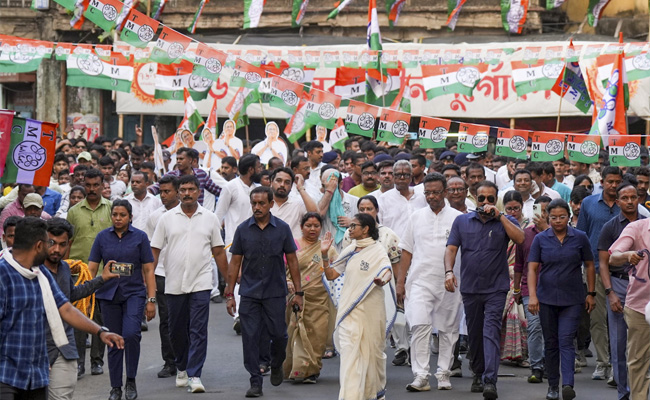
Kolkata (PTI): Chief Minister Mamata Banerjee cut short her speech at a rally in her Bhabanipur constituency, alleging that the BJP was deliberately playing loud music from a nearby public meeting.
A peeved Banerjee said despite having the required permission of the Election Commission, her rally in Chakraberia was disrupted by the BJP, "who want to capture Bengal by intimidation and threat".
"It is not possible for me to go ahead with this meeting. If they can do such a thing in my constituency, imagine how undemocratic the BJP is. If they behave like this, I have to take legal action," she said.
"This is an insult, humiliation. BJP is stepping on our toes to instigate trouble. Not possible to address the gathering in this situation. I am leaving the stage. Please vote for me in your protest," she added.
Banerjee was then seen calling someone over and venting her grievances.
Before leaving the stage, she said, "I will hold a rally tomorrow at the same spot."
TMC supporters then rushed towards the BJP rally, which was later addressed by Leader of the Opposition Suvendu Adhikari, but security personnel intervened and prevented the situation from escalating.
TMC workers later staged a demonstration outside the local police station and filed a complaint, alleging that the BJP violated the model code of conduct.
A senior TMC leader said another complaint will also be lodged with the Election Commission.
Asked about Banerjee's allegations, Adhikari told reporters after the rally he held nearby, "Her reaction shows she is nervous about the imminent loss."
"There was no violence, no obstruction in her meeting and her behaviour shows her nervousness. On May 4, people of Bhabanipur will celebrate the victory of the BJP," he claimed, alleging that the TMC also tried to disrupt his meeting by playing loud music.
South Kolkata's Bhabanipur, one of the battleground seats in the West Bengal elections, will vote in the second phase on April 29.