Dubai–Mangaluru Air India Express flight leaves passengers’ luggage behind in Dubai

Mangaluru: Passengers arriving from Dubai on an Air India Express flight to Mangaluru on Saturday evening were left angry and helpless after learning that their luggage had not arrived with them and was left behind in Dubai.
When the flight landed and travellers went to collect their baggage, they were informed by the airline staff that several bags had not been loaded due to the aircraft being “full”. The staff assured passengers that the missing luggage would arrive on the next flight from Dubai at 5 am on Sunday and would be delivered to their addresses.
The explanation, however, did little to calm the passengers. Many of them including those who had travelled just for a day or were carrying perishable items got into heated arguments with the airline staff at Mangaluru International Airport.
“Why didn’t you inform us in Dubai before taking our baggage? If there wasn’t enough space, why were we allowed to board with full tickets? You’ve given us receipts saying the luggage will reach Mangaluru but left it behind without a word. Had we known this earlier, we wouldn’t have taken this flight,” some passengers questioned.
Several travellers said they had essential items and clothes in their checked baggage. “You say the bags will come tomorrow morning, but of what use is that when some of us have to return tonight itself?” one passenger said.
Airline staff reportedly told the passengers to provide their contact details so that the luggage could be delivered to their homes once it arrived. However, many travellers said they were not satisfied with the response.
Some frequent flyers alleged that such issues were becoming common with Air India Express. “This is the third or fourth time this has happened to me,” said one passenger. Others demanded compensation for items that might get spoiled due to the delay.
The flight, which was scheduled to depart from Dubai at 12 pm and reach Mangaluru by 5:30 pm, took off only around 2:30 pm and landed at 7:20 pm. Upon arrival, the baggage issue came to light, leaving many passengers frustrated and angry with the airline’s handling of the situation.
Let the Truth be known. If you read VB and like VB, please be a VB Supporter and Help us deliver the Truth to one and all.
KMES Institutions shine in SSLC result, continue four-decade legacy of education in rural Karkala
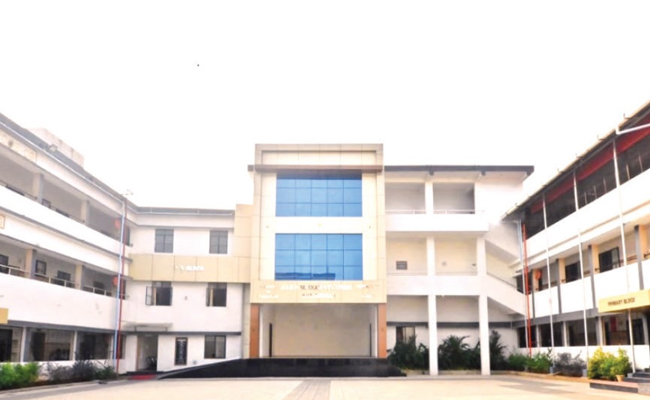
Karkala: KMES Institutions of Education at Kukkundooru in Karkala taluk has recorded outstanding results in the 2025-26 SSLC and PUC examinations, continuing a four-decade educational journey that began with just 22 kindergarten students and no building of its own.
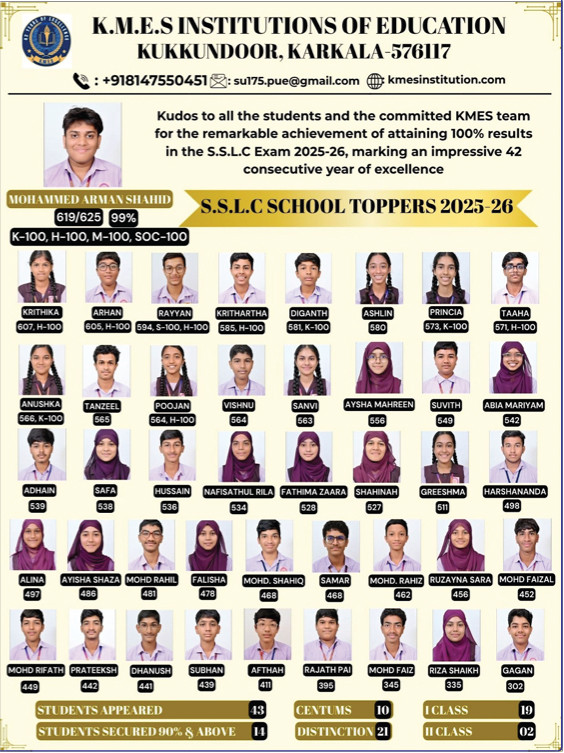
The institution secured a 100 per cent result in the SSLC examinations, with all 43 students passing the examination this year.
Muhammad Arman Shahid emerged as the school topper by scoring 619 marks out of 625, securing 99 per cent and also ranking sixth at the state level. He scored full marks in Kannada, Hindi, Mathematics and Social Science.
Krithika V. Nayak secured the second position in the school with 607 marks and 97.12 per cent, while Arhan stood third with 605 marks and 96.8 per cent.
Out of the 43 students, 21 passed with distinction, 19 secured first class, two students obtained second class and one student passed in third class. Fourteen students scored above 90 per cent.
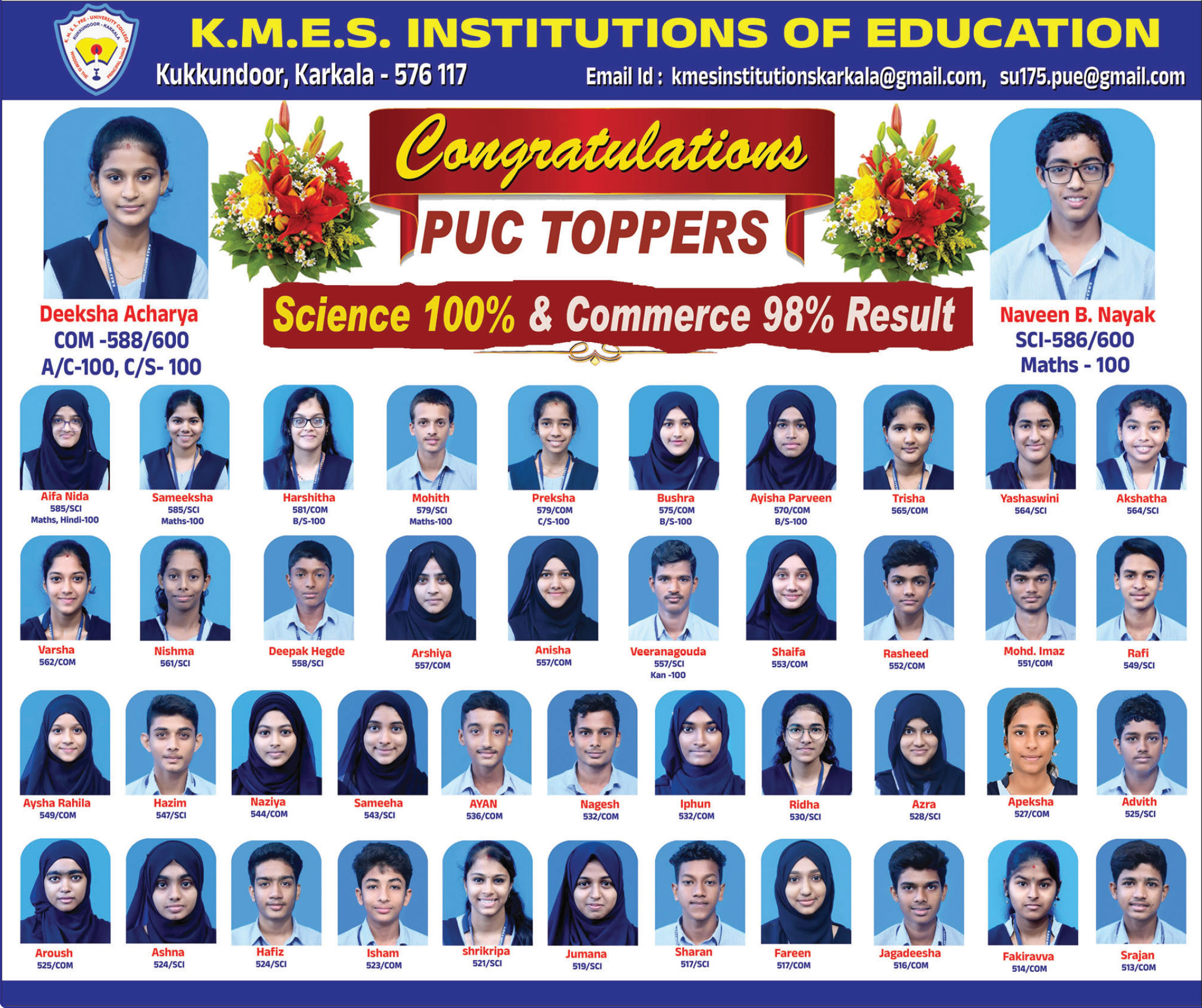
The institution also performed strongly in the PUC examinations. The Science stream recorded a 100 per cent result, with all 44 students passing, while Commerce secured a 98 per cent pass percentage.
Twelve students scored full marks in different subjects, including Mathematics.
In Commerce, Deeksha Acharya topped the college with 588 marks, while Harshitha H. Kini secured the second position with 581 marks.
In Science, Naveen B. Nayak emerged as topper with 586 marks, followed closely by Sameeksha Moily and Aifa Nidha, who both secured 585 marks.
Speaking about the achievement, High School head teacher Shrimati Patkar said the institution has always focused on supporting academically weak students through affordable education and free special classes.
“Our ambition is to provide quality education even to students who struggle in studies. The fees are very low, and free coaching classes are conducted. I have worked here for 28 years and have always found the atmosphere supportive of education,” she said.
Primary School head teacher Lolita Zeena D’Silva appreciated the dedication of the teaching staff and said the school encourages students not only to achieve high marks but also to become role models.
PU College Principal Balakrishna Rao said the institution focuses on value-based education and overall personality development.
“The aim is to help students succeed not only academically but also in cultural activities, sports and leadership. We encourage qualities such as patience, tolerance and discipline,” he said.
Rao also credited the institution’s growth to the support of founders K.S. Mohammed Masood and K.S. Nissar Ahmed, along with President K.S. Imtiaz Ahmed.
Speaking on the occasion, Imtiaz Ahmed said the institution was built on the dream of making quality education accessible to financially backward families in rural areas.
He said the guidance and encouragement of his elder brothers, Mohammed Masood and Nissar Ahmed, along with the contribution of teachers, students and parents, helped transform the institution into a model educational centre.
The KMES Institutions trace their roots back to 1984, when they were founded by senior social activists Haji P.M. Khan, K.S. Nazeer Ahmed and Haji A.S. Rashid Haider.
The institution initially functioned from the Government Urdu School premises as it did not have a building of its own. Classes began with only 22 students in lower kindergarten and two teachers.
Later, under the leadership of K.S. Mohammed Masood and with continuous financial and moral support from non-resident businessman K.S. Nissar Ahmed, the institution gradually expanded.
In 1993, the school shifted to its own building and began conducting classes from LKG to Class 5.
As student admissions increased, Nissar Ahmed personally funded the construction of three additional classrooms to address infrastructure shortages.
The institution’s new school building was completed in 1997, while the PU College building was constructed in 2001.
From humble beginnings in a borrowed building to producing state-level rank holders and consistent academic results, the KMES Institutions have grown into one of the prominent educational centres in the Karkala region.