Ex-minister Ramanath Rai hits out at BJP leader Ashoka for ‘irresponsible’ comments on KC Venugopal
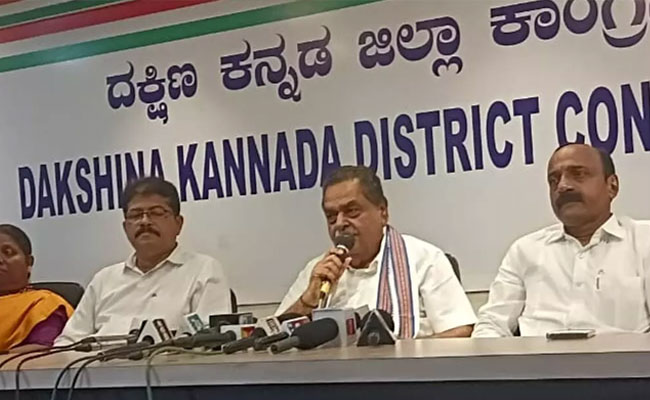
Mangaluru: Congress leader and former minister B Ramanath Rai slammed BJP leader R Ashoka for calling AICC General Secretary KC Venugopal an agent of the party high command, and asked if the general secretary and other office-bearers in the BJP were commission agents too.
Rai, who addressed a press meet at the Congress office in the city on Friday, expressed fury over the recent comments of the BJP leader that Chief Minister Siddaramaiah was presenting himself in a shameless manner in public life. Ashoka, who is also Leader of the Opposition (LoP) in the Karnataka Legislative Assembly, had said that the Congress government had ‘broken every previous record on corruption-related controversies’.
“Ashoka has spoken with sheer ignorance and displays his lack of maturity, as he often does while facing the media. KC Venugopal has been working at organization of the party and it is unbecoming of Ashoka to criticize Venugopal as he did,” Rai told reporters.
“Being in a responsible position, how acceptable is it for Ashoka to pass disrespectful, random comments about another leader who also holds a responsible position? If KC Venugopal is indeed an agent of the party high command, what should we consider BJP leaders to be? Are they brokers?” he asked
Commenting on Ashoka’s allegations of corruption in the Congress government in Karnataka, Rai pointed out, “The KSRTC land was sold to private parties when he (Ashoka) was transport minister. We can find several such cases across the state, which need to be probed.”
The former minister, however, refused to comment on the incident that occurred at Mangaluru airport during CM Siddaramaiah’s visit to the city recently.
Former mayors Ashraf and Shashidhar Hegde, Congress activists Vishwas Kumar Das, Subhodaya Alva, Shabeer, Baby Kundar, Padmanabha, Nazeer Bajal and Prem were present.
Let the Truth be known. If you read VB and like VB, please be a VB Supporter and Help us deliver the Truth to one and all.
Centre spent Rs 76.13 lakh on print media ads for RSS centenary, reveals RTI

New Delhi: The Union Ministry of Culture allegedly spent Rs 76.13 lakh on print advertisements marking the 100-year celebrations of the Rashtriya Swayamsevak Sangh (RSS), according to a Right to Information (RTI) reply.
The information was sought by RTI activist Ajay Basudev Bose, who filed an application seeking details on expenditure incurred by the ministry for advertisements commemorating the RSS centenary.
Bose shared a picture of the reply from the ministry on his official ‘X’ handle.
“It is informed that an amount of Rs 76,13,129 has been spent on advertisement given in various print media by the Ministry of Culture on the occasion of the completion of 100 years of RSS,” the government’s reply stated.
RTI reply shows Min of Culture Govt of India spent a Whopping Rs 76L,13K,129 on Advertisement in Print Media on occasion of 100 yrs of #RSS
— AJAY Basudev Bose (@AjayBos93388306) April 16, 2026
When Everyone knows RSS is Not Registered & Does not Pay any Tax is it justified to spend Tax Payers Money on such Private event??@RSSorg… pic.twitter.com/dW4IUtdNCg
Bose questioned the expenditure in the post X, “when Everyone knows RSS is Not Registered & Does not Pay any Tax is it justified to spend Tax Payers Money on such Private event??”
Reacting to the development, Karnataka’s IT-BT and Panchayat Raj Minister Priyank Kharge also criticised the spending.
In a post on X, he asked why public money was being used for what he described as a “private ideological project.”
"Modi Sarkar spent Rs 76,13,129 of public money on newspaper advertisements to celebrate 100 years of the RSS. Why is Government spending taxpayers money on an unregistered, non-tax-paying organisation to celebrate their centenary?," he added.
Why is public money being used to serve a private ideological project?
— Priyank Kharge / ಪ್ರಿಯಾಂಕ್ ಖರ್ಗೆ (@PriyankKharge) April 16, 2026
Modi Sarkar spent ₹76,13,129 of public money on newspaper advertisements to celebrate 100 years of the RSS.
Why is Government spending taxpayers money on an unregistered, non-tax-paying organisation to… pic.twitter.com/EoZ6Pim3IM
According to reports, the RSS describes itself as a volunteer-based organisation and has stated that it functions as a body of individuals rather than a registered entity.
Founded by Keshav Baliram Hedgewar in 1925, the organisation is marking its centenary year beginning from Vijaydashami in 2025, with the milestone observed on October 2.