Five arrested in Udupi for alleged attempt to assault police, involvement in cricket betting case

Udupi: Police have arrested five persons in connection with two incidents involving an alleged attempt to attack police personnel and involvement in an illegal cricket betting racket in Karkala and Shirva, Deccan Herald reported.
According to police, the first incident occurred near a Honda showroom at Hanchikatte in Kasaba village of Karkala taluk. Police Sub-Inspector Prasanna M.S. and his team from Karkala Rural Police Station signalled a black car to stop. However, the occupants allegedly tried to run over the police personnel and obstructed them from discharging their duties.
A case was registered at the Karkala Town Police Station under relevant sections of the Bharatiya Nyaya Sanhita (BNS).
In a related incident, PSI Manjunath Marabada of Shirva Police Station intercepted the same vehicle near Padavu in Shirva village after it was found moving suspiciously from Belman. The driver initially slowed down but allegedly pushed the officer and attempted to flee. The vehicle was later stopped in Shirva town by police personnel.
During investigation, police found that the accused were allegedly involved in an organised cricket betting racket, luring people to invest money and cheating them through illegal gambling activities.
A case was registered at Shirva Police Station under relevant sections of the BNS and the Karnataka Police Act.
The arrested accused have been identified as Sudarshan Shetty (29) of Nadoor, Kartavya Shetty (27) of Heruru, Arun Shetty (29) of Moodoor, Tejas (28) of Belanje in Hebri, and Prajwal Shetty (29) of Shiroor in Byndoor taluk.
Let the Truth be known. If you read VB and like VB, please be a VB Supporter and Help us deliver the Truth to one and all.
Karnataka records 274 springs in first statewide census, majority located in Western Ghats
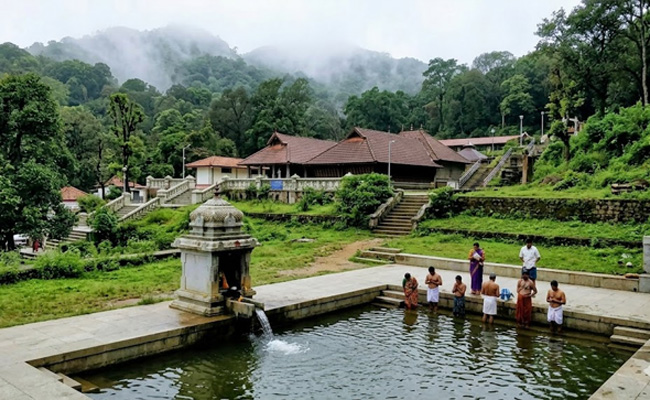
Hubballi: In its first-ever comprehensive census conducted during 2023-24, Karnataka has identified 274 natural springs across the State with 144 classified as perennial, 114 as seasonal and 16 reported to have dried up.
The enumeration was carried out by the Karnataka Minor Irrigation and Groundwater Development Department in association with the Groundwater Directorate as part of a Union government initiative, according to a Deccan Herald report. Officials were quoted as saying that the nine-month exercise involved field visits to nearly all identified springs. These springs were digitally mapped using a dedicated mobile application.
Belagavi district recorded the highest number of springs at 59, followed by Uttara Kannada with 31, while Chamarajanagar and Kodagu reported 23 each. Dharwad, Ramanagar, Bengaluru Rural, Davangere and Kolar districts have one spring each.
Bendru Teertha in Dakshina Kannada is the only hot spring documented in the State, which is attributed to a distinct hydrological formation. Springs in Talacauvery in Kodagu, Javali in Chikkamagaluru and Ambutheertha in Shivamogga, are the source points of major rivers such as the Cauvery, Hemavathi and Sharavathi.
According to the directorate, springs are natural discharge points where groundwater flows to the surface through openings in the earth’s crust, which occur when the water table intersects with the ground surface or when groundwater is forced out through fractures, faults or permeable rock layers.
The Western Ghats and Malnad regions, covering districts like Kodagu, Chikkamagaluru, Uttara Kannada, Dakshina Kannada, Belagavi and Shivamogga, account for a significant share of the springs due to high rainfall and favourable geological conditions.
K B Rajendra, Director of the Groundwater Directorate, was quoted by Deccan Herald as saying that nearly 80 per cent of the springs are located in rural areas. He noted that apart from those associated with religious or historical sites, most springs remain open and lack protective measures.
Noting their vital contributions to drinking water supplies and agricultural irrigation, especially in areas with hills and mountains, Rajendra said that these springs help maintain the flow of rivers and streams when the weather is dry, thereby supporting ecological balance and promoting biodiversity.
He added that the census findings would serve as a database for conservation, rejuvenation efforts, groundwater management and long-term water resource planning in the State.