Focus on developing a whole green infrastructure : Dr Ken Yeang
Renowned sustainable architect Dr. Ken Yeang at BEADS/BIT
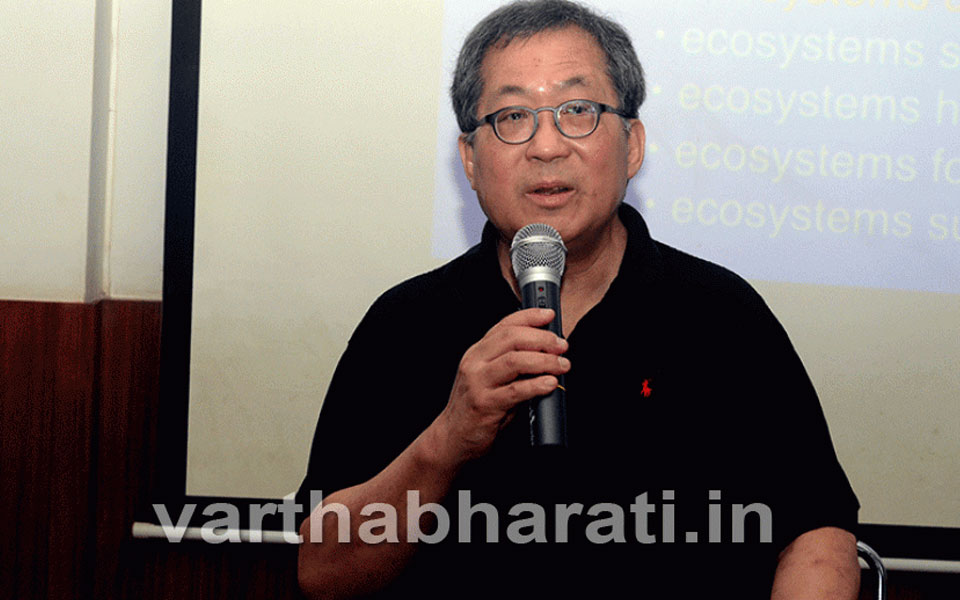
Mangaluru : "Architects should not limit themselves to building only a green building but focus on developing a whole green infrastructure in the city " said world renowned architect , planner and author Dr. Ken Yeang of Malaysia. Dr Ken, who is recognised as the first and only ecologist architect globally was delivering a talk at the Bearys Enviro Architecture Design School (BEADS) and Bearys Institute of Technology (BIT) at Inoli on Sunday.
Dr Ken gave a presentation on ‘Sustainability and building in harmony with the natural world” and explained briefly how he has worked on some of his most important projects across the world. He stressed the need to understand the importance of ecological architecture and masterplanning and creating hybrid systems as ‘constructed ecosystems’.
When asked about the economic feasibility of sustainable construction, Dr Ken said it will cost 6.3% more than the normal industry standards. But the amount of energy and water saved in these sustainable buildings will return that extra cost within 8 years. Architects, developers and the society should understand this, he said.
Dr Ken reminded the young architects that they should have the passion, ability to handle stress and work very hard to give best results. They should not come to this field if their main intention is to make money , he said.
Bearys Group with Dr. Ken Yeang
Chairman of the Bearys Group, Syed Muhammad Beary said that the group will be joining hands with Dr Ken in a prestigious project in Chennai and will start work on that very soon. " Being the pioneers in green building and the only developer to have 6 platinum certifications from IGBC , Bearys Group is proud to be associated with Dr Ken" Beary added.
BEADS principal Ashok Mendonsa introduced the guest. Architects of Dr Ken's team Saw Seng Ee, Muhammad Haiqal and Vanessa Lai , Principal of BIT, Dr Antony AJ, academic Dean Dr Malabaleshwarappa, Principal of BIT Polytechnic Dr Aziz Musthafa were also present. Anjali compered the program. Faculty member Laxminarayan presented Dr Ken's portrait which he has drawn to him.
If you get visa and if you are a good architect ...
When a student asked Dr Ken if he will take interns from India, he replied that " the problem is not me, its about visa from Malaysia government. If you can get the visa and if you are a good architect and designer, i will definitely consider " he said.
Ken Yeang is an world renowned architect, ecologist, planner and author from Malaysia, best known for his ecological architecture and eco master plans that have a distinctive green aesthetic. He pioneered an ecology-based architecture (since 1971), working on the theory and practice of sustainable design. He has built over 200 buildings globally and published numerous books advocating an environmentally responsive approach to design. Yeang lectures extensively at conferences and schools of architecture (over 30 countries worldwide). The Guardian newspaper (2008) named him "one of the 50 people who could save the planet".


Let the Truth be known. If you read VB and like VB, please be a VB Supporter and Help us deliver the Truth to one and all.
Real Madrid fines Valverde and Tchouaméni half a million euros each for altercation

Barcelona (AP): Real Madrid slapped players Federico Valverde and Aurélien Tchouaméni with half-a-million-euro ($588,000) fines on Friday for their altercation during practice.
The massive fines came a day after the midfielders tussled when the team trained. Valverde said in a post on social media on Thursday that no punches were thrown. But Valverde knocked his head on a table and he suffered a small cut that required a brief hospital visit.
On social media, Valverde initially called it a “meaningless fight” with a teammate and said “everything has been blown out of proportion."
His employers, however, considered it a significant enough breach of team discipline to nail both Valverde and Tchouaméni with fines that bite even the bank account of a top soccer player. The half-a-million euro penalties reflect the reputational damage the club was enduring in a chaotic end to a disappointing season.
In a statement, the 15-time European champion said its disciplinary action was concluded after both players expressed to the club “their complete remorse for what happened and apologized to one another.”
Madrid added they also apologized to their teammates, the coaching staff and club supporters, as well as showing their willingness to accept whatever disciplinary action the club deemed “opportune.”
Tchouaméni was back training with Madrid on Friday, two days before they play at Barcelona in a clasico. Madrid has to win otherwise Barcelona will be crowned La Liga champion.
After being notified of the fine, he posted a public apology to the club and its fans on social media.
“What happened this week in training is unacceptable,” Tchouaméni wrote. "I say this while thinking about the example we are expected to set for young people, whether in football or at school.
“Above all, I am sorry for the image we projected of the club.”
Valverde was not at practice due to the head knock.
Both players are set to play in the World Cup next month, with Tchouaméni playing for France and Valverde for Uruguay.
Chaotic end to a poor season
===================
The run-in between the players, who for seasons have played side by side in Madrid's midfield, came after they argued this week in previous training sessions. But tempers boiled over on Thursday. Spanish media was rife with reports that the players previously disagreed over the club's decision to let coach Xabi Alonso go after just months on the job.
It was not the only altercation involving Madrid players during training this week. Álvaro Carreras confirmed he was in a “minor” incident with a teammate. Spanish media said he and fellow defender Antonio Rüdiger got into a scuffle.
Álvaro Arbeloa, the coach who was promoted from Madrid's reserve team when Alonso was fired in January, will face tough questions on what went wrong inside the changing room when he gives a press conference on Saturday ahead of the clasico at Camp Nou.
Madrid is facing a second consecutive campaign without a major trophy amid rumors in the Spanish media that club president Florentino Pérez is considering bringing back Jose Mourinho to straighten out his underperforming team.