
Former Bajrang Dal Karnataka President slams PM Modi for destroying Constitution
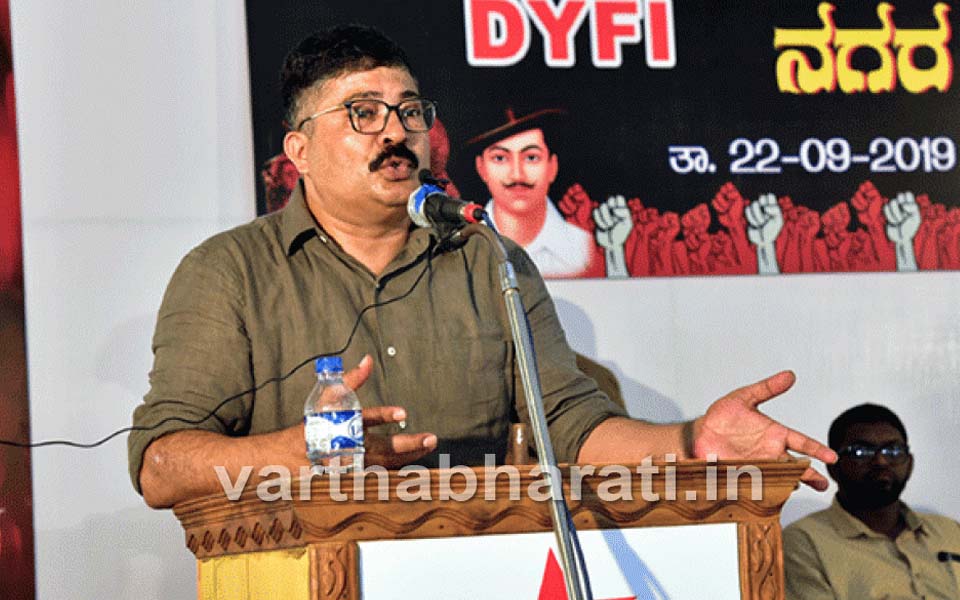
Mangaluru: Former Bajrang Dal Karnataka President Mahendra Kumar on Sunday slammed PM Narendra Modi for destroying constitution of the country while also destabilizing the constitutional institutions.
Mahendra Kumar was speaking at an event organised by DYFI at Mangaluru’s Townhall.
Kumar slammed Modi led BJP government for using condemnable events like Pulwama Attack to get political mileage during the Lok Sabha Election. He further added that the current economic slowdown is also conspired the NDA government to put the country in a position where nobody can question the government about their acts.
Kumar stressed upon creating awareness among the youths of the country against the government that is manipulating facts and history to gain political mileage and advantage.
Kumar also condemned the hatred that is being promoted and created in the hearts and minds of youngsters in the Dakshina Kannada District to divide Muslim and Hindus. He also called for awareness against RSS and its institutions that is doing such acts.
“If the situation doesn’t improve in Dakshina Kannada and mainly in Mangaluru there will come a time when people in the region will roam around with guns and weapons”, Kumar said.
Speaking at the event Muneer Kattipala also added that the struggle against the facist forces will not end. He said that they were fighting against economic slowdown, price hikes in transport and other issues in Dakshina Kannada for which they have conspired and are booked with several cases but inisited that his struggle will not take a hit by such vendetta politics.


Let the Truth be known. If you read VB and like VB, please be a VB Supporter and Help us deliver the Truth to one and all.
Rupee gains 20 paise to 93.15 against US dollar in early trade
_vb_80.jpeg)
Mumbai (PTI): The rupee recovered 20 paise to 93.15 against the US dollar in early trade on Wednesday, backed by lower levels of crude oil prices and a weak American currency amid hopes of resuming US-Iran peace talks.
Investor sentiment turned positive after US President Donald Trump said that a second round of talks with Iran could be held "over the next two days".
The latest remarks, which came days after the two sides failed to reach a peaceful resolution to the conflict in West Asia, led to a sharp decline in crude oil prices, boosting the risk appetite for market participants, forex analysts said.
At the interbank foreign exchange market, the rupee opened at 93.19 against the US dollar and gained further, trading at 93.15 against the greenback in early deals, up 20 paise from its previous closing level.
On Monday, the rupee weakened by 52 paise to settle at 93.35 against the US dollar. The forex market was closed on Tuesday on account of Baba Saheb Ambedkar Jayanti.
Meanwhile, the dollar index, which gauges the greenback's strength against a basket of six currencies, was marginally higher by 0.04 per cent at 97.95.
Brent crude, the global oil benchmark, was trading 0.57 per cent up at USD 95.33 per barrel in futures trade.
On the domestic equity market front, the stock markets witnessed a steep surge in the morning trade. The 30-share Sensex jumped 1162.04 points or 1.51 per cent to 78,009.61, while the Nifty climbed 348.65 points or 1.46 per cent to 24,191.30.
Foreign Institutional Investors were net sellers on Monday and offloaded equities worth Rs 1,983.18 crore, according to exchange data.
_vb_77.jpeg)
_vb_92.jpeg)
_vb_17.jpeg)