Kabaka: Muslim youth perform last rites of Hindu woman
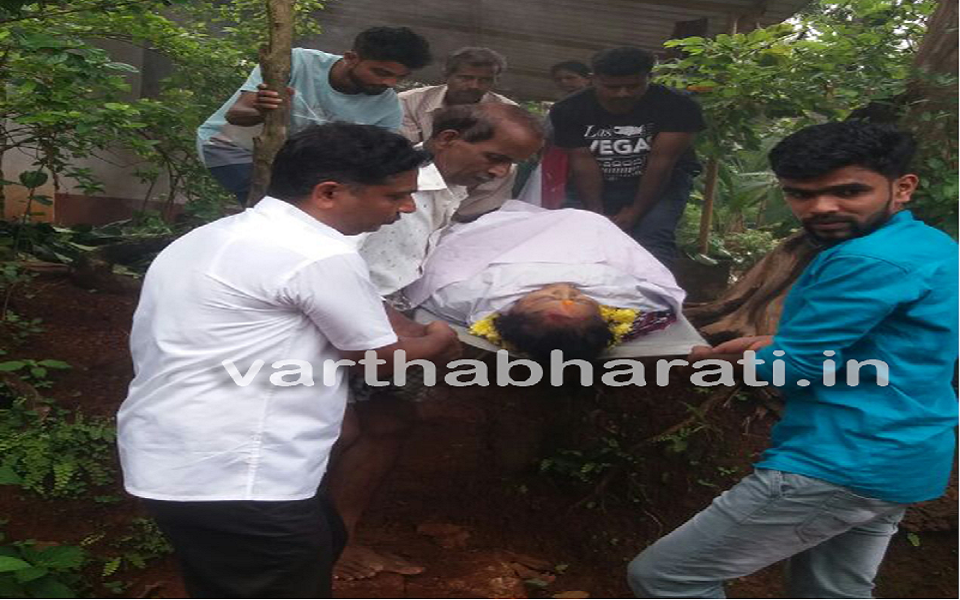
Puttur, June 16: As the family members and locals did not come forward to perform the last rites of Bhavani (52), an unmarried of Vidyapura in Kabaka who died of heart attack on Saturday, a group of Muslim youth performed the last rites with all religious rituals. This humane act has got appreciation from all corners.
When Bhavani died of heart attack, her brother Krishna informed his relatives and local residents about the incident and appealed them to cooperate for the last rites. But none of his relatives and neighbours turned up to cremate the body. As a result, her brother Krishna had to keep the body at home till afternoon.
Noticing the news, Vidyapura residents Shoukath, Hamza, Nazeer, Riyaz, Farooq and others collected the money to be paid to the graveyard. When no family members and Hindu women came forward to wash the body of Bhavani, the process was completed with the help of Anganwadi worker Rajeshwari, Bhavani’s sister and locals Safiya and Zubaida. Later, the body was taken to the Puttur graveyard in ambulance by paying Rs 3500 and performed the last rites.
Speaking to Varthabharati, Farooq said that “We have considered any religious affiliation while performing the last rites. We Muslim youth conducted the last rites of a Hindu woman and it was not our motive to get publicity out of it. Such incidents should not happen in future. We see such incidents in Uttar Pradesh, Rajasthan in media. But it is unfortunate that such incident happened in our village. It is painful that those who supposed to do their work did not do that. Here we have many Hindu organizations which behave like they adopted the Hindus. But they did not turn up. Kabaka gram panchayat president who is backed by BJP did not visit the house and it is sad”, he said.
Let the Truth be known. If you read VB and like VB, please be a VB Supporter and Help us deliver the Truth to one and all.
IndianOil says it has scaled up Auto LPG supplies

Bengaluru (PTI): IndianOil on Thursday said it has significantly scaled up its Auto LPG supplies across Karnataka in response to a sharp surge in demand, particularly following the closure or partial shutdown of several private Auto LPG outlets in Bengaluru and other parts of the state.
The PSU major said it is currently meeting the fuel requirements of auto rickshaws and LPG-driven cars through its network of 55 Auto LPG Dispensing Stations (ALDS) spread across Karnataka, even as a substantial portion of demand has shifted to public sector outlets due to over 300 privately operated outlets being closed or only partially functional.
"Indian Oil Corporation Limited (IndianOil) has significantly scaled up its Auto LPG supplies across Karnataka in response to a recent surge in demand," V Vetriselvakkumar, Chief General Manager (Corporate Communications) said in a release.
He added that the move comes particularly following the closure or partial shutdown of several private Auto LPG outlets in Bengaluru and other parts of the state.
Despite the increased operational burden, the company said it has taken concerted measures to ensure uninterrupted supply and efficient service delivery to LPG-powered vehicles during the current situation.
The average daily sales at IndianOil's ALDS in Karnataka have risen sharply to 59.53 metric tonne (MT), compared to the previous three-month average of 43.4 MT, reflecting a significant spike in consumer demand, the release said.
Reiterating its commitment, Vetriselvakkumar said IndianOil remains focused on ensuring seamless fuel accessibility while adhering to government directives and maintaining equitable distribution across all sectors.