
Kashmir status withdrawn to protect nation's integrity: Sadananda Gowda
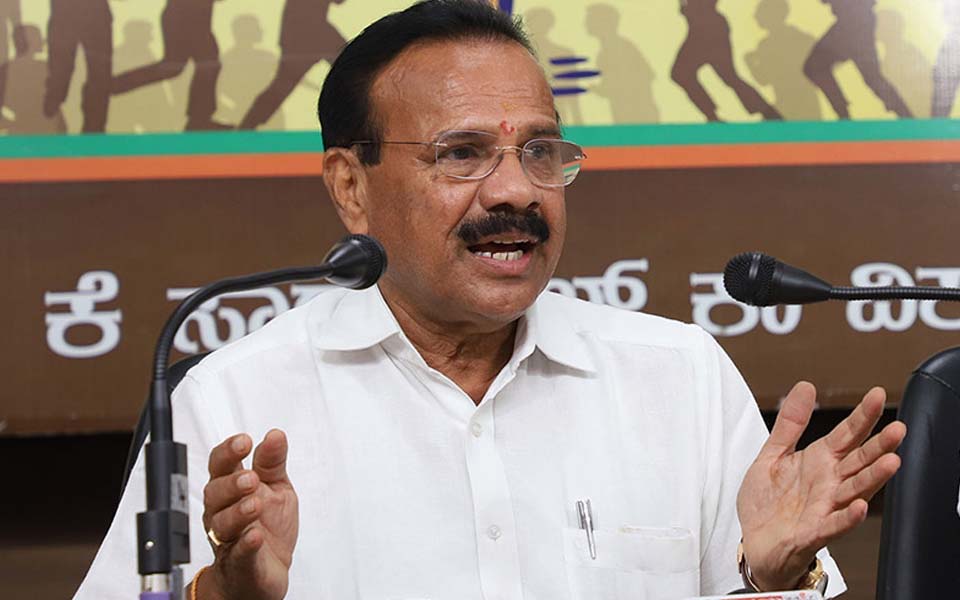
Mangaluru, Sept 22: The BJP's prime objective of protecting the integrity of the nation and it's development agenda led to the decision for abrogation of Article 370 and 35 A of the Constitution that gave special status to Jammu and Kashmir, according to Union Minister D V Sadananda Gowda.
He said the party had long back started the process to annul both the Articles, which offered special status to J&K.
The minister said that once normality is restored in Kashmir, the Union government would focus on the development of the region.
"Since the abrogation of Article 370, not a single shot has been fired in Kashmir.
The special status accorded to Kashmir earlier had made it a heaven for terrorists," the Union Minister for Chemicals and Fertilisers said.
He was addressing a public awareness programme on Article 370, organised by the Udupi district unit of BJP at Manipal on Saturday.
Gowda said even Congress leaders, including Karan Singh and Jyotiraditya Scindia, had appreciated the Centres decision on Kashmir.
To a question from a participant on when the union government would implement the Uniform Civil Code in the country, he said the BJP manifesto had clearly mentioned that it wanted the UCC.
The government too desired it, he said.
Let the Truth be known. If you read VB and like VB, please be a VB Supporter and Help us deliver the Truth to one and all.
Boat carrying 250 people, including Rohingya and Bangladeshis, sinks in Andaman Sea
_vb_00.jpeg)
Dhaka (AP): At least 250 people, including Rohingya refugees and Bangladeshi nationals, were missing after a boat capsized in the Andaman Sea recently on the way to Malaysia, according to the United Nations' refugee and migration agencies.
When the boat sank and the status of any search Wednesday were unclear.
The UN High Commissioner for Refugees and the International Organisation for Migration in a joint statement said Tuesday that the trawler departed from Teknaf in the southern Bangladeshi district of Cox's Bazar carrying a large number of passengers to Malaysia.
Overcrowding, strong winds and rough seas caused the vessel to lose control and sink, the agencies said.
UNHCR and IOM said the disappearance reflected the protracted displacement of Rohingya people and the absence of durable solutions.
They said ongoing violence in Myanmar's Rakhine state has made the Rohingyas' safe return to Myanmar uncertain, and limited humanitarian assistance, restricted access to education and employment in refugee camps, continue to push vulnerable Rohingya refugees to choose risky sea journeys, often based on false promises of higher wages and better opportunities abroad.
UNHCR and IOM urged the international community to strengthen funding and solidarity to ensure lifesaving assistance for Rohingya refugees in Bangladesh, which has sheltered more than 1 million Rohingya from Myanmar.
_vb_80.jpeg)
_vb_77.jpeg)
_vb_92.jpeg)