KMES Institutions shine in SSLC result, continue four-decade legacy of education in rural Karkala
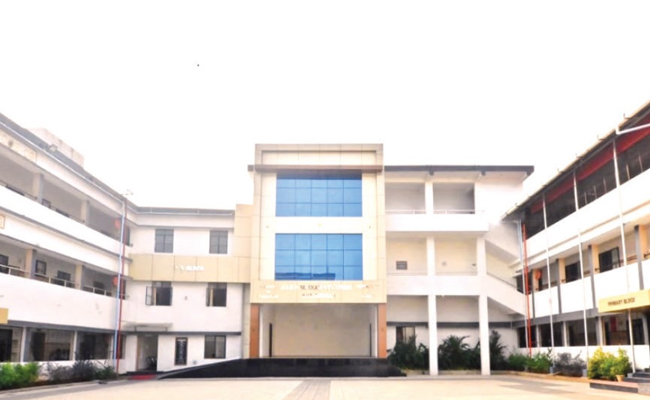
Karkala: KMES Institutions of Education at Kukkundooru in Karkala taluk has recorded outstanding results in the 2025-26 SSLC and PUC examinations, continuing a four-decade educational journey that began with just 22 kindergarten students and no building of its own.
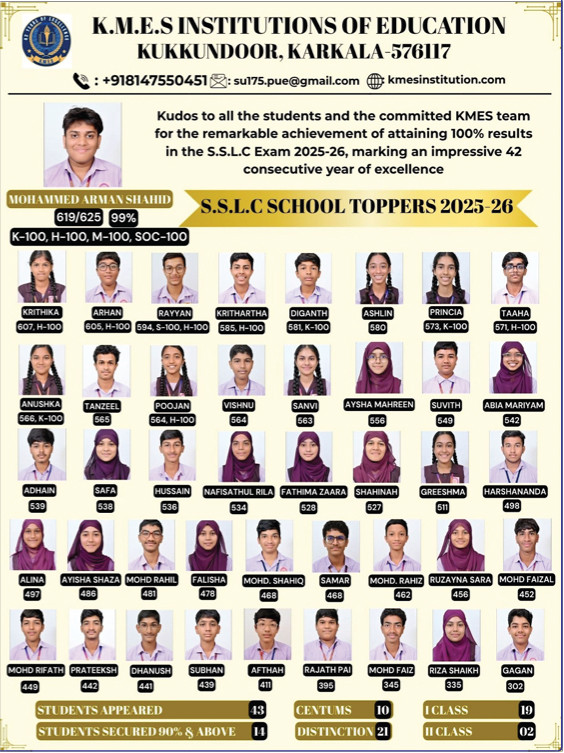
The institution secured a 100 per cent result in the SSLC examinations, with all 43 students passing the examination this year.
Muhammad Arman Shahid emerged as the school topper by scoring 619 marks out of 625, securing 99 per cent and also ranking sixth at the state level. He scored full marks in Kannada, Hindi, Mathematics and Social Science.
Krithika V. Nayak secured the second position in the school with 607 marks and 97.12 per cent, while Arhan stood third with 605 marks and 96.8 per cent.
Out of the 43 students, 21 passed with distinction, 19 secured first class, two students obtained second class and one student passed in third class. Fourteen students scored above 90 per cent.
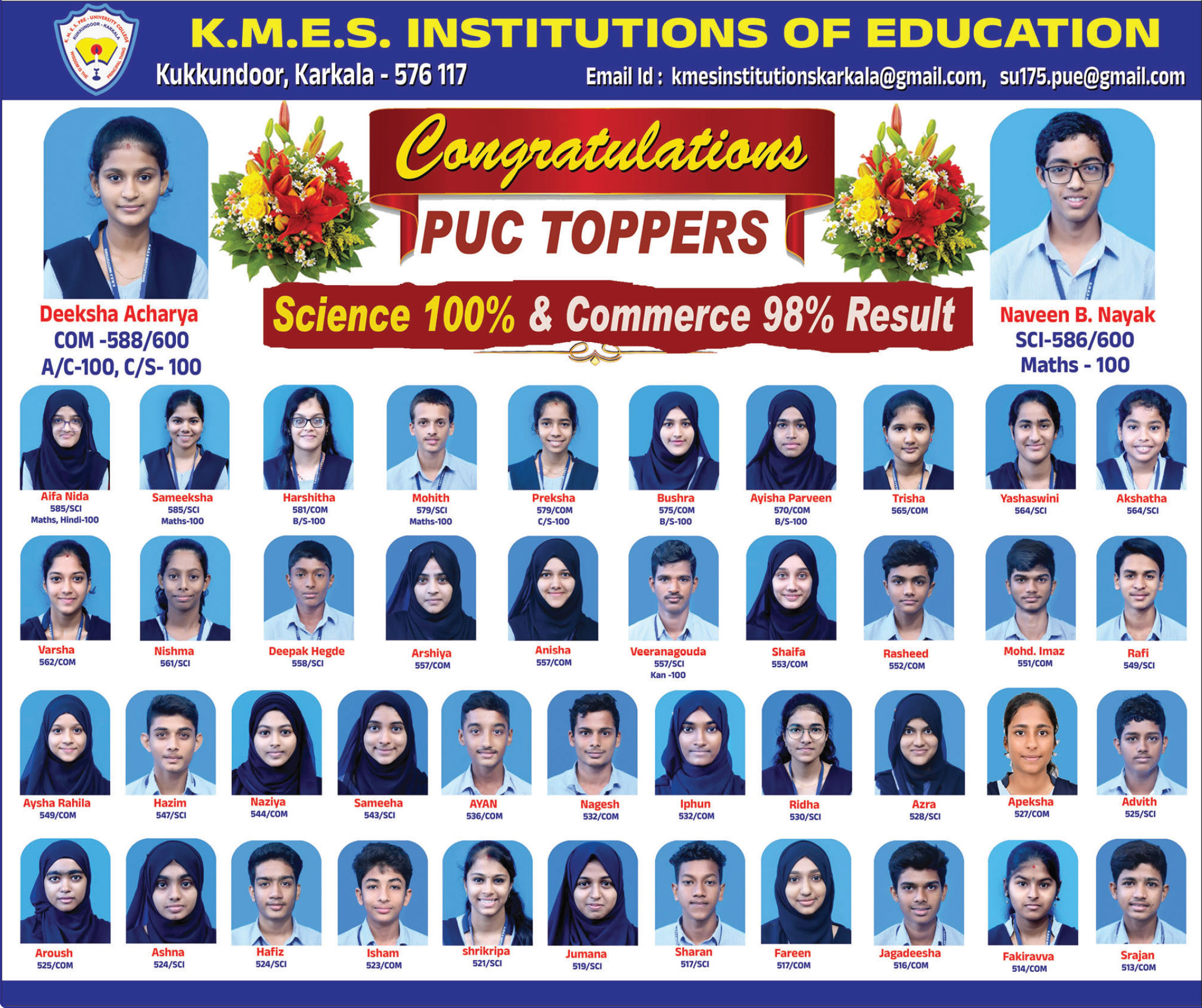
The institution also performed strongly in the PUC examinations. The Science stream recorded a 100 per cent result, with all 44 students passing, while Commerce secured a 98 per cent pass percentage.
Twelve students scored full marks in different subjects, including Mathematics.
In Commerce, Deeksha Acharya topped the college with 588 marks, while Harshitha H. Kini secured the second position with 581 marks.
In Science, Naveen B. Nayak emerged as topper with 586 marks, followed closely by Sameeksha Moily and Aifa Nidha, who both secured 585 marks.
Speaking about the achievement, High School head teacher Shrimati Patkar said the institution has always focused on supporting academically weak students through affordable education and free special classes.
“Our ambition is to provide quality education even to students who struggle in studies. The fees are very low, and free coaching classes are conducted. I have worked here for 28 years and have always found the atmosphere supportive of education,” she said.
Primary School head teacher Lolita Zeena D’Silva appreciated the dedication of the teaching staff and said the school encourages students not only to achieve high marks but also to become role models.
PU College Principal Balakrishna Rao said the institution focuses on value-based education and overall personality development.
“The aim is to help students succeed not only academically but also in cultural activities, sports and leadership. We encourage qualities such as patience, tolerance and discipline,” he said.
Rao also credited the institution’s growth to the support of founders K.S. Mohammed Masood and K.S. Nissar Ahmed, along with President K.S. Imtiaz Ahmed.
Speaking on the occasion, Imtiaz Ahmed said the institution was built on the dream of making quality education accessible to financially backward families in rural areas.
He said the guidance and encouragement of his elder brothers, Mohammed Masood and Nissar Ahmed, along with the contribution of teachers, students and parents, helped transform the institution into a model educational centre.
The KMES Institutions trace their roots back to 1984, when they were founded by senior social activists Haji P.M. Khan, K.S. Nazeer Ahmed and Haji A.S. Rashid Haider.
The institution initially functioned from the Government Urdu School premises as it did not have a building of its own. Classes began with only 22 students in lower kindergarten and two teachers.
Later, under the leadership of K.S. Mohammed Masood and with continuous financial and moral support from non-resident businessman K.S. Nissar Ahmed, the institution gradually expanded.
In 1993, the school shifted to its own building and began conducting classes from LKG to Class 5.
As student admissions increased, Nissar Ahmed personally funded the construction of three additional classrooms to address infrastructure shortages.
The institution’s new school building was completed in 1997, while the PU College building was constructed in 2001.
From humble beginnings in a borrowed building to producing state-level rank holders and consistent academic results, the KMES Institutions have grown into one of the prominent educational centres in the Karkala region.
Let the Truth be known. If you read VB and like VB, please be a VB Supporter and Help us deliver the Truth to one and all.
Air India resorts to cost-cutting ways amid 'tough times'; layoffs not anticipated
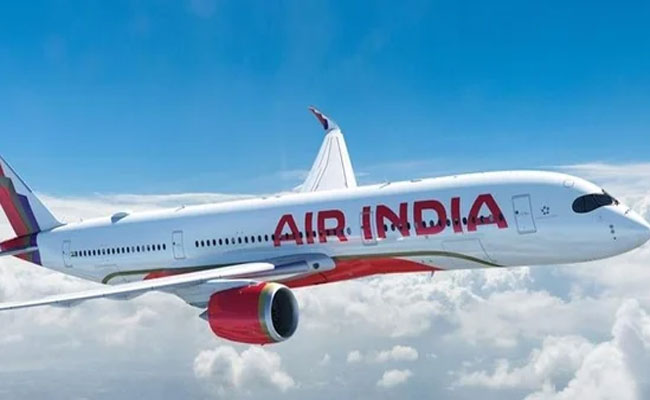
New Delhi/Mumbai (PTI): Hit hard by Pakistan airspace closure and Iran war, Air India has resorted to cost-cutting measures, including holding back annual increments for staff and asking them to cut discretionary spending as well as non-critical expenditures, warning of "tough times".
On Friday, Air India Chief Executive Officer & Managing Director (CEO & MD) Campbell Wilson told the staff it is going to be a "very, very difficult year" if things don't improve on the Middle East front.
A day after the loss-making airline's board discussed various cost-saving steps, Wilson, along with Chief Financial Officer (CFO) Sanjay Sharma and Chief Human Resources Officer (CHRO) Ravindra Kumar GP, addressed the employees during a townhall on Friday where the emphasis on the need to keep a close watch on costs.
With higher jet fuel prices due to the West Asia conflict and airspace curbs, the loss-making airline's expenses have spiralled in recent times and against this backdrop, Sharma also told staffers that FY26 has seen a softening in revenue amid heightened external uncertainties.
Calling for a relentless focus on costs in these tough times, Wilson urged employees to suspend discretionary spending, renegotiate rates where feasible, and defer non-critical expenditures.
"There must be a laser-sharp focus on eliminating wastage and leakages," he said.
Stressing the need to tighten the belt for a while, Wilson sounded optimistic that travel demand would rebound and the industry would continue on its upward path.
CHRO Ravindra Kumar told staff that the airline will proceed with variable pay for the last financial year and continue with planned promotions while noting that annual increments will be deferred by at least one quarter.
"We don't anticipate layoffs," he said.
At the airline's board meeting on Thursday, various cost-saving steps, including likely furloughs, were discussed. The Tata Group-owned airline has around 24,000 employees.
Generally, furlough refers to sending staff on unpaid leaves by companies during a tough financial situation.
During the townhall, CFO Sanjay Sharma said while strong revenue growth and fleet expansion drove financial momentum through FY25, FY26 has seen a softening in revenue amid heightened external uncertainties.
Air India has seen around 40 per cent CAGR (Compounded Annual Growth Rate) in revenue between 2022 and 2025, he added.
The airline was acquired by the Tata Group from the government in January 2022.
The Air India CEO mentioned the external challenges being facing the aviation industry as a whole, including the continued closure of Pakistan airspace that is expected to persist for the foreseeable future and geopolitical conflicts leading to disruptions and airspace closures across West Asia.
Wilson, who is set to step down later this year, also flagged a sharp depreciation of the rupee and a 2.5-3 times increase in jet fuel prices, and added that these factors have adversely affected travel sentiment and consumer confidence, as per the sources.
If the Strait of Hormuz opens, oil prices fall and consumer as well as business confidence come back, there is a decent chance of a solid recovery, Wilson said, adding that unless those circumstances happen, it was going to be "a very, very difficult year".
"I feel somewhat responsible that we ended up with probably the biggest surprise of the year in the external environment which was a full-scale war in our neighbouring region in the Gulf. That has had a huge impact on airspace," he said.
For Air India, Wilson said the situation is compounded by the fact that the airline cannot fly over the neighbouring country and has to take a much longer routing for any west-bound destination.
"Every airline is reporting that they are under some sort of financial pressure as a result of higher fuel prices and economic uncertainty. So, it is unfortunately not a great environment to be running an airline," the Air India CEO said.
The Air India Group -- Air India and Air India Express -- is projected to have incurred more than Rs 22,000 crore loss in the financial year ended March 2026.
At the townhall, Wilson also highlighted various initiatives, including completion of the retrofit of its legacy narrow-body aircraft and rapid network optimisation to redeploy capacity more efficiently.