Kundapura: 37th edition of ‘Clean Beach-Green Kodi’ Campaign held successfully

The 37th edition of the "Clean Beach-Green Kodi" campaign, organized by the Bearys Group of Educational Institutions, was successfully conducted on Sunday, December 1, at Kodi Beach. The initiative aims to promote environmental awareness and cleanliness among students and the community.
Addressing the participants, Syed Mohamed Beary, the convener of Bearys Group of Educational Institutions, highlighted the significance of environmental service, calling it a noble act favored by the divine. He urged for continuity and innovation in such initiatives, stating, "Environmental service should be carried out with devotion and bring about meaningful transformation. By organizing this activity every month, we can instill the importance of environmental cleanliness in our students. In the future, this campaign should evolve to achieve even greater impact."
Marking a change in schedule, the organizers announced that the campaign will now take place on the first Sunday of each month, replacing its earlier timing on the last Sunday.
A key moment of the event was the recognition of Sharmin Banu, a first-year student of Bearys B.Ed College, as the ambassador of the "Clean Beach-Green Kodi" campaign. Banu, who represented the Asia Pacific region at the World Conference on Climate Change in Azerbaijan as part of the "Girl Lead Action on Climate Change Advocacy Champion" initiative, was lauded for her achievements. She was the sole representative of the 'World Girl Scouts and Girl Guides' at the conference.
The event witnessed participation from members of the Bearys Board of Trustees, the School Development Advisory Board, well-wishers, parents, departmental heads, teaching and non-teaching staff, and students. Together, they actively contributed to the cleanliness drive, underscoring the shared commitment to preserving the environment.
Let the Truth be known. If you read VB and like VB, please be a VB Supporter and Help us deliver the Truth to one and all.
VP Radhakrishnan discusses further deepening of bilateral ties with Sri Lankan President Dissanayake
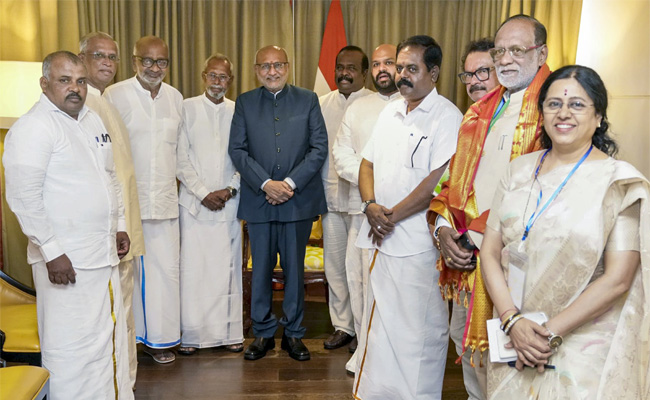
Colombo (PTI): Vice President C P Radhakrishnan met Sri Lankan President Anura Kumara Dissanayake here on Sunday and held productive discussions on further deepening the multifaceted bilateral ties, housing projects and fishermen issues between the two South Asian neighbours.
Radhakrishnan, who arrived here earlier in the day on a two-day visit, also discussed with Dissanayake the ongoing Indian project implementation in Sri Lanka with emphasis on the USD 450 million Cyclone Ditwah aid offered by India.
Accompanied by a 49-member delegation, the vice president was received at the Bandaranaike International Airport in Colombo by Sports Minister Sunil Kumara Gamage and several other dignitaries.
Radhakrishnan’s visit is the first ever by an Indian vice president to Sri Lanka, officials said.
Radhakrishnan laid emphasis on India’s 'Neighbourhood First' policy and developmental bilateral cooperation, officials said.
“Both leaders held productive discussions on further deepening the multifaceted India–Sri Lanka ties, rooted in shared history, strong civilizational and people-to-people linkages,” according to a social media post by Radhakrishnan.
They held wide-ranging discussions on various initiatives, including the Indian housing project and projects being implemented under the USD 450 million package for areas affected by Cyclone Ditwah in Sri Lanka, including reconstruction and rehabilitation efforts in the most affected regions of the Indian-origin Tamil community, it added.
The two sides also discussed addressing fishermen issues in a humanitarian manner, considering the livelihoods of fishing communities on both sides.
The fishermen issue is a contentious one in the ties between India and Sri Lanka.
The Palk Strait, a narrow strip of water separating Tamil Nadu from Sri Lanka, is a rich fishing ground for fishermen from both countries.
Fishermen from both countries are arrested frequently for inadvertently trespassing into each other's waters.
Sri Lankan Prime Minister Harini Amarasuriya hosted a luncheon meeting for the vice president at her official residence, Temple Trees, in Colombo.
“Both leaders shared the civilizational heritage of the two countries and discussed the importance of further strengthening bilateral ties, including people-to-people bonds,” Radhakrishnan said in a post on X.
Sri Lanka’s Leader of Opposition Sajith Premadasa also called on Radhakrishnan in Colombo and both leaders discussed further strengthening India-Sri Lanka bilateral ties.
“Sri Lanka and India are not just neighbours, we are true partners with shared history, shared challenges, and a shared future. It is time we move with greater ambition, intent and trust, to reap the benefits of this partnership for all citizens,” Premadasa said in a social media post.
He also met leaders of Sri Lankan Tamil parties and Indian Origin Tamil parties.
The Tamil parties thanked the Government of India for its efforts for the USD 450 million rehabilitation and relief package post Cyclone Ditwah, as well as other relief measures taken.
A number of memoranda of understanding between the two countries are also scheduled to be exchanged during the visit, a Sri Lankan Foreign Ministry release said.
Later in the day, the vice president also participated in a community reception organised by the Indian diaspora here during which he virtually handed over houses to beneficiaries from Tamil communities, built with assistance from the Indian government as part of the third phase of the Indian Housing Project.
With this, the total number of houses for Tamil communities will reach 50,000, and 10,000 more houses are being built in the fourth phase of the project, an official statement said.
On Monday, the vice president will travel to Nuwara Eliya, visit the Indian Housing Projects, and interact with the local Tamil community.
This visit, which follows recent high-level engagements between the two countries, is expected to further strengthen the millennia-old civilisational and people-to-people ties between India and Sri Lanka, an official statement said.