Lawyer clarifies SC’s dismissal in Dharmasthala case, says SIT probe stands on strong legal ground

New Delhi: A fresh clarification has been issued by Advocate KV Dhanajay on the Supreme Court’s May 5, 2025 order in the Dharmasthala case, where a former sanitation worker had alleged mass burials of victims of murder and sexual assault inside the temple town. The statement, dated September 26, 2025, stressed that the top court’s dismissal of the writ petition had been purely on procedural grounds of delay and laches, and not on the merits of the grave allegations.
According to the clarification note, the Supreme Court order itself clearly recorded that the matter was not examined on merits. The order had said: “The writ petition has to be dismissed on the ground of delay and laches without requiring to consider the same on merits.”
The note explained that no notice had been issued to any of the respondents, including the temple trust and the State Government. As a result, the respondents had no chance to accept or contest the allegations before the court. “Therefore, the Supreme Court had nothing to say about the merits of the case,” it added.
The clarification comes amid discussions suggesting that the State Government would not have ordered a Special Investigation Team (SIT) had it been informed about the dismissal of the writ petition. Rejecting this claim, the statement underlined that the dismissal of the earlier petition “has no relevance or impact” on subsequent lawful steps such as:
the complainant’s formal police complaint at Dharmasthala Police Station on July 3, 2025, registration of FIR No. 39/2025, and the State Government’s order dated July 19, 2025, constituting an SIT to investigate the case.
The note stressed that under Indian criminal law, the police are duty-bound to investigate cognizable offences, and under constitutional law, a State Government has full authority to constitute an SIT. “The SIT was constituted because the allegations, on their face, disclosed cognizable offences of grave public importance. To argue that disclosure of a procedural dismissal would have deterred the State is to misstate both the law and the responsibility of the Government,” it read.
The counsel further explained that their role was to ensure an investigation began, which was achieved once the SIT was formed. He also pointed out that the case stands on the complainant’s sworn statements, and if any part of his testimony is proven false, he would be prosecuted for perjury.
The controversy traces back to a writ petition filed earlier this year by a former sanitation worker of Dharmasthala Temple. Filed under Article 32 of the Constitution, the petition alleged that between 1995 and 2014, he was coerced into secretly disposing of hundreds of bodies, many of them victims of murder, sexual assault, and violence against marginalized communities.
The petition described a chilling account of systematic crimes allegedly carried out in and around the temple town. According to the petitioner, the crimes included brutal assaults on women, targeted killings of indigent persons, and secret burials or cremations to destroy evidence. He claimed he was forced to carry out burials under threats of death, and that local police colluded with the temple administration instead of investigating.
The petition sought the Supreme Court’s intervention to set up a Special Investigation Team under a retired judge, to exhume burial sites, identify victims through forensic analysis, and probe the alleged nexus between temple authorities and law enforcement.
In support of his claims, the petitioner produced photographic evidence of skeletal remains he had exhumed from one such burial site. He also offered to guide investigators to multiple locations where he claimed to have buried victims.
However, on May 5, 2025, the Supreme Court dismissed the writ on procedural grounds, noting that the petition had been filed after an extraordinary delay and without a prior FIR. The court, however, specifically clarified that it was not entering into the merits of the allegations.
With the filing of a fresh complaint in July and the registration of an FIR, the State Government constituted a Special Investigation Team, which is currently probing the allegations. The press statement emphasised that the SIT’s mandate remains legally intact and unaffected by the earlier dismissal, which was confined to procedural aspects.
Let the Truth be known. If you read VB and like VB, please be a VB Supporter and Help us deliver the Truth to one and all.
BJP has history of ‘contradictory alliances’, says BK Hariprasad
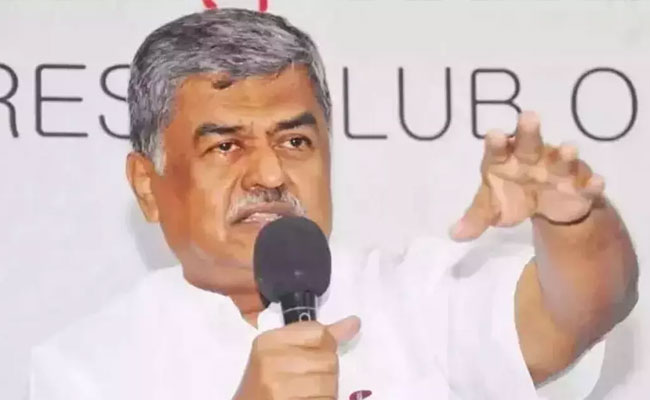
Bengaluru: Congress MLC B. K. Hariprasad has launched a sharp attack on the BJP, accusing the party of hypocrisy over its criticism of alliance politics in Tamil Nadu.
In a post on X on Friday, Hariprasad said BJP leader B. L. Santhosh criticising the Congress party’s alliance politics in Tamil Nadu was “not just laughable, but the height of political contradiction.”
He said the Congress has always joined hands with like-minded parties to protect secular and democratic values in the country.
Hariprasad questioned the BJP over several of its past and present alliances across the country. Referring to Jammu and Kashmir, Punjab, Tripura, Bihar and Maharashtra, he accused the BJP of sharing power with parties it had earlier criticised.
He alleged that the BJP had aligned with separatist and corruption-linked political forces in different states for political gains.
“The BJP, which speaks against alliances today, should first look at its own political history,” he said, adding that the party’s record was full of “contradictions and changing stands.”
Hariprasad also accused the BJP of using central agencies such as the Enforcement Directorate, Income Tax Department and CBI as political tools to target opposition leaders, topple governments and influence electoral mandates.
He further claimed that the people of Tamil Nadu had strongly rejected the BJP and its ideology in the recent election.
“Congress forms alliances to protect the Constitution, secularism and national unity, while the BJP enters into alliances only for power,” he said.