Mahendra Kumar’s post on Pulwama terror strike evokes mixed response
Mangaluru, Feb 14: Around 40 CRPF soldiers have been killed in a worst ever suicide terror strike in last two decades, on their convoy at Pulwama in Jammu and Kashmir on Thursday.
Sources said that a Jaish-e-Mohammad(JeM) terrorist rammed a car loaded with over 350 kg explosives to a bus carrying CRPF jawans and the country witnessed the worst ever terror strike.
Cutting across party lines, all politicians have strongly condemned the terror attack.
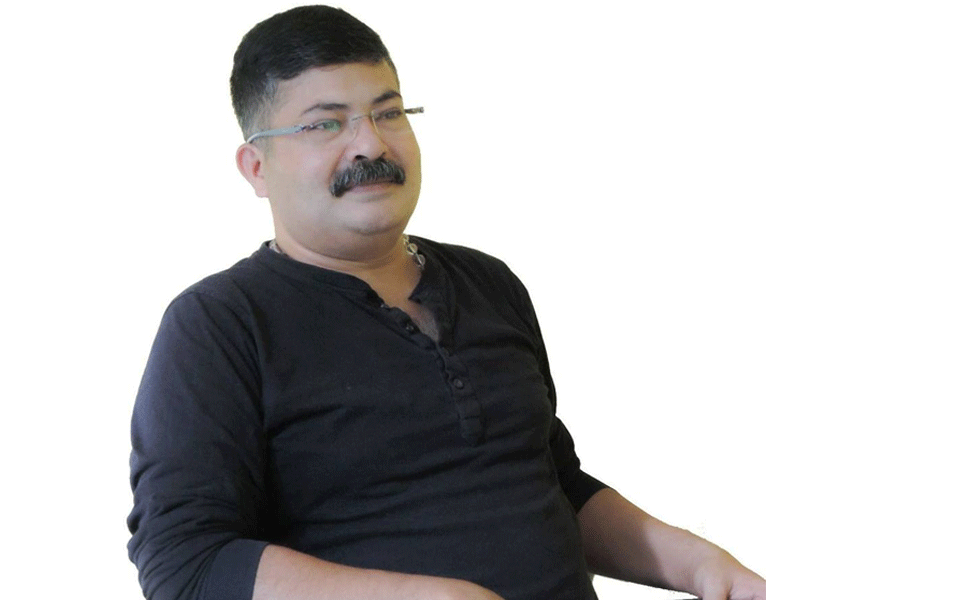
In a Facebook post, Bajrang Dal former leader and social activist Mahendra Kumar expressed his doubt about the terror strike.
“As to why this terror strike occurred at this time…? What’s there behind this act? It's full of confusion.. confusion in the country…If the soldiers were killed as part of an election strategy, whoever it may be, the country will not forgive them. There were rumours that war might take place with Pakistan during election time. But now whether the war takes place or not…the incident has happened and soldiers were died. If it is proved that it was a conspiracy to kill the soldiers as an effort to bind the people of the country emotionally, the history will not forgive it….”, he said.
This post has triggered debate. He said that the terror strike could have been planned as part of an election strategy and the netizens expressed their favour and against comments on the post.
Let the Truth be known. If you read VB and like VB, please be a VB Supporter and Help us deliver the Truth to one and all.
BJP's downfall has begun, its govt at Centre in minority: Mamata
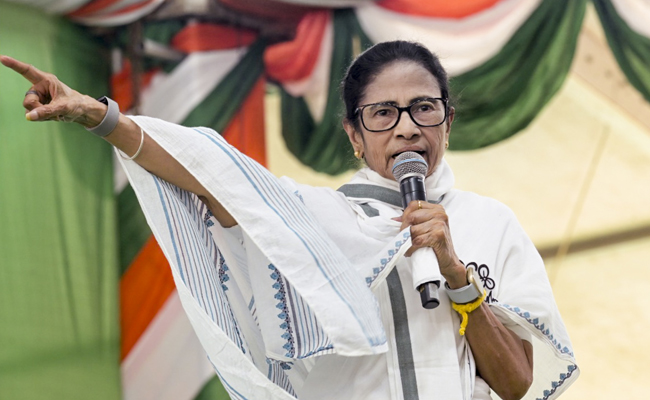
Howrah/Baruipur (WB) (PTI): West Bengal Chief Minister Mamata Banerjee on Saturday hit out at the BJP and Prime Minister Narendra Modi, claiming that the saffron party's "downfall" began after the Centre failed to secure passage of a Constitution amendment bill to implement women's reservation in legislatures from 2029.
Addressing back-to-back rallies at Uluberia in Howrah and Baruipur in South 24 Parganas, the TMC supremo said Friday's events in Parliament had shown that the BJP was no longer a party with a majority of its own and was surviving in office only with the support of two allies.
"Yesterday proved they are no longer a majority government. It is a minority government. They are somehow running it with the support of two parties," she said, in an apparent reference to the BJP's dependence on allies in the NDA.
In a major setback to the Centre, a Constitution amendment bill to implement 33 per cent reservation for women in legislatures in 2029 and increase the number of Lok Sabha seats to 816 was defeated on Friday, with the ruling dispensation asserting that the struggle to give the rights to women will continue.
While 298 members voted in support of the bill in the Lok Sabha, 230 MPs voted against it. Out of 528 members who voted, the bill required 352 votes for a two-thirds majority.
Banerjee questioned why the women's reservation was tied to the delimitation exercise.
"Why link it with delimitation? Is this an attempt to hide fish with greens?" she asked, invoking the Bengali phrase 'shak diye mach dhaka' to claim that the "Centre was trying to conceal its real intentions".
Ahead of the upcoming West Bengal assembly elections, Banerjee sought to turn the BJP's parliamentary setback into a larger political narrative, portraying it as the "beginning of the BJP's decline nationally".
"Modi sahib's downfall began in Delhi yesterday. In the Lok Sabha, you have been defeated; now you will have to be defeated on the ground. Bengal will show the way," she told cheering supporters at Uluberia.
In typical Mamata style, she mixed political attacks with personal anecdotes and old grievances.
Recalling her long association with the demand for women's reservation, Banerjee said she had been fighting for the cause since 1998, long before the BJP made it an issue.
"This is not a women's bill. I have fought for women's reservation since 1998. They are using the media to spread lies," she said.
The TMC supremo accused the Centre of linking the women's quota with delimitation in order to conceal what she described as a larger political design.
Banerjee alleged that the proposed delimitation exercise was aimed at redrawing political boundaries and weakening states like West Bengal.
"It was a plan to divide the country, divide Bengal and divide every state. The game was to increase the number of Lok Sabha seats. We sent our 21 MPs to Parliament because the issue was important. We will not allow Bengal to be divided," she said.
The chief minister said the BJP did not need to lecture her party on women's empowerment, asserting that the TMC had already ensured greater representation for women than most parties in the country.
She said women constituted around 37 per cent of the party's elected Lok Sabha MPs and 46 per cent of its Rajya Sabha members.
"We have given 50 per cent reservation to women in panchayats and municipalities. Show me another party that has done this," she said.
The reference was meant to reinforce one of the Trinamool Congress' strongest political claims -- that it has built a durable support base among women voters through welfare schemes and representation.
As she moved from Uluberia to Baruipur, Banerjee sharpened her attack further and sought to bring Bihar Chief Minister Nitish Kumar into the campaign.
"Did you see what happened to Nitish Kumar? They used him during the elections and then pushed him aside," she said.
Kumar resigned as Bihar chief minister on Tuesday, making way for the first-ever BJP-led government in the state.
Banerjee also cautioned people against filling up forms under a proposed scheme promising cash assistance by the BJP.
"Now, they (BJP leaders) are saying they will give Rs 3,000. Do not fill up those forms by mistake. They are taking your name and address. Then they will take away all the money from your account. They are all frauds," she alleged.
Banerjee also accused the BJP of planning to "misuse" the central agencies and security forces during the assembly elections.
"IAS and IPS officers have their dignity. We will foil every plan to capture Bengal using the central forces. Yesterday, Modi's downfall began in Delhi. The election defeat in Bengal will be the second fall," she said.
Her remarks drew loud applause from party workers, as the TMC has been projecting the 2026 West Bengal election not merely as a state contest but as the next big political battle after the 2024 Lok Sabha polls.
Banerjee also used the rallies to revive her familiar attack on the BJP over what she calls its "double standards" on religion and food.
"You are looting the country and destroying it. When you go to Saudi Arabia and hug leaders there, you do not talk about Hindu-Muslim. So much beef is exported. But in Bengal, you want to stop people from eating fish and meat," she said.
VIDEO | West Bengal polls: “BJP's downfall has begun”, says CM Mamata Banerjee (@MamataOfficial) on NDA failing to pass bill to give women quota from 2029.#AssemblyPollsWithPTI #WestBengalPollsWithPTI
— Press Trust of India (@PTI_News) April 18, 2026
(Source: Third Party)
(Full video available on PTI Videos -… pic.twitter.com/dTdOcEKfW5