Mangaluru: Barrier collapse at Netravati River project amid NGT stay sparks outrage
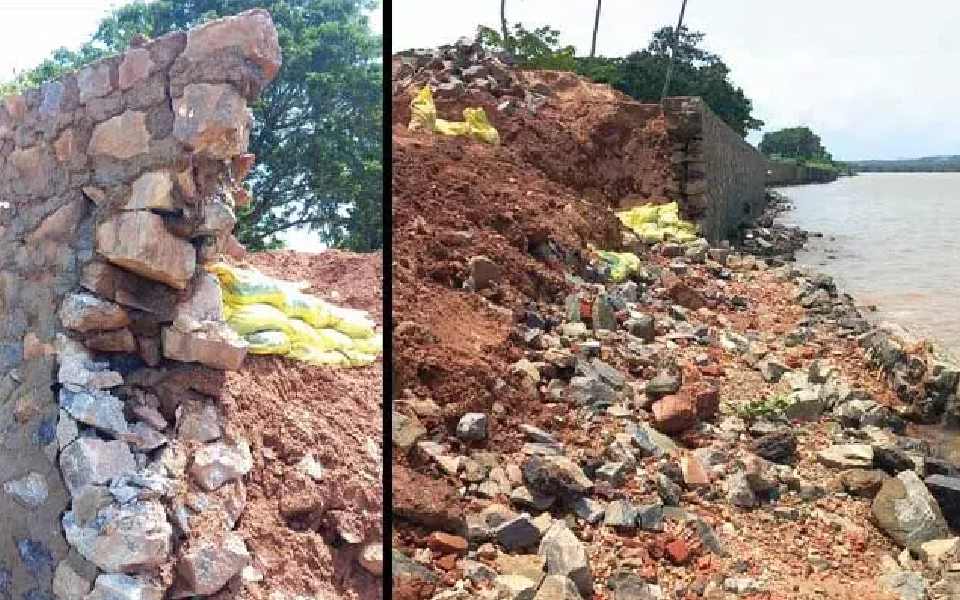
Mangaluru: A barrier constructed for the waterfront project on the banks of the Netravati River has collapsed near Mulihithlu, causing significant public outrage. This incident occurred even as the National Green Tribunal (NGT) in Chennai stayed the project's work following opposition from environmentalists and locals.
Deputy Commissioner Mullai Muhilan has ordered an investigation into the collapse. Assistant Commissioner Raju K. stated that notices will be issued to the supervising officers, and payments to the contractors responsible for the construction will be withheld pending further inquiry.
The Netravati River Front (waterfront) project, stretching 2.1 km from Morgansgate to Bolar, developed by Mangalore Smart City Limited, aims to transform the area into a walking area. As part of the project, a barrier wall was constructed along the riverbank and soil filling was carried out. However, heavy rains last week caused a section of the barrier near Mulihithlu to collapse.
Smart City officials reported that 1,200 meters of the project has been completed, with some areas filled with soil. These sections were intended to be leveled with a roller. Unfortunately, water infiltrated one part of the project, creating a pit and leading to the collapse of the barrier wall. Officials have stated that the contractor responsible for the construction will be questioned regarding the incident.
Arun Prabha, Senior Officer of the Siruva Smart City Project, assured that such problems would not recur.
The project spans 2.1 km, but currently, work is ongoing only up to 1,600 meters. Local opposition has led to court cases concerning the remaining sections, indicating that the project's completion is contingent on resolving these issues.
Environmentalists have expressed strong opposition. The National Green Tribunal (NGT) has been approached by the NECF alleging violations of environmental norms related to the Netravati waterfront project. The NGT has registered a case and issued a notice to the district administration and the relevant committee to investigate these allegations. Both the committee and the district collector have conducted site inspections. Meanwhile, the collapse of the barrier wall has bolstered the objections of locals and environmental activists, strengthening allegations of regulatory violations.
Following the NGT order, a joint committee arrived to inspect environmental norm violations in the project area. The Deputy Commissioner had also visited the project area. However, the NECF, which filed the complaint with the NGT, was not informed or provided with the opportunity to present documents for verification. Smart City officials, along with some project supporters, were called for inspection instead. This has led to dissatisfaction among activists of the National Environment Care Federation (NECF), who are unclear about the nature of the project.
The site of the barrier wall collapse will be visited and inspected, and the engineers and officials responsible will be called and cautioned to carry out their work diligently. A notice regarding the collapse will also be issued to the concerned parties. The investigation is currently underway by the NGT, and work will resume only after obtaining permission from the NGT.
Raju K., Assistant Commissioner, Mangaluru
A bridge in Bihar collapsed before its inauguration. This project, undertaken by people’s representatives in a district known for its intelligent population, risks losing hundreds of crores of rupees. What is the story behind this spending plan if the barrier collapses after a few days of rain? The project is being carried out flouting all environment laws. Even before the inauguration, the barrier has collapsed. Despite the apparent looting of the environment and people's tax money, the concerned authorities remain silent. Fake activists are working to cause trouble against those legitimately opposing it.
Shasidhara Shetty, Convenor, NECF
The Netravati WaterFront Project was initially estimated at Rs. 70 crore but has since been revised and sanctioned for Rs. 32 crores. The project covers a distance of 2.1 km and is designed for non-motor vehicle use, with facilities for cycling and other amenities for public enjoyment. Arun Prabha, a senior officer of Smart City Limited informed that currently, 5% of the work, amounting to Rs. 5 crore, has been completed, and the contractor has been paid Rs. 2,42,18,650.
Let the Truth be known. If you read VB and like VB, please be a VB Supporter and Help us deliver the Truth to one and all.
Delhi High Court advocate jumps to death from high-rise CP hotel

New Delhi (PTI): A 26-year-old Delhi High Court advocate died after allegedly jumping from the 15th floor of a hotel in New Delhi's Connaught Place area, police said on Monday.
The police said they were informed about the incident at The Royal Plaza hotel around 9.15 pm on Sunday. The deceased was identified as Rajesh Singh, a practising advocate at the Delhi High Court who had checked into the hotel the previous evening.
"A police team rushed to the hotel and found that the victim, identified as Rajesh Singh, a resident of Mahavir Enclave, had allegedly jumped from the 15th floor of the building," a police statement said.
"The family members of the deceased have been informed about the incident. As per their statement, no foul play is suspected in the matter," it said.
A police officer privy to the investigation said that a purported suicide note was also found, in which the advocate did not blame anyone. The police said he was staying alone in the room.
Teams from the crime department and the forensic science laboratory (FSL) were called to inspect the scene. Relevant exhibits were lifted and seized, and CCTV footage from the hotel premises was examined, the police said.
A police source said that it is suspected that the victim was depressed over some issues. Furthe