Mangaluru CCB Police arrest four men smuggling narcotics, seize 119 kg ganja, vehicles used by men
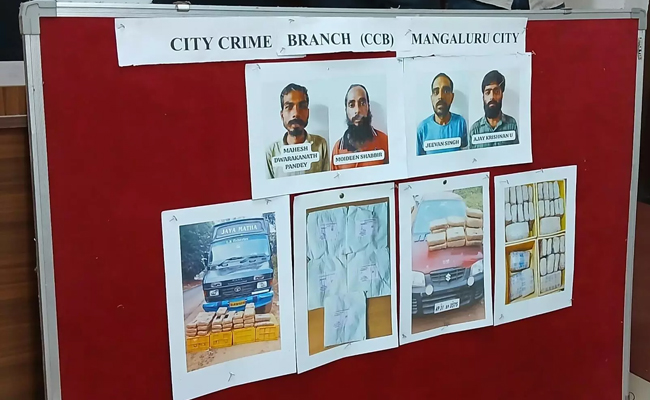
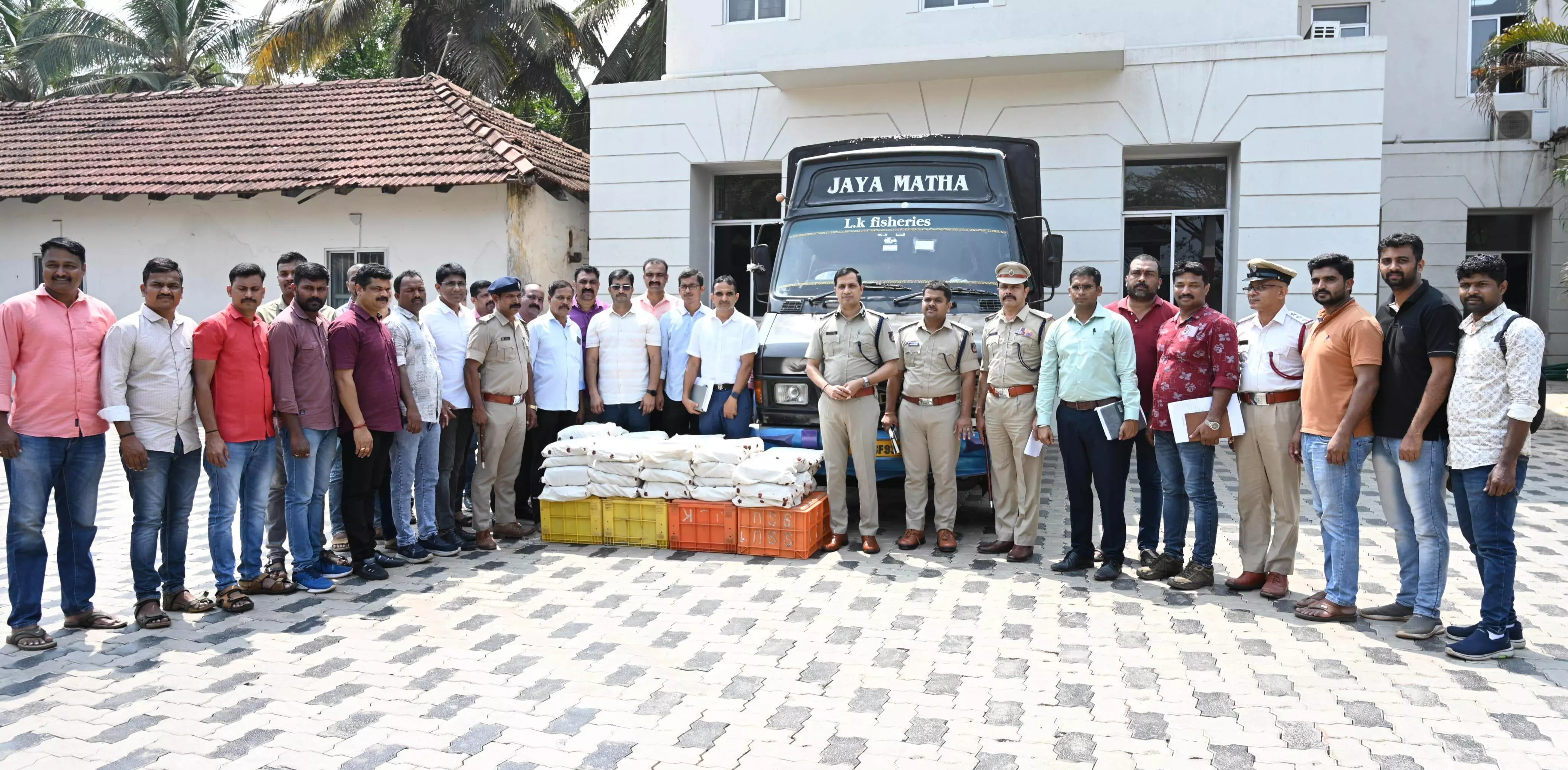
Mangaluru: The Mangaluru Central Crime Branch (CCB) Police recently arrested four men who were smuggling narcotics (ganja) from Andhra Pradesh to Kerala and seized 119 kg narcotics from them, City Police Commissioner Anupam Agrawal has said.
The Commissioner told reporters in the city that the arrested men, Ajay Krishnan U, Jeevan Singh, Moideen Shabbeer, and Mahesh Dwarakanath Pande, had been transporting the narcotics to Kerala through Mangaluru. The CCB Police, who received information that a large quantity of ganja was being smuggling within the jurisdiction limits of Konaje Police Station, conducted an investigation in the area and seized the narcotics as well as a car and a mini truck that were being used by the smugglers.
The CCB Police personnel, on inspection of the car, found up to 34 kg of narcotics inside. The mini truck had an additional 85 kg of narcotics wrapped in packets as well as empty fish trays. The police also confiscated five mobile phones from the arrested men, the senior officer said.
Speaking of the arrested men, Agrawal said that Moideen Shabbeer was a criminal from Kerala who had 12 cases against him for murder, violation of Arms Act, smuggling of narcotics and illegal trade of cattle. Six robbery cases had been filed against his acquaintance Ajay Krishnan. Mahesh Pande and Jeevan Singh, who had been arrested in 2021 in a case, had been planning to smuggle narcotics from Andhra Pradesh to Kerala, he added.
Further, the Commissioner said that Visakhapatnam had become a prime spot for narcotics smugglers who got their supplies from the Maoist-infested areas in Andhra Pradesh. The smugglers collected the narcotics in Visakhapatnam and transported them to various places in Kerala and Maharashtra, among other states, he explained.

Let the Truth be known. If you read VB and like VB, please be a VB Supporter and Help us deliver the Truth to one and all.
How Indian AI Is Booming with GEOX AI Leading the Next Wave of Geolocation Intelligence
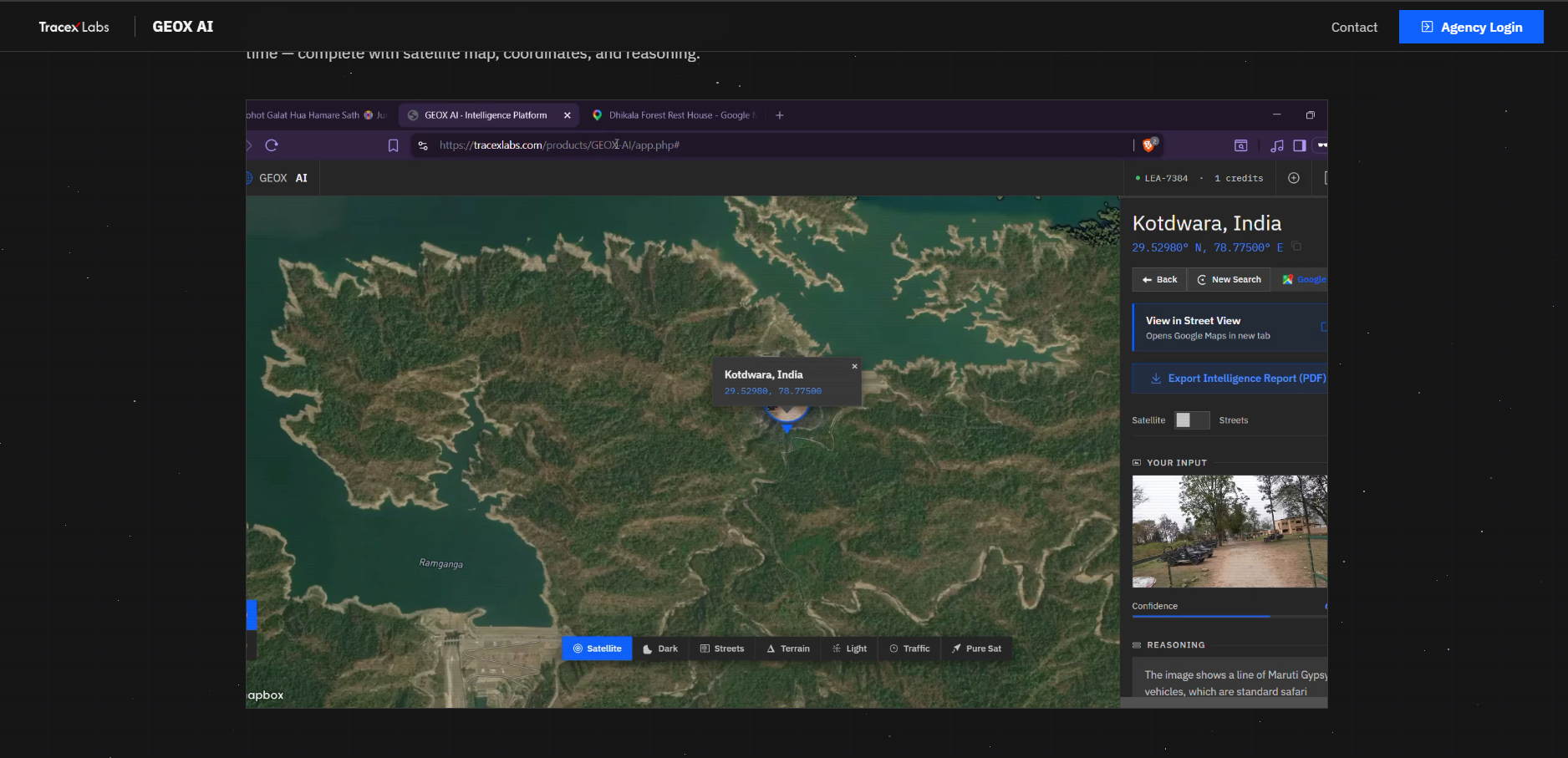
TraceX Labs has announced the launch of GEOX AI, an advanced artificial intelligence platform capable of identifying the real-world location where a photograph or video was taken using only the visual content within the media.
Positioned as an enterprise-grade intelligence solution, GEOX AI leverages advanced computer vision and multi-agent AI to analyze pixel-level details such as architecture, road patterns, vegetation, signage, lighting, and environmental context. By interpreting these visual clues, the system can estimate—and in many cases precisely determine—the origin of an image or video.
AI-Powered Geolocation Intelligence
Marketed under the concept of “Locate Anywhere From Any Image,” GEOX AI is designed for intelligence operations where speed, accuracy, and reliability are critical. The platform currently supports:
- 400+ analyses available
- <10 seconds average response time
- Up to 99% accuracy on landmark-based identification
- Global coverage across diverse terrains and environments
Core Capabilities
GEOX AI integrates multiple intelligence features into a single platform:
- Precise Geolocation:
Identifies exact geographic coordinates using visual landmarks, architecture, vegetation, and cultural indicators. - Satellite Map View:
Results are plotted on live satellite imagery with 2D/3D viewing options and multiple map styles for deeper analysis. - AI Reasoning Analysis:
Provides a detailed explanation of how the system arrived at a conclusion, including confidence scoring. - Multi-Result Analysis:
Returns multiple possible locations ranked by confidence, enabling cross-verification. - Intelligence PDF Export:
Allows one-click generation of professional reports containing maps, coordinates, analysis, and structured findings. - Credit-Based Access:
Agencies are allocated credits, with each analysis consuming one credit. Additional credits can be requested directly.
Speed Meets Intelligence
GEOX AI is designed to balance rapid processing with analytical depth:
- Fast Mode: Delivers results within seconds for clear and high-context images
- Advanced Mode: Performs deeper multi-step analysis for complex or ambiguous visuals
- Built for real-time decision-making in high-pressure environments
How GEOX AI Works
The platform follows a simple and efficient workflow:
- Upload any image or video frame
- AI analyzes visual clues such as structures, terrain, and environment
- The system identifies location with coordinates, confidence score, and reasoning
- Results are displayed on an interactive satellite map
- Export a professional intelligence report in one click
A Breakthrough for Investigations
GEOX AI is expected to have wide-ranging applications across multiple domains:
- Tracking the origin of images from social media and open sources
- Supporting digital forensics and cyber investigations
- Assisting law enforcement and intelligence operations
- Helping journalists and OSINT analysts verify visual content
- Providing support in missing person cases and threat intelligence scenarios
Enterprise Access and Deployment
GEOX AI is available to verified law enforcement agencies, intelligence organizations, and authorized enterprises. Access is provided through a structured system where organizations can request credentials and define their operational use cases.
Interested users can request access via tracexlabs.com or contact contact@tracexlabs.com, with response times typically within 24–48 hours.
Privacy Debate Intensifies
The launch of GEOX AI has also sparked renewed discussion around digital privacy. By demonstrating how location data can be extracted purely from visible elements within images, the platform highlights the potential risks associated with sharing photos online without considering what those visuals may reveal.
Conclusion
With GEOX AI, TraceX Labs is entering the rapidly evolving geolocation intelligence space with a platform that combines speed, precision, and real-world usability. As artificial intelligence continues to advance, tools like GEOX AI are expected to play a critical role in shaping the future of investigations, security, and digital intelligence.