
Mangaluru: Coast Guard conducts coastal clean-up campaign
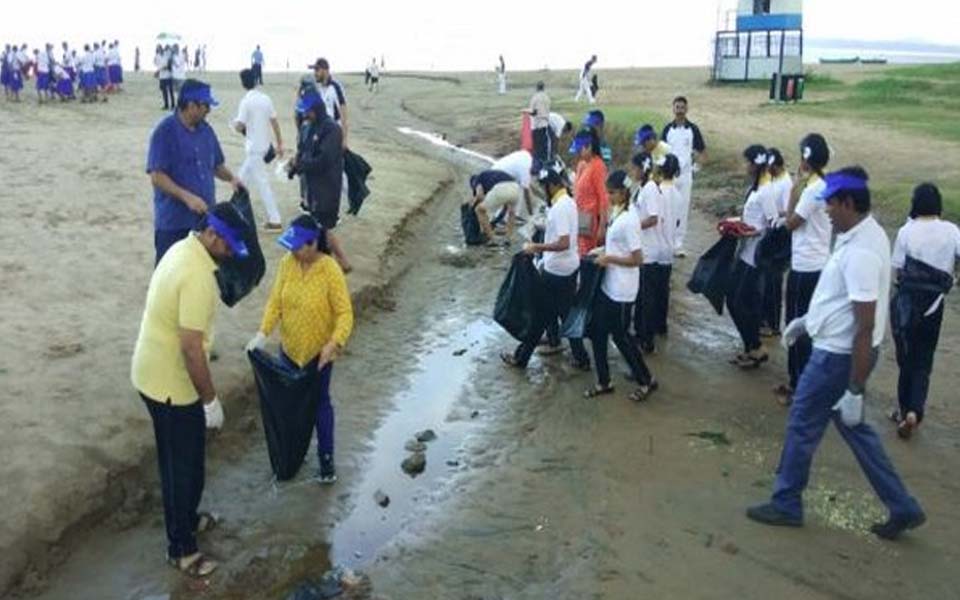
Mangaluru, Sep 22: Coast Guard district (Karnataka) under the aegis of the South Asian Cooperative Environment Programme (SACEP) conducted a coastal clean-up programme on the beaches in the coastal region in Karnataka .
The programme, as part of International Coastal Clean-up (ICC 2019), was held on Saturday at the beaches in Panambur, Tannirbhavi, Surathkal, Sasihithlu, Malpe, Rabindranath Tagore beach, Baithkol and Kodibag at Karwar, all along the coast.
ICC was started by the Ocean Conservancy in 1986 to engage volunteers in collecting marine debris.
The Coast Guards efforts of coastal clean-up drive was supported, among others, by Indigo Airlines Mangaluru, NMPT, CISF, MRPL, KIOCL, students and volunteers of the Coast Guard wives welfare association, a release here said.
All the prominent educational institutions in the region also took part in the drive.
Coast Guard Karnataka commander DIG S S Dasila, who was present at Panambur beach, said people need to serve as a voice for the ocean and work towards a trash-free ocean.
"Let's all be part of smart ocean planning to avoid risk, conflict and crises in the preservations of our vulnerable oceans," he said.
Let the Truth be known. If you read VB and like VB, please be a VB Supporter and Help us deliver the Truth to one and all.
Boat carrying 250 people, including Rohingya and Bangladeshis, sinks in Andaman Sea
_vb_00.jpeg)
Dhaka (AP): At least 250 people, including Rohingya refugees and Bangladeshi nationals, were missing after a boat capsized in the Andaman Sea recently on the way to Malaysia, according to the United Nations' refugee and migration agencies.
When the boat sank and the status of any search Wednesday were unclear.
The UN High Commissioner for Refugees and the International Organisation for Migration in a joint statement said Tuesday that the trawler departed from Teknaf in the southern Bangladeshi district of Cox's Bazar carrying a large number of passengers to Malaysia.
Overcrowding, strong winds and rough seas caused the vessel to lose control and sink, the agencies said.
UNHCR and IOM said the disappearance reflected the protracted displacement of Rohingya people and the absence of durable solutions.
They said ongoing violence in Myanmar's Rakhine state has made the Rohingyas' safe return to Myanmar uncertain, and limited humanitarian assistance, restricted access to education and employment in refugee camps, continue to push vulnerable Rohingya refugees to choose risky sea journeys, often based on false promises of higher wages and better opportunities abroad.
UNHCR and IOM urged the international community to strengthen funding and solidarity to ensure lifesaving assistance for Rohingya refugees in Bangladesh, which has sheltered more than 1 million Rohingya from Myanmar.
_vb_80.jpeg)
_vb_77.jpeg)
_vb_92.jpeg)