Mangaluru: The Shepherds’ International Academy organises 'Graduation day' for Montessori students
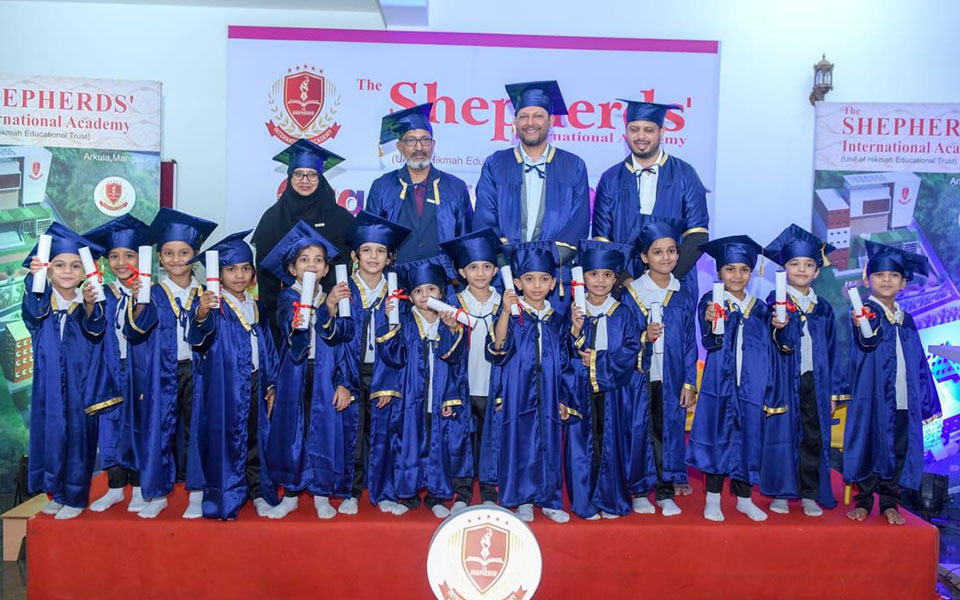
Mangaluru: “Graduation is an enthusing time combined with gusto and gaiety. It is both the completion and commencement. It is warm memories of the past and big dreams for the future” a press release from the Shepherds’ International Academy stated as it organised Graduation Day for the tiny tots of Montessori, here on Friday March 29 at the premises of The Shepherds’ International Academy in Vaslane.
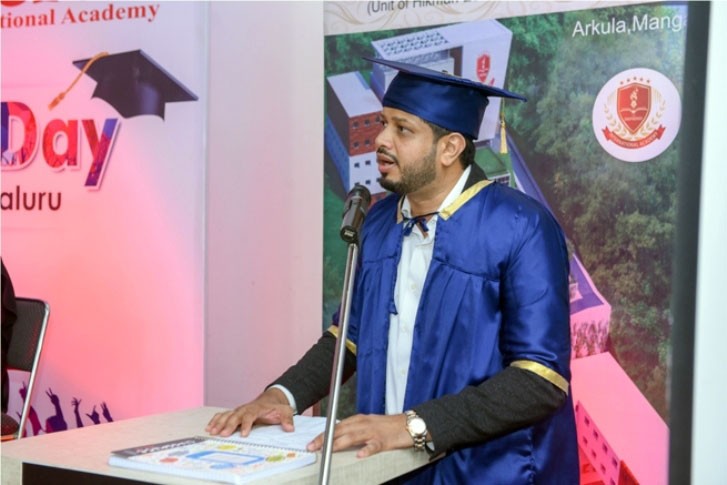
Dr. Syed Habeeb, the International Leadership Coach, was the chief guest for the event which was also marked by the presence of School Chairman Mohammed Nisar and CAO Hasan Yusuf along with Principal Asma Syed.
The tiny tots of Shepherds’ Montessori, looking beautiful in their graduation robes and caps, marched on the red carpet amidst cheering and appreciation from their parents, grandparents, family and friends which was evident by their ‘sparkled with smile faces’.
The Chief Guest of the event and the School Chairman addressed the gathering and motivated both parents and the students and enlightened them.
The little kids also took to the stage confidently to express their feelings and adding few lines to mark their ‘Graduation’ sending the gathering into their awe. They were later awarded with Graduation Certificates.
Students of Montessori-3 sung graduation songs while kids of Montessori-2 bid farewell to the outgoing batch by singing an emotional song in their honor.
Principal Asma Syed, Teachers Preeti Shenoy and Sajida Fathima encouraged the graduates and parents with their heart-touching addresses. Ms. Lubaina convened the program while a PPT presentation was also presented at the event which exhibited the day-to-day learning routines of Montessori-3 students.




Let the Truth be known. If you read VB and like VB, please be a VB Supporter and Help us deliver the Truth to one and all.
Govt comes out with set of FAQs on women's reservation bill
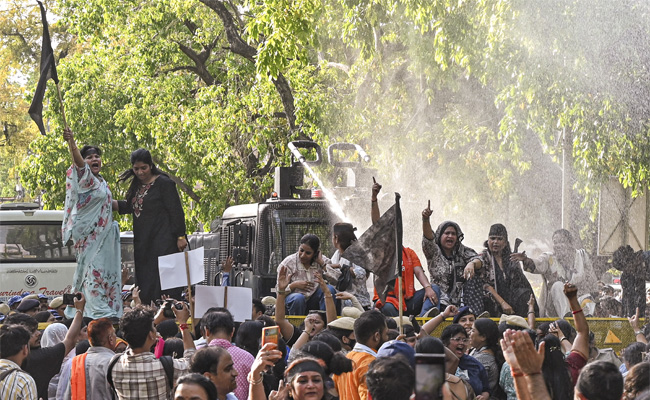
New Delhi (PTI): The government on Sunday came out with a set of Frequently Asked Questions (FAQs) related to the reservation for women in legislatures following the defeat of a Constitution Amendment Bill in the Lok Sabha that seeks to provide 33 per cent quota for women in the Lower House and state assemblies.
The FAQs came amid the Opposition's claim that in the name of women quota, the government was trying to carry out delimitation on its own will based on 2011 census.
Here are the FAQs:-
1. Which Bills were introduced by the central government in the Lok Sabha on April 16, 2026?
A:- On April 16, the central government introduced three key Bills in the Lok Sabha: The Constitution (One Hundred and Thirty-First Amendment) Bill, 2026, The Delimitation Bill, 2026 and The Union Territories Laws (Amendment) Bill, 2026.
2. Why were these three Bills brought at this point in time?
A:- The 'Nari Shakti Vandan Adhiniyam', commonly known as the Women Reservation Act, provides that reservation for women will be implemented based on delimitation after the Census conducted post-2026.
If the government had waited for the Census and subsequent delimitation, women would not have been able to benefit from 33 per cent reservation even in the 2029 general elections as the Census and subsequent delimitation period takes time.
Therefore, to ensure timely benefits to half the population, it was considered necessary to delink implementation of the Act from this condition.
3. What would have been the benefits if these Bills had been passed?
A:- If passed and approved, these Bills would have enabled women to receive 33 per cent reservation in the Lok Sabha as early as the 2029 general elections.
4. Why was delimitation linked with the Nari Shakti Vandan Adhiniyam, and why was there a proposal to increase seats?
A:- Delimitation means finalising the boundary of a constituency. It is essential for implementing women's reservation. The limit on seats in the Lok Sabha was set at 550 in 1976. In 1971, the population of India was 54 crore. Today it is 140 crore. Therefore, it is important to increase seats to 850 in the Lok Sabha. This would enable fair representation of people in Parliament.
5. Was there any attempt to modify the Delimitation Commission Act for political advantage? Would ongoing state elections be affected?
A:- No changes were proposed to the Delimitation Commission Act. The existing legal framework remains intact, and any recommendations of the commission would require parliamentary approval and Presidential assent.
Ongoing elections, including those in states like Tamil Nadu or West Bengal, would not be affected, as elections up to 2029 will be conducted under the current system.
6. What was the rationale behind increasing Lok Sabha seats to 850?
A:- The proposal was based on a proportional expansion approach. A uniform 50 per cent increase in seats would maintain the proportion for all states and UTs. Applying this principle to the current 543 seats would lead to approximately 815 seats. Therefore, the upper limit on seats was increased from current cap of 550 seats in Lok Sabha to 850 seats.
7. Would southern or smaller states have been adversely affected by the new delimitation proposal?
A:- No. All states would see uniform 50 per cent increase in seats. Southern states would not face any reduction in representation; rather, their overall share would remain stable. For example, Tamil Nadu's seats would increase proportionally, ensuring no disadvantage. The southern states currently have 23.76 per cent seats in Lok Sabha. This would have become 23.87 per cent after the passage of the Bills.
Lok Sabha seats in Karnataka would have increased to 42 from present 28; in Andhra Pradesh, the seats would have been 38 from the present 25; in Telangana, the total seats would have been 26 from the present 17; in Tamil Nadu, it would have been 59 seats from the present 39 and in Keralam, it would have been 30 from the present 20 seats.
Total seats in the five southern states would have been increased to 195 from the present 129.
This is 543 seats to 816 seats - 50 per cent increase model.
8. Would states that have controlled population growth face any disadvantage?
A:- No, as the increase in seats was proposed uniformly across states, their proportional representation would remain unchanged or slightly improve.
9. Would the representation of Scheduled Castes and Scheduled Tribes be affected?
A:- No, the process of delimitation ensures proportional reservation for Scheduled Castes and Scheduled Tribes. With an expanded House, the number of reserved seats would increase significantly, thereby strengthening their representation.
10. Was this Constitutional Amendment Bill introduced to delay caste census?
A:- No, the government has already started a time-bound programme for caste census. The process includes detailed enumeration, and caste-related data will be recorded during the population count phase.
11. Why was there no separate quota for Muslim women within the reservation framework?
A:- The Constitution of India does not provide for reservation based on religion. Reservation policies are based on social and economic backwardness, as laid out in the Constitution.
12. Why was women's reservation not implemented in the 2024 general elections itself?
A:- Implementing reservation requires delimitation of seats. Delimitation is an extensive consultative process. It takes about two years to complete delimitation. Therefore, these Bills (including Delimitation Bill) were brought in Parliament for implementing women's reservation.
13. Why was the Women's Reservation Bill introduced in 2023 if it was not to be implemented immediately?
A:- The Bill was introduced and passed in 2023 to establish the legal and constitutional framework for women's reservation. Its unanimous passage reflected broad political support at the time, enabling the enactment of the Nari Shakti Vandan Adhiniyam.
14. Why was a separate Union Territories Bill required?
A:- Legislative Assemblies in Union Territories such as Jammu and Kashmir, Delhi and Puducherry are governed by separate legal provisions. Therefore, specific amendments were required to implement women's reservation in these regions, necessitating a separate Bill.