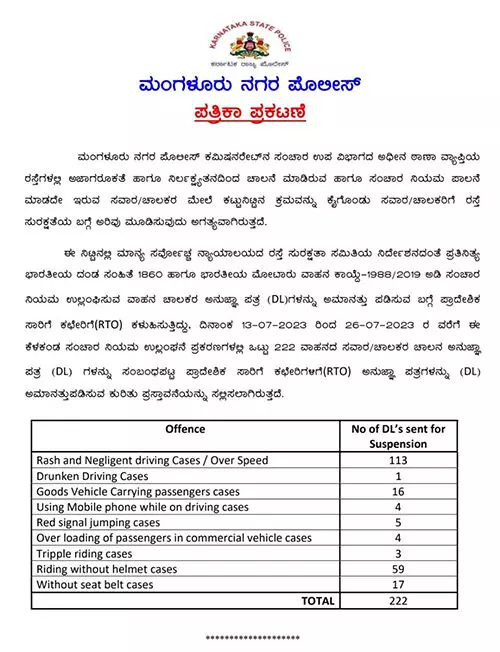
Mangaluru: The Mangaluru Traffic sub-division on Thursday reccomended the state transport department to cancel the driving licenses (DL) of 222 drivers who were found violating the traffic rules and drove recklessly and negligently.

The Mangaluru police which conducted an operation from July 13 to July 26, during which, the police have recommended the cancellation of the driving licenses (DL) of 222 drivers who were booked for driving carelessly, negligently, and violating traffic rules.

A total of 113 cases of speeding and negligent driving have been officially recorded. Additionally, one case of drunken driving, 16 cases of carrying passengers in goods vehicles, four cases of using a mobile phone while driving, and five cases of red signal jumping have been registered. Furthermore, there are four cases of carrying passengers in commercial vehicles and three cases of triple riding.

The transport department has received a recommendation to revoke the driving licenses (DL) of 222 individuals, including 59 cases of driving without wearing a helmet and 17 cases of driving without wearing a seat belt.
Let the Truth be known. If you read VB and like VB, please be a VB Supporter and Help us deliver the Truth to one and all.


Bengaluru (PTI): Karnataka Minister for Large and Medium Industries M B Patil on Thursday directed officials to expedite the integration of the remaining 28 services in various departments under the SWS.

The direction was issued at a review meeting on EoDB and Single Window Committees held at Vidhana Soudha, attended by senior officials from various departments.

In a statement, Patil said, "We face intense competition from neighbouring states. We have studied their policies and regulations and are determined to establish a system that is even more efficient and industry-friendly," he said.

Under the Single Window System, 115 services across 20 departments have already been integrated, the minister said, adding the remaining 28 services have been prioritised for time-bound implementation.

Patil said Revenue, Forest, Home, Environment, Primary Education, Fire Services and Energy departments are among the services.

According to the minister, the goal is to ensure that investors do not lose valuable time and are encouraged to invest in Karnataka.

He sought cooperation of all the government departments to make it happen.

Referring to emerging challenges, he said Karnataka has long been a frontrunner in the IT sector but the rapid rise of Artificial Intelligence (AI) has introduced new uncertainties.

He stressed that all departments, including KIADB, must ensure swift approvals for industrial projects.

Patil underlined that entrepreneurs should not be subjected to "unnecessary delays," he said, adding that clearances for electricity connections, Fire Department NOCs and Pollution Control Board approvals must be issued promptly.

Detailing the reforms, the minister said the time limit for Fire Department NOCs has been reduced from 60 days to 21 days, while electricity connection approvals have been cut from 25 days to 10 days. Permission for lift and escalator operations has been brought down from 40 days to 20 days, and new water connection approvals from 42 days to 30 days, he said.

The Labour Department will now issue industrial licences and boiler registrations within 14 days instead of 30 days, he said, noting that necessary notifications have already been issued.

"These amendments will soon be placed before the Cabinet and formalised through legislation on a fast-track basis," Patil said.

He further stated that timelines at the State Pollution Control Board have been significantly reduced.

Change-of-land-use permission within Bengaluru city limits, which earlier took up to 120 days, will now be granted within 45 days.

With 32 data centres currently operating in the state, Patil underscored the importance of uninterrupted power supply and called for the development of dedicated data centre clusters with exclusive power lines.

A ministerial-level meeting will soon be convened to identify suitable locations and ensure essential infrastructure, including power connectivity, he said.