Over 18 thousand cases of traffic violation booked in Mangaluru city in April
Data reveals over Rs. 23 lakh fines collected in 30 days

Mangaluru: Ever since Sandeep Patil took charge as the Commissioner of Mangaluru Police in late February this year, several changes were made in the traffic arrangements and regulations with the department looking for ways to improve the traffic management in the city.
In last two months several measures were undertaken, towing vehicles have been introduced for the first time in the city, vehicles checking at different points of the city has been beefed up and special instructions have been issued against several violations of traffic laws to curb the traffic menace.
Speaking to Vartha Bharati one month after taking the charge Patil had made it clear that it was “a very top-priority” for him to resolve the traffic grievances and had indicated that several measures would be taken in this regard in months to come.
According to the data provided by the Office of Deputy Commissioner (Traffic and Crime) to Vartha Bharati, over 18,000 cases of traffic violations have been booked and fine of over 23 lakh rupees have been collected in the month of April.
The data revealed that a total of 18,382 cases of traffic violation were booked in the month of April and fine collection in the month amounted to Rs. 23,20,150/-.
Nearly two thousand cases each were reported of violation of parking rules and driving two wheelers without helmet and fines worth nearly two lakhs were collected under each of the two categories. About one lakh thirty five thousand rupees were collected from the violators of speed limits of which 447 cases were reported.
The department has also initiated a crackdown on the drunken driving in the city over the last few months and in April 604 cases of drunken driving were booked.
Among other major violations reported in the month 2047 cases were reported when the pillion rider on the two wheeler were found not wearing helmet and 1174 cases were booked against violation of seat belt regulations. Over seven thousand cases were booked under “other traffic violation” categories reportedly resulting in 10,96,250 Rupees’ fines collection.
532 cases were also booked for vehicles stopping on Zebra crossing during red signal, causing inconvenience to the pedestrians. A warning was also issued by the department earlier urging motorist to keep the Zebra crossing clear for pedestrians on signals.
The crackdown on traffic violation to smoothen the traffic movement by the department has seen mixed reaction among the general public, a section of which is irked with the towing away of vehicles even if the vehicles are parked at a point for a few seconds. The section of the people believes the department is being harsh with towing away of vehicles, releasing which takes due process and time. On the other hand the section has appreciated the reforms and measures being introduced to ease traffic movement in the city and has lauded the efforts of the department.
The department however, looks resolved to sticking to their plans of curbing the traffic menace and grievances and to ease it for drivers and riders abiding by the traffic rules and regulation.
Let the Truth be known. If you read VB and like VB, please be a VB Supporter and Help us deliver the Truth to one and all.
BJP, Opposition in war of words after Constitution Amendment Bill defeat
New Delhi (PTI): The BJP and the Opposition on Saturday engaged in a war of words over the issue of the implementation of women's reservation in legislatures, with Union minister Kiren Rijiju saying the parties which stalled the Constitution Amendment Bill will face the wrath of women.
The Opposition accused the government of delaying implementation by linking it with delimitation and using it to serve its political interests.
While the BJP termed the development a “black day” and accused the Congress and other opposition parties of betraying women, the Congress and its allies asserted that the quota law, passed in 2023, should be implemented immediately and accused the government of playing politics over it.
Parliamentary Affairs Minsiter Kiren Rijiju accused the Congress of being anti-women, and said it will have to face their wrath across the country.
“They will have to face the anger of the women of the country. This is a black stain on the Congress and its allies, one that they will never be able to erase. This Bill was about giving historic representation to women—what objection could there have been?” he told reporters in the Parliament House complex.
"The opposition is celebrating after depriving women of their rights; women of the country will teach them a good lesson," he added.
Union minister Shobha Karandlaje targeted Leader of Opposition Rahul Gandhi, alleging that the Opposition’s actions had undermined both women’s empowerment and regional representation.
“They have harmed south India as well, where seats could have increased by over 50 per cent. Women were supposed to get reservation, but they have been denied that opportunity. This has been done under the leadership of Rahul Gandhi,” she alleged.
BJP MP Bansuri Swaraj accused the Congress and the INDIA bloc of deceiving women and backtracking on their earlier stand. “They have betrayed the trust of women, and we will take this story of your deception to every citizen,” she said.
Swapna Verma, general Secretary, BJP (Madhya Pradesh) Mahila Morcha, said, “Congress and its INDI alliance have once again exposed their anti-women mindset. Despite the sincere appeal of Prime Minister Shri Narendra Modi ji for collective, and non-partisan support, those driven by political obstinacy chose to defeat not just a Bill, but the aspirations of an entire nation.”
Opposition leaders accused the government of delaying implementation and using the issue for political gain in Assembly elections in West Bengal and Tamil Nadu.
Congress MP Shashi Tharoor said the opposition is not against women’s reservation, but has objected to its linkage with delimitation. “We are fully in support of women’s reservation and would have happily passed the Bill on Friday itself. Our objection was not to reservation, but to linking it with delimitation,” he said.
Tharoor said delimitation raises “fundamental questions” about the country’s future and cannot be rushed.
“This is a very important issue for India’s unity and democracy. It requires serious, wide-ranging discussion -- not something to be decided in a two-day session.
Alleging political motives, he added, “This was a political game, not about women. Women were being used to serve short-term political interests. If the government brings a new Bill in the Monsoon Session without linking it to delimitation, we will pass it.”
"There must be a serious discussion involving all parties and states, especially in light of future Census data and the framework for a new delimitation exercise.”
Congress MP K C Venugopal said there is no disagreement on women’s reservation and demanded its immediate implementation.
“Their agenda was to link delimitation with women’s reservation, which has failed. They wanted delimitation according to their convenience, like in Assam and Jammu and Kashmir, by redrawing constituencies. That has failed.
“We demand that, without any delay, the 2023 women’s reservation law be implemented,” he said.
CPI(M) leader John Brittas alleged that the government’s strategy had been exposed in Parliament.
“The dubious and diabolical game plan of the government has fallen flat. They were using women as a shield to mislead the nation. If they have even an iota of sincerity, let them implement one-third reservation based on the present strength of legislatures,” he said.
“The opposition will jointly defeat any ulterior motives and designs of this government,” he added.
Samajwadi Party leader Ram Gopal Yadav questioned the legislative process and alleged political motives. “This historic Bill was already passed in 2023. Why was there a need to bring amendments again? Even after that, the earlier law was notified. So what was the need for discussion and voting?” he asked.
“The whole country knows this was done with elections in West Bengal in mind. When you knew you did not have a two-thirds majority, what was the point of bringing it? This shows there was a political angle, not genuine intent,” he said.
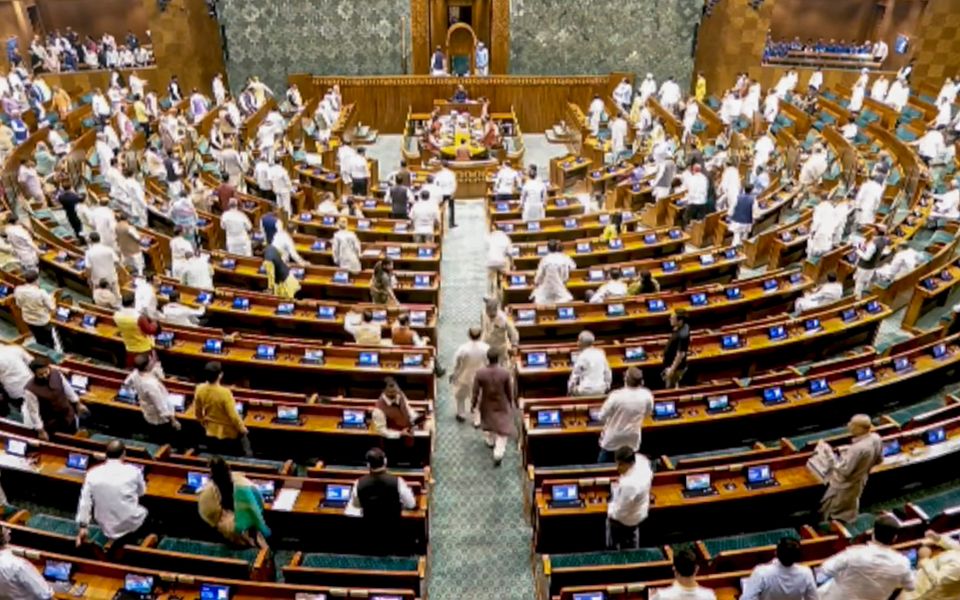
The Constitution Amendment Bill, which sought to operationalise women’s reservation and increase the strength of the Lok Sabha, was defeated in the Lower House on Friday as it failed to secure the required two-thirds majority.
While 298 members voted in favour of the Bill, 230 voted against it. Out of 528 members who voted, the Bill required 352 votes for passage.
According to the Bill, Lok Sabha seats were to be increased to a maximum of 850 from the current 543 to operationalise the women’s reservation law before the 2029 parliamentary polls, following a delimitation exercise based on the 2011 Census. Seats were also to be increased in state and Union Territory assemblies to accommodate 33 per cent reservation for women.