Pejawar seer’s proposed Iftar party cancelled
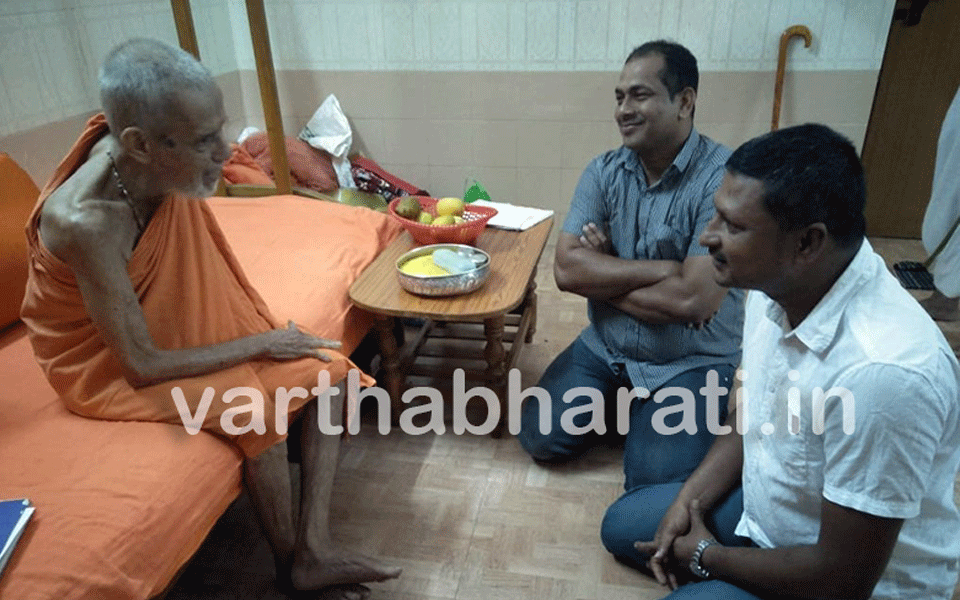
Udupi, June 10: The proposed Iftar party of Vishvesha Theertha Swamiji of Pejawar Mutt scheduled to be held at Ajjarakadu Govinda Kalyana Mandir in the city on June 13 is cancelled.
During the Swamiji’s Paryaya period, the swamiji had conducted the Iftar party at Sri Krishna Mutt and allowed the Muslims to have their prayer last year. Later, the swamiji’s decision stirred a controversy and Sri Rama Sene had conducted a protest against this issue.
This time, the swamiji has decided to conduct the Iftar party at Govinda Kalyana Mandir and this has created a lot of debates. Now, it is said that the swamiji has cancelled the Iftar party following the outrage from the people.
Sources in the mutt said that as the swamiji has lot of engagements and on tour, he has cancelled the Iftar party. When Arief Doddanagudde and Ansar Ahmed of swamiji’s Blood Donating team met the swamiji in Bengaluru, the swamiji informed them that the proposed Iftar party was cancelled, it is said.
Ansar Ahmed told Varthabharati that “the swamiji himself has organized the Iftar party. We have made all preparations for the party. But as some organizations have opposed the swamiji’s decision and put pressure on the swamiji, the iftar party is cancelled”, he said.
Let the Truth be known. If you read VB and like VB, please be a VB Supporter and Help us deliver the Truth to one and all.
Power tariffs under BESCOM to rise from May 1
Bengaluru (PTI): Power bills for consumers under the Bangalore Electricity Supply Company Limited (BESCOM) will go up from May 1, following an order issued by the Karnataka Electricity Regulatory Commission (KERC) on Friday.
The hike comes after KERC allowed the BESCOM to recover a revenue deficit of Rs 2,068 crore incurred in 2024-25, from the consumers.
As a result, for every unit of electricity consumed in 2024-25, the customers will be charged an additional 56 paise, it said.
"BESCOM shall calculate, for each of the active consumers of FY2024-25 the amount to be recovered based on their actual energy consumption during FY2024-25. Such amount shall be recovered during FY 2026-27 in equal monthly instalments, to be called as 'FY25 True up Charges', commencing from the first meter reading date falling on or after 1 May 2026 and concluding with the reading date ending on 30 April 2027," the order said.
"It is further ordered that BESCOM shall maintain a separate head of account, allocated for the purpose, to record the adjustment of the said amount to ensure full recovery of the deficit," it added.
Similarly Chamundeshwari Electricity Supply Corporation Limited (CESC) has also recorded a revenue deficit of Rs 121.71 crore and can collect an additional 15 paisa per unit for consumption in 2024-25, official sources said.