Polali Candle Santhu murder case: Life term for two accused
Mangaluru, July 20: The fourth additional principal district and sessions court on Friday convicted two accused for life imprisonment and slapped a penalty of Rs 1 lakh each on charges of murdering Candle Santu alias Santosh of Polali Badakabailu.
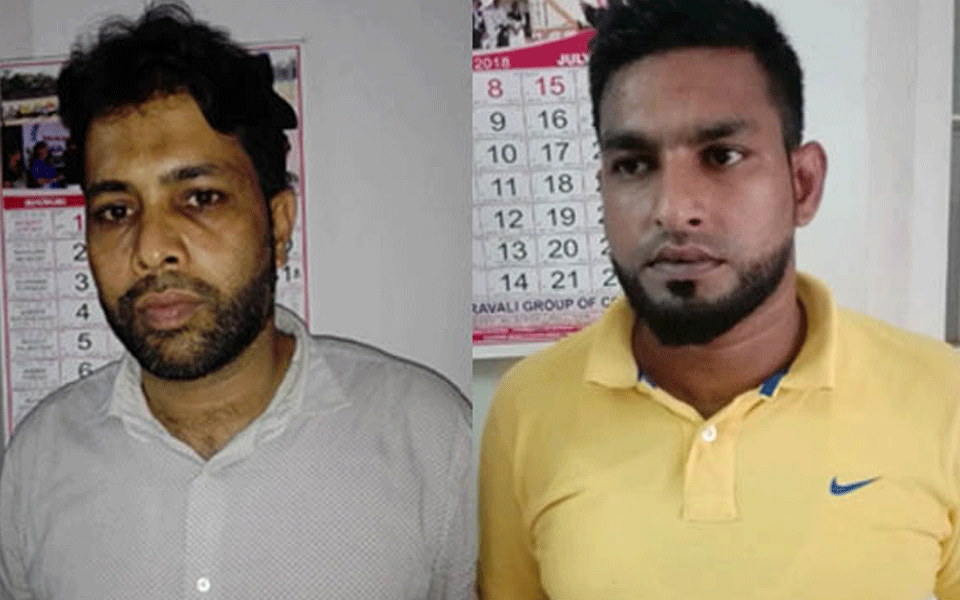
The convicted are identified as Iqbal (39) of Bandaru and Farooq (30) of Kukkundoor Bangle Gudde in Karkala taluk. Out of Rs 2 lakh penalty, Rs 1.8 lakh should be given to the family of Santhosh and Rs 20,000 should be remitted to the government, the court said.
There were total 22 accused in the case and 13 accused were acquitted from the case, while three accused were absconding and four were died. Convicted Iqbal was the prime accused in the case and Farooq was the sixth accused.
Incident
When Santosh was sitting on a gutter at Badakabailu in Bantwala taluk on February 18 2009 at 9.30 am, the miscreants who came in a car and motorbike attacked him with lethal weapons. Sensing the danger, Santosh started running to escape from them. But as he had a leg injury in an incident earlier, he could not run fast. He was chased and attacked him brutally. Though the local people rushed him to the hospital, he died in the hospital.
Murder plan prepared in abroad
Being in abroad, Madoor Isubu had planned for the murder of Santosh and given a contract to the accused to kill him. He was killed in the jail at the city in 2015. During the arrest of the accused, Rs 2 lakh supari money was confiscated from them. Another accused Madoor Ismail died of heart attack,while Kukkundoor Sulaiman alias Khader was murdered at Karkala.
Reason for murder?
Santosh was an accused in the murder of Mallur Hamid of Kairangala village in Bantwala taluk on April 9, 2006 and Rafeeq of Gurupura Kaikamba on December 23, 2000. To take revenge against these murders, Madoor Isubu had planned to kill Santosh.
Taking it for hearing, judge Nerale Veerabhadraiah Bhavani got the statements of 25 witnesses heard the arguments and delivered the judgement. Then Bantwala rural inspector Nanjunde Gowda filed the charge sheet to the court. Public prosecutor Harishchandra Udyavara argued against the accused.
Meanwhile, SP Ravikanthe Gowda had appreciated the efforts of the Bantwala rural inspector Nanjunde Gowda and police personnel and announced a prize.
Let the Truth be known. If you read VB and like VB, please be a VB Supporter and Help us deliver the Truth to one and all.
Belagavi youth’s murder case projected as road accident, cracked in Uttara Kannada; Three arrested

Karwar: Uttara Kannada police have cracked a murder case in which a Belagavi youth was killed and his body burnt inside a car to make it appear like a road accident.
Addressing a press meet in the city, Superintendent of Police Deepan M.N. said three accused from Old Hubballi have been arrested in connection with the case. The crime was a pre-planned act driven by personal enmity, he said.
The case came to light on April 8 morning when a car (KA-04/MJ-8996) was found completely burnt in a roadside ditch near Talekumbri bus stand in Yellapur. Only charred human remains were found inside the vehicle. Initially, it was suspected to be an accident caused by overspeeding, and a case was registered at Yellapur police station based on a complaint filed by the deceased’s father, Jagannath Dhapale.
However, the father later expressed suspicion that his son’s death was not accidental, prompting a detailed investigation.
Taking the matter seriously, two special teams were formed under the leadership of Yellapur Inspector Ramesh Hanapur. On analysing technical evidence and CCTV footage, police found that it was a planned murder.
The accused have been identified as Abdul Raheem Basheer Ahmed Mujawar (32), Maulasab Bavahan Wada (36) and Dadapeer alias Aftab Mehboob Saab Balasangi (22), all chicken traders from Old Hubballi.
Police have seized the car used in the crime along with two scooters. The accused have been remanded to judicial custody.
Investigations revealed that the accused killed Nitesh Dhapale due to personal enmity and later set the car on fire along with the body to project it as an accident.
SP Deepan M.N. appreciated the efforts of Inspector Ramesh Hanapur, PSIs Rajashekhar Vandali and Siddappa Gudi, and the entire team for solving the complex case.