Prioritize research in basic science: BITS Pilani director Dr G Raghuram
‘World needs more scientists than technicians’
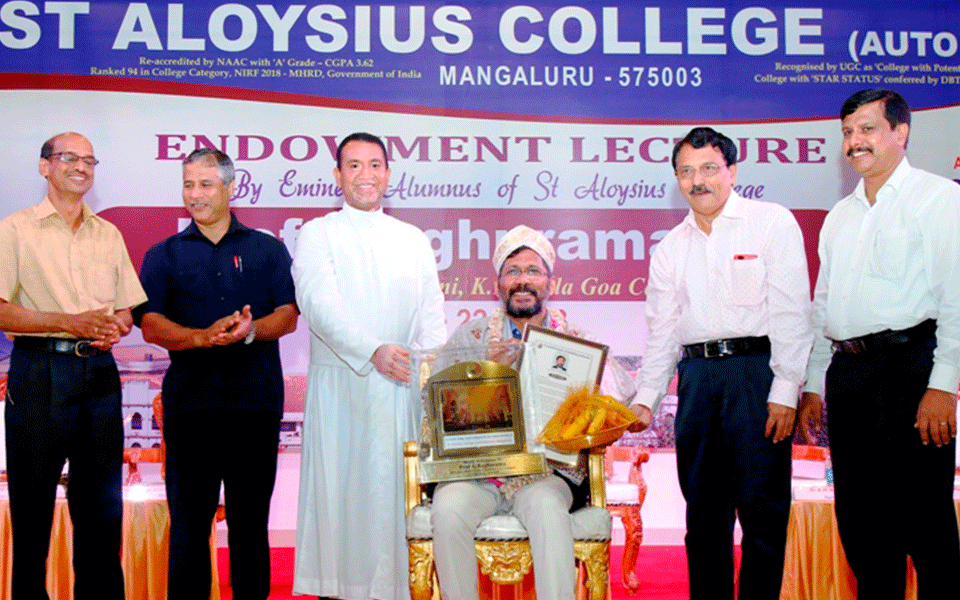
Mangaluru, June 22: Birla Institute of Technology and Sciences (BITS) Pilani KK Birla Campus director Dr G Raghuram said that world is now required creative scientists who can develop technology to utilize the resources effectively, than technicians.
Delivering an endowment lecture on ‘How to prepare for future?’, organized by the St. Aloysius College Science Department here on Friday, he said that “it is a good sign that nowadays, youth are interested in research in basic science”. India should not concentrate only on skills development, but along with skills development, it should also develop the creativity and research attitude among youth. So education institutions should take up this as their priority, he advised.
Much needed skills development is possible only when four important disciplines like science, technology, engineering and mathematics are taken into consideration. The students have plenty of opportunities and they should choose the field they are interested in and achieve, he said.
“If we tapped just 1.5 per cent of the Sun light getting on the earth properly, the entire world would get the power requirement. Though we have more than 75 per cent water on the earth, we have been facing water scarcity and this problem could be solved by converting the salt water into sweet water with the help of available technology. Such inventions are the need of the hour”, he said.
Future industrial revolution would happen because of the new-age technologies. By 2034, the robots would do more than 42 per cent works. Revolutionary tools like ‘Internet of Things’ would bring a sea change in the life of people. According to a recent study, more than 94 per cent IT graduates are not employable. Only solution for this problem is to give importance to research in basic science, he said.
“Based on the new-age demands, our learning system should also be changed. Instead of solving the problem, we need to inculcate among students the curiosity and inspiration. Then a new perspective is possible to find solution for a problem”, he said.
Along with the science, humanity is also important. Learning social science, art and languages are also necessary. Youth should concentrate on interdisciplinary study and world languages. In the process of making students competent to fight in the competitive world, the society has been killing their creativity and imagination, he said.
Presiding over the programme, College principal Rev. Dr Praveen Martis SJ said that “desire, dream and determination would take a person to success. The students should develop questioning attitude. If you dream, you can work on it and achieve it”, he said.
Xavier Block director Prof John D’Silva welcomed. Registrar AM Narahari, Star College Scheme coordinator Dr Ronald Nazareth, programme coordinator Dr Narayan Bhat and others were present. Students who scored more marks in the last PU exam were felicitated on the occasion.
Let the Truth be known. If you read VB and like VB, please be a VB Supporter and Help us deliver the Truth to one and all.
ISRO launches Mission MITRA for safety of human spaceflight mission crew
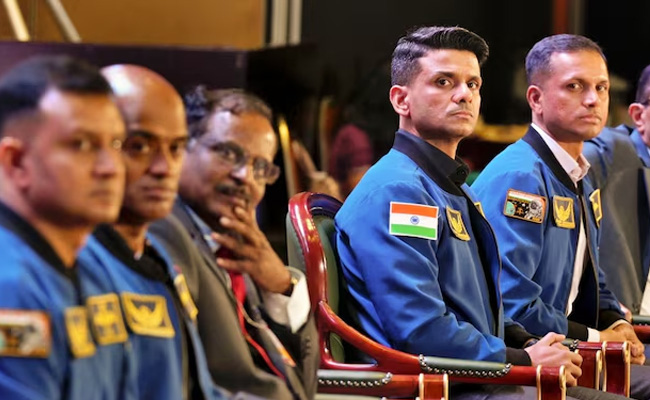
Bengaluru (PTI): ISRO on Friday said it has undertaken mission MITRA in Leh, Union Territory of Ladakh, from April 2 to 9, a first-of-its-kind team behavioural study for the benefit of human spaceflight missions such as Gaganyaan.
The mission, inaugurated by the ISRO chairman V Narayanan, was mainly for the crew safety and performance.
"Mission MITRA is a first-of-its-kind team behavioural study designed by ISRO and IAF-Institute of Aerospace Medicine to examine the physiological, psychological, and operational dynamics of Crew and ground teams functioning in a high-altitude environment," ISRO said in a statement.
This study is targeted to generate vital understanding on the team interoperability between crew (Gaganyatris) and ground control teams and the effectiveness of decision making under environmental & operational stress, the space agency said.
Noting that the crew safety and performance are the most critical elements of all Human Spaceflight Missions, ISRO said the ability of the crew to communicate effectively, adapt to stress, maintain psychological resilience and support one another determines the success and safety of any mission.
Analogue missions conducted under controlled yet realistic conditions are utilised to understand how crews perform under challenging conditions, it added.
The space agency said the high altitude of approximately 3,500 meters at Leh having the environmental conditions of hypoxia, low temperature, and isolation, is a natural analogue for spaceflight operations.